Hollywood great, Katharine Hepburn, dies at 96
About the article
This is a digitised version of an article from The Cayman Compass's print archive. Occasionally, the digitisation process introduces transcription errors, or other problems.
See the article in its original context from July 2003.
Brought to you by

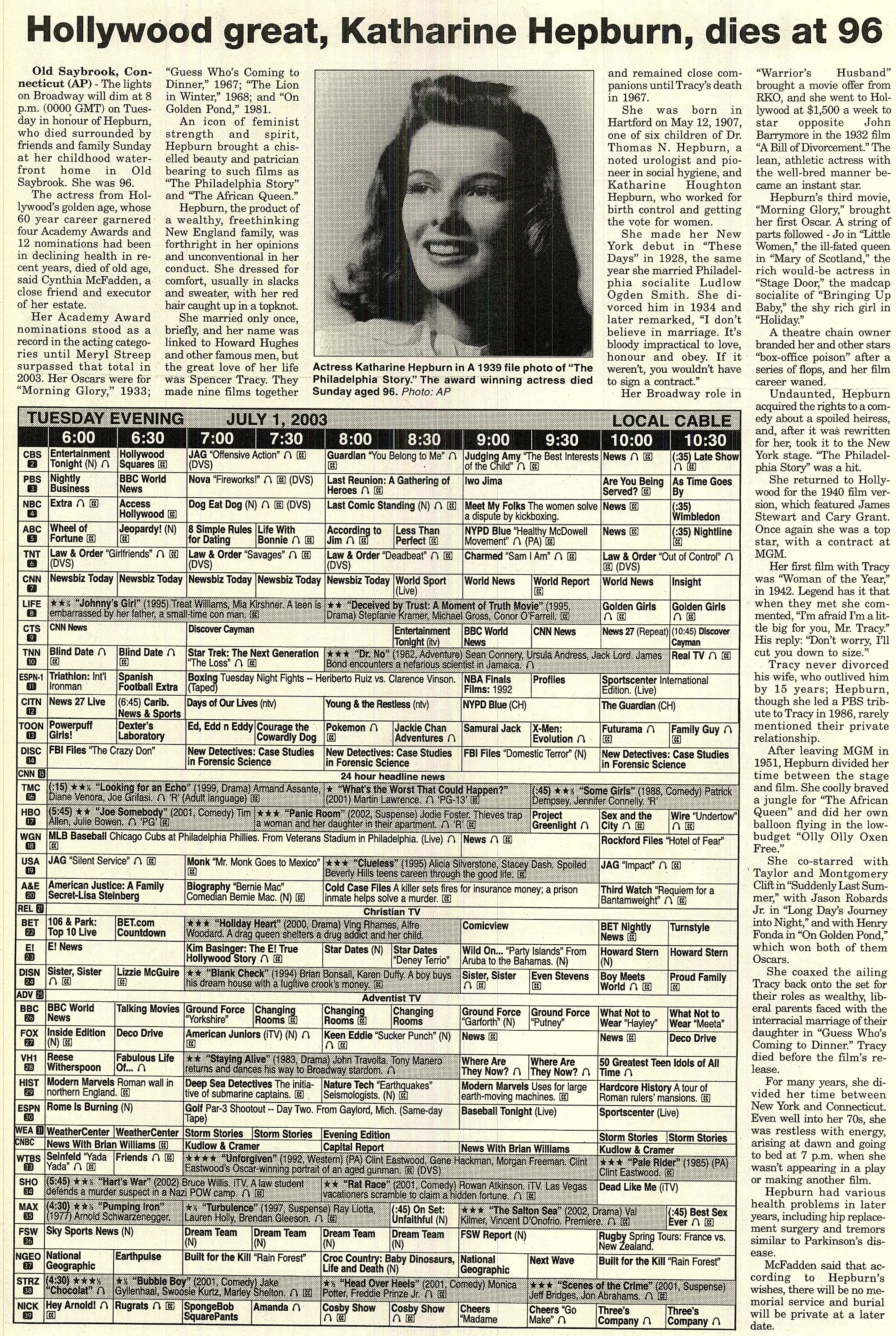
The actress from Hollywood's golden age, whose 60 year career garnered four Academy Awards and 12 nominations had been in declining health in recent years, died of old age, said Cynthia McFadden, a close friend and executor of her estate.
Her Academy Award nominations stood as a record in the acting categories until Meryl Streep surpassed that total in 2003. Her Oscars were for "Morning Glory," 1933; "Guess Who's Coming to Dinner," 1967; "The Lion in Winter," 1968; and "On Golden Pond," 1981.
An icon of feminist strength and spirit, Hepburn brought a chiselled beauty and patrician bearing to such films as "The Philadelphia Story" and "The African Queen."
Hepburn, the product of a wealthy, freethinking New England family, was forthright in her opinions and unconventional in her conduct. She dressed for comfort, usually in slacks and sweater, with her red hair caught up in a topknot. She married only once, briefly, and her name was linked to Howard Hughes and other famous men, but the great love of her life was Spencer Tracy. They made nine films together. and remained close companions until Tracy's death in 1967.
She was born in Hartford on May 12, 1907, one of six children of Dr. Thomas N. Hepburn, a noted urologist and pioneer in social hygiene, and Katharine Houghton Hepburn, who worked for birth control and getting the vote for women.
She made her New York debut in "These Days" in 1928, the same year she married Philadelphia socialite Ludlow Ogden Smith. She divorced him in 1934 and later remarked, "I don't believe in marriage. It's bloody impractical to love, honour and obey. If it weren't, you wouldn't have to sign a contract." Her Broadway role in "Warrior's Husband" brought a movie offer from RKO, and she went to Hollywood at $1,500 a week to star opposite John Barrymore in the 1932 film "A Bill of Divorcement." The lean, athletic actress with the well-bred manner became an instant star.
Hepburn's third movie, "Morning Glory," brought her first Oscar. A string of parts followed - Jo in "Little Women," the ill-fated queen in "Mary of Scotland," the rich would-be actress in "Stage Door," the madcap socialite of "Bringing Up Baby," the shy rich girl in "Holiday."
A theatre chain owner branded her and other stars "box-office poison" after a series of flops, and her film career waned.
Undaunted, Hepburn acquired the rights to a comedy about a spoiled heiress, and, after it was rewritten for her, took it to the New York stage. "The Philadelphia Story" was a hit.
She returned to Hollywood for the 1940 film version, which featured James Stewart and Cary Grant. Once again she was a top star, with a contract at MGM.
Her first film with Tracy was "Woman of the Year," in 1942. Legend has it that when they met she commented, "I'm afraid I'm a little big for you, Mr. Tracy." His reply: "Don't worry, I'll cut you down to size."
Tracy never divorced his wife, who outlived him by 15 years; Hepburn, though she led a PBS tribute to Tracy in 1986, rarely mentioned their private relationship.
After leaving MGM in 1951, Hepburn divided her time between the stage and film. She coolly braved a jungle for "The African Queen" and did her own balloon flying in the low-budget "Olly Olly Oxen Free."
She co-starred with Taylor and Montgomery Clift in "Suddenly Last Summer," with Jason Robards Jr. in "Long Day's Journey into Night," and with Henry Fonda in "On Golden Pond," which won both of them Oscars.
She coaxed the ailing Tracy back onto the set for their roles as wealthy, liberal parents faced with the interracial marriage of their daughter in "Guess Who's Coming to Dinner." Tracy died before the film's release.
For many years, she divided her time between New York and Connecticut. Even well into her 70s, she was restless with energy, arising at dawn and going to bed at 7 p.m. when she wasn't appearing in a play or making another film.
Hepburn had various health problems in later years, including hip replacement surgery and tremors similar to Parkinson's disease.
McFadden said that according to Hepburn's wishes, there will be no memorial service and burial will be private at a later date.