Typhoon lashes China
About the article
This is a digitised version of an article from The Cayman Compass's print archive. Occasionally, the digitisation process introduces transcription errors, or other problems.
See the article in its original context from September 2003.
Brought to you by

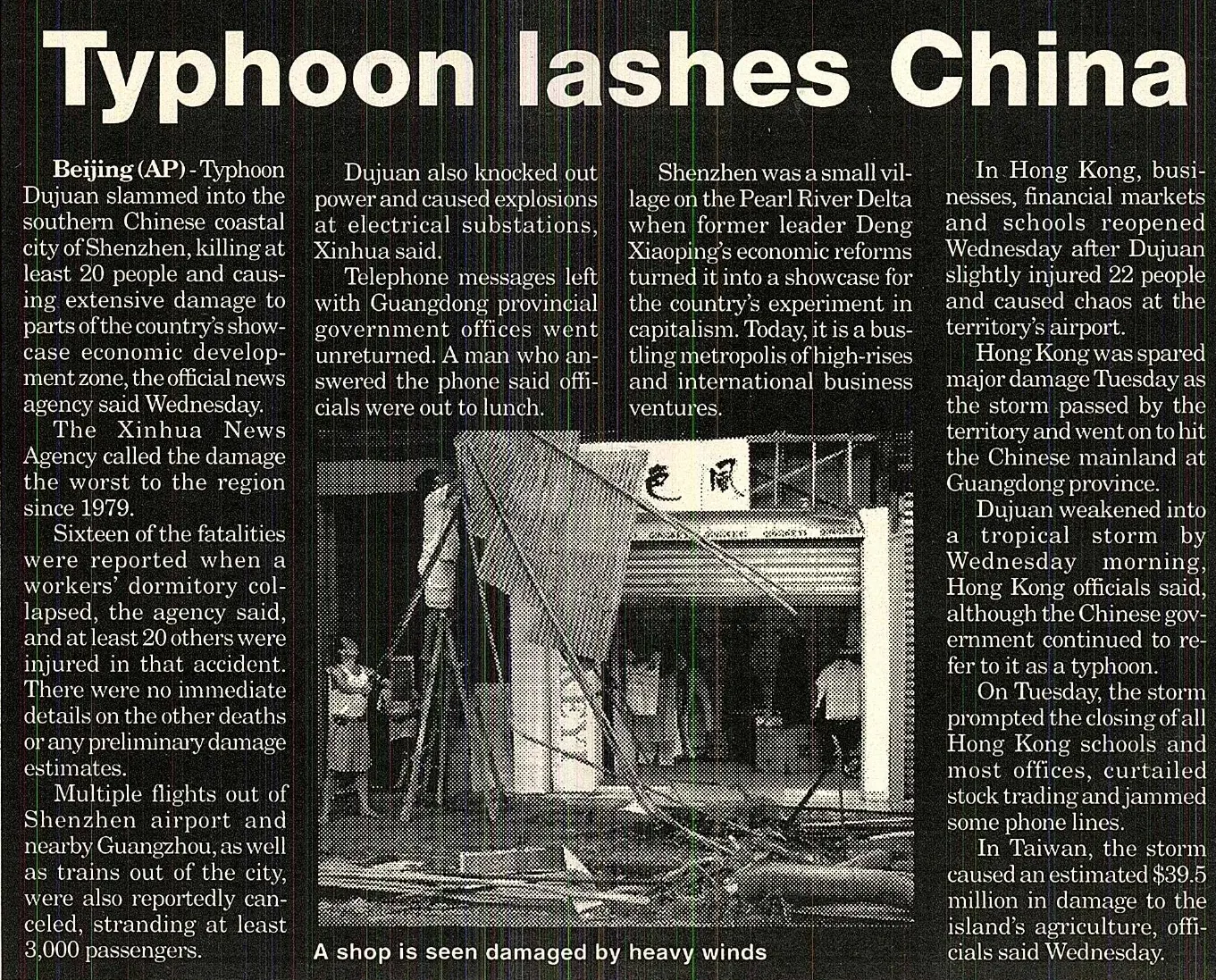
The Xinhua News Agency called the damage the worst to the region since 1979.
Sixteen of the fatalities were reported when a workers' dormitory collapsed, the agency said, and at least 20 others were injured in that accident. There were no immediate details on the other deaths or any preliminary damage estimates.
Multiple flights out of Shenzhen airport and nearby Guangzhou, as well as trains out of the city, were also reportedly canceled, stranding at least 3,000 passengers. Dujuan also knocked out power and caused explosions at electrical substations, Xinhua said.
Telephone messages left with Guangdong provincial government offices went unreturned. A man who answered the phone said officials were out to lunch. Shenzhen was a small village on the Pearl River Delta when former leader Deng Xiaoping's economic reforms turned it into a showcase for the country's experiment in capitalism. Today, it is a bustling metropolis of high-rises and international business ventures. In Hong Kong, businesses, financial markets and schools reopened Wednesday after Dujuan slightly injured 22 people and caused chaos at the territory's airport.
Hong Kong was spared major damage Tuesday as the storm passed by the territory and went on to hit the Chinese mainland at Guangdong province.
Dujuan weakened into a tropical storm by Wednesday morning, Hong Kong officials said, although the Chinese government continued to refer to it as a typhoon.
On Tuesday, the storm prompted the closing of all Hong Kong schools and most offices, curtailed stock trading and jammed some phone lines.
In Taiwan, the storm caused an estimated $39.5 million in damage to the island's agriculture, officials said Wednesday.