Which Ten Commandments?
About the article
This is a digitised version of an article from The Cayman Compass's print archive. Occasionally, the digitisation process introduces transcription errors, or other problems.
See the article in its original context from September 2003.
Brought to you by

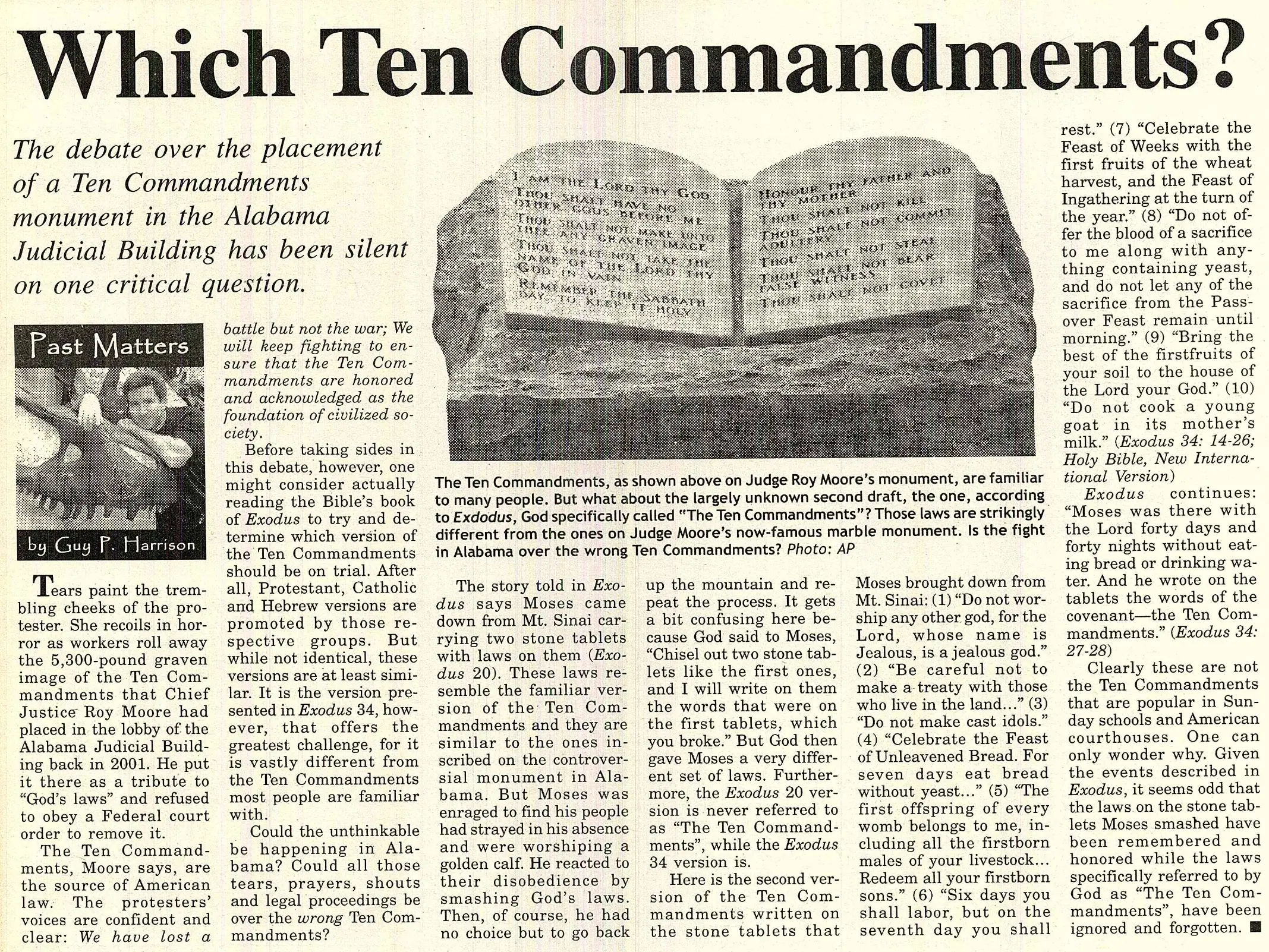
The Ten Commandments, Moore says, are the source of American law. The protesters' voices are confident and clear: We have lost a battle but not the war; We will keep fighting to ensure that the Ten Commandments are honored and acknowledged as the foundation of civilized society.
Before taking sides in this debate, however, one might consider actually reading the Bible's book of Exodus to try and determine which version of the Ten Commandments should be on trial. After all, Protestant, Catholic and Hebrew versions are promoted by those respective groups. But while not identical, these versions are at least similar. It is the version presented in Exodus 34, however, that offers the greatest challenge, for it is vastly different from the Ten Commandments most people are familiar with.
Could the unthinkable be happening in Alabama? Could all those tears, prayers, shouts and legal proceedings be over the wrong Ten Commandments? The story told in Exodus says Moses came down from Mt. Sinai carrying two stone tablets with laws on them (Exodus 20). These laws resemble the familiar version of the Ten Commandments and they are similar to the ones inscribed on the controversial monument in Alabama.
But Moses was enraged to find his people had strayed in his absence and were worshiping a golden calf. He reacted to their disobedience by smashing God's laws. Then, of course, he had no choice but to go back. up the mountain and repeat the process. It gets a bit confusing here because God said to Moses, "Chisel out two stone tablets like the first ones, and I will write on them the words that were on the first tablets, which you broke." But God then gave Moses a very different set of laws. Furthermore, the Exodus 20 version is never referred to as "The Ten Commandments", while the Exodus 34 version is.
Here is the second version of the Ten Commandments written on the stone tablets that Moses brought down from Mt. Sinai: (1) "Do not worship any other god, for the Lord, whose name is Jealous, is a jealous god."
(2) "Be careful not to make a treaty with those who live in the land..." (3) "Do not make cast idols."
(4) "Celebrate the Feast of Unleavened Bread. For seven days eat bread without yeast..." (5) "The first offspring of every womb belongs to me, including all the firstborn males of your livestock... Redeem all your firstborn sons." (6) "Six days you shall labor, but on the seventh day you shall rest." (7) "Celebrate the Feast of Weeks with the first fruits of the wheat harvest, and the Feast of Ingathering at the turn of the year." (8) "Do not offer the blood of a sacrifice to me along with anything containing yeast, and do not let any of the sacrifice from the Passover Feast remain until morning." (9) "Bring the best of the firstfruits of your soil to the house of the Lord your God." (10) "Do not cook a young goat in its mother's milk." (Exodus 34: 14-26; Holy Bible, New International Version)
Exodus continues: "Moses was there with the Lord forty days and forty nights without eating bread or drinking water. And he wrote on the tablets the words of the covenant-the Ten Commandments." (Exodus 34: 27-28) Clearly these are not the Ten Commandments that are popular in Sunday schools and American courthouses. One can only wonder why. Given the events described in Exodus, it seems odd that the laws on the stone tablets Moses smashed have been remembered and honored while the laws specifically referred to by God as "The Ten Commandments", have been ignored and forgotten.