Top Ten Signs Your Neighbor Is A Cannibal
About the article
This is a digitised version of an article from The Cayman Compass's print archive. Occasionally, the digitisation process introduces transcription errors, or other problems.
See the article in its original context from December 2003.
Brought to you by

10. You see repairmen go in, but you never really see them come out.
9. Your name: Lou Levy; recipe on his refrigerator: "Lou Levy Almandine."
8. Lives alone, yet at his garage sale, had men's and women's shoes in most sizes
7. Asks if sailors count as seafood.
6. Sues Denny's for false advertising over its so-called "Lumberjack Breakfast."
5. Calls his hot tub "the slow cooker."
4. At Halloween, he always has extremely realistic skeletons on the porch.
3. You ask for a beer, he replies, "They're in the fridge next to Steve."
2. Says, "I'm in the mood for a Mexican...I mean Mexican."
1. The "pork shoulder" he serves you is wearing a wristwatch. From The Late Show With David Letterman: CBS; around the world archaeologists have found fossilized human bones that had been worked with stone tools to deflesh and/or access the marrow inside. These finds suggest that cannibalism may have been common and widespread, in the prehistoric world.
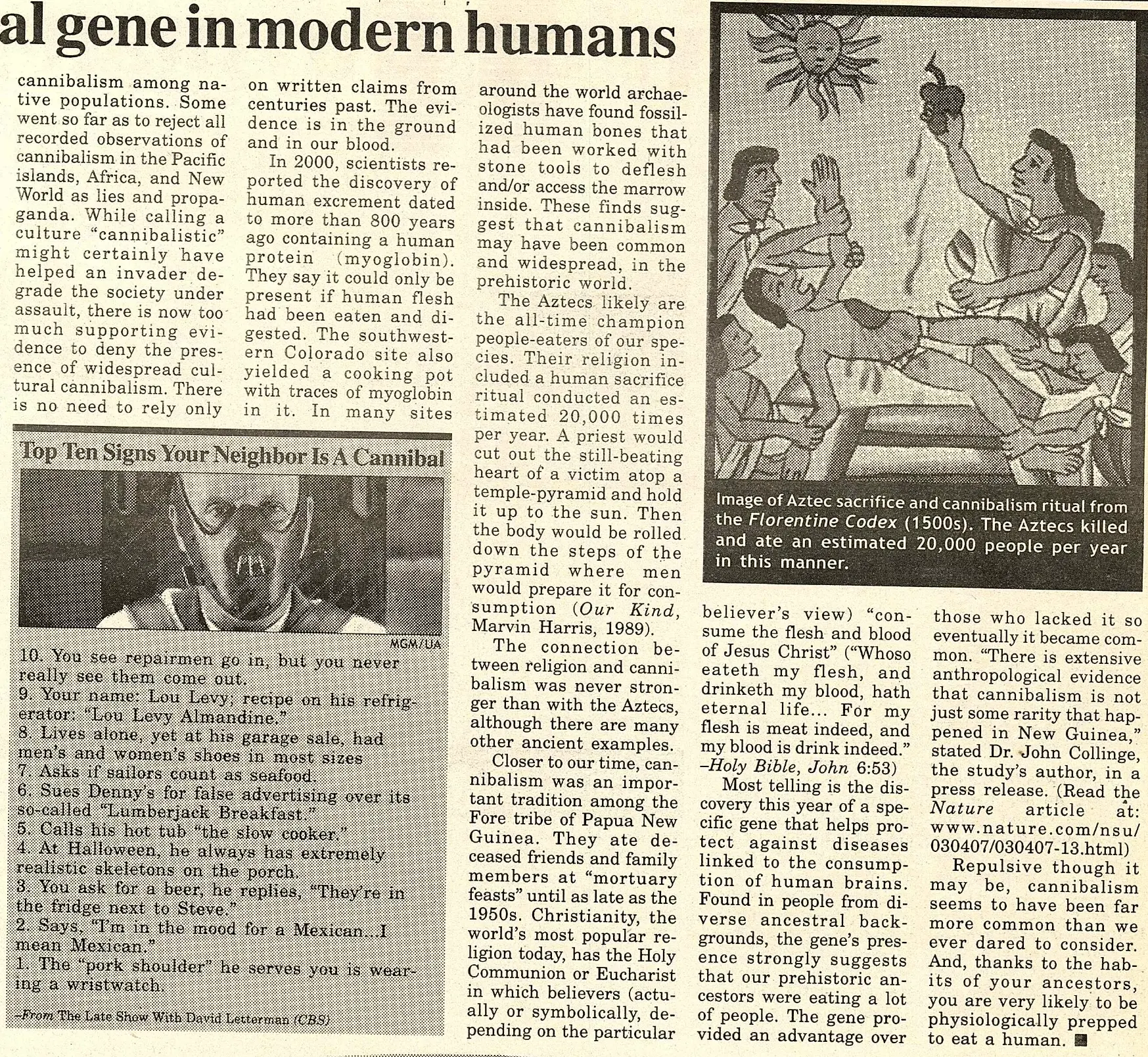
The Aztecs likely are the all-time champion people-eaters of our species. Their religion included a human sacrifice ritual conducted an estimated 20,000 times per year. A priest would cut out the still-beating heart of a victim atop a temple-pyramid and hold it up to the sun. Then the body would be rolled down the steps of the pyramid where men would prepare it for consumption (Our Kind, Marvin Harris, 1989).
The connection between religion and cannibalism was never stronger than with the Aztecs, although there are many other ancient examples. Closer to our time, cannibalism was an important tradition among the Fore tribe of Papua New Guinea. They ate deceased friends and family members at "mortuary feasts" until as late as the 1950s. Christianity, the world's most popular religion today, has the Holy Communion or Eucharist in which believers (actually or symbolically, depending on the particular believer's view) "consume the flesh and blood of Jesus Christ" ("Whoso eateth my flesh, and drinketh my blood, hath eternal life... For my flesh is meat indeed, and my blood is drink indeed." -Holy Bible, John 6:53)
Most telling is the discovery this year of a specific gene that helps protect against diseases linked to the consumption of human brains. Found in people from diverse ancestral backgrounds, the gene's presence strongly suggests that our prehistoric ancestors were eating a lot of people. The gene provided an advantage over those who lacked it so eventually it became common. "There is extensive anthropological evidence that cannibalism is not just some rarity that happened in New Guinea," stated Dr. John Collinge, the study's author, in a press release. (Read the Nature article at: www.nature.com/nsu/030407/030407-13.html)
Repulsive though it may be, cannibalism seems to have been far more common than we ever dared to consider. And, thanks to the habits of your ancestors, you are very likely to be physiologically prepped to eat a human.