What became of Mengele?
About the article
This is a digitised version of an article from The Cayman Compass's print archive. Occasionally, the digitisation process introduces transcription errors, or other problems.
See the article in its original context from March 2004.
Brought to you by

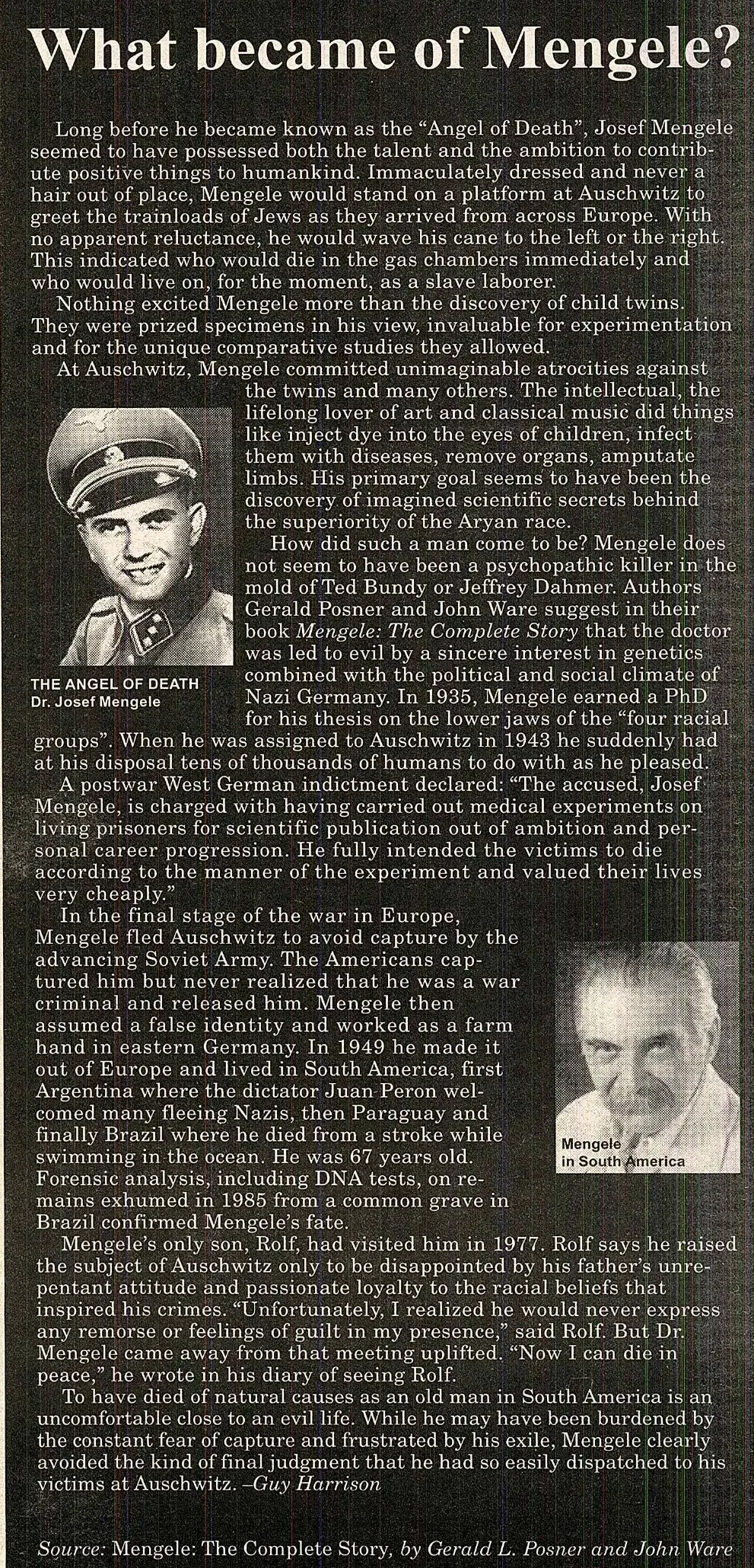
Nothing excited Mengele more than the discovery of child twins. They were prized specimens in his view, invaluable for experimentation and for the unique comparative studies they allowed. At Auschwitz, Mengele committed unimaginable atrocities against the twins and many others. The intellectual, the lifelong lover of art and classical music did things like inject dye into the eyes of children, infect them with diseases, remove organs, amputate limbs. His primary goal seems to have been the discovery of imagined scientific secrets behind the superiority of the Aryan race. How did such a man come to be? Mengele does not seem to have been a psychopathic killer in the mold of Ted Bundy or Jeffrey Dahmer. Authors Gerald Posner and John Ware suggest in their book Mengele: The Complete Story that the doctor was led to evil by a sincere interest in genetics combined with the political and social climate of Nazi Germany. In 1935, Mengele earned a PhD for his thesis on the lower jaws of the "four racial groups". When he was assigned to Auschwitz in 1943 he suddenly had at his disposal tens of thousands of humans to do with as he pleased.
A postwar West German indictment declared: “The accused, Josef Mengele, is charged with having carried out medical experiments on living prisoners for scientific publication out of ambition and personal career progression. He fully intended the victims to die according to the manner of the experiment and valued their lives very cheaply."
In the final stage of the war in Europe, Mengele fled Auschwitz to avoid capture by the advancing Soviet Army. The Americans captured him but never realized that he was a war criminal and released him. Mengele then assumed a false identity and worked as a farm hand in eastern Germany. In 1949 he made it out of Europe and lived in South America, first Argentina where the dictator Juan Peron welcomed many fleeing Nazis, then Paraguay and finally Brazil where he died from a stroke while swimming in the ocean. He was 67 years old. Forensic analysis, including DNA tests, on remains exhumed in 1985 from a common grave in Brazil confirmed Mengele's fate.
Mengele's only son, Rolf, had visited him in 1977. Rolf says he raised the subject of Auschwitz only to be disappointed by his father's unrepentant attitude and passionate loyalty to the racial beliefs that inspired his crimes. “Unfortunately, I realized he would never express any remorse or feelings of guilt in my presence,” said Rolf. But Dr. Mengele came away from that meeting uplifted. "Now I can die in peace," he wrote in his diary of seeing Rolf.
To have died of natural causes as an old man in South America is an uncomfortable close to an evil life. While he may have been burdened by the constant fear of capture and frustrated by his exile, Mengele clearly avoided the kind of final judgment that he had so easily dispatched to his victims at Auschwitz. -Guy Harrison