Thatcher celebrated 25 years on
About the article
This is a digitised version of an article from The Cayman Compass's print archive. Occasionally, the digitisation process introduces transcription errors, or other problems.
See the article in its original context from May 2004.
Brought to you by

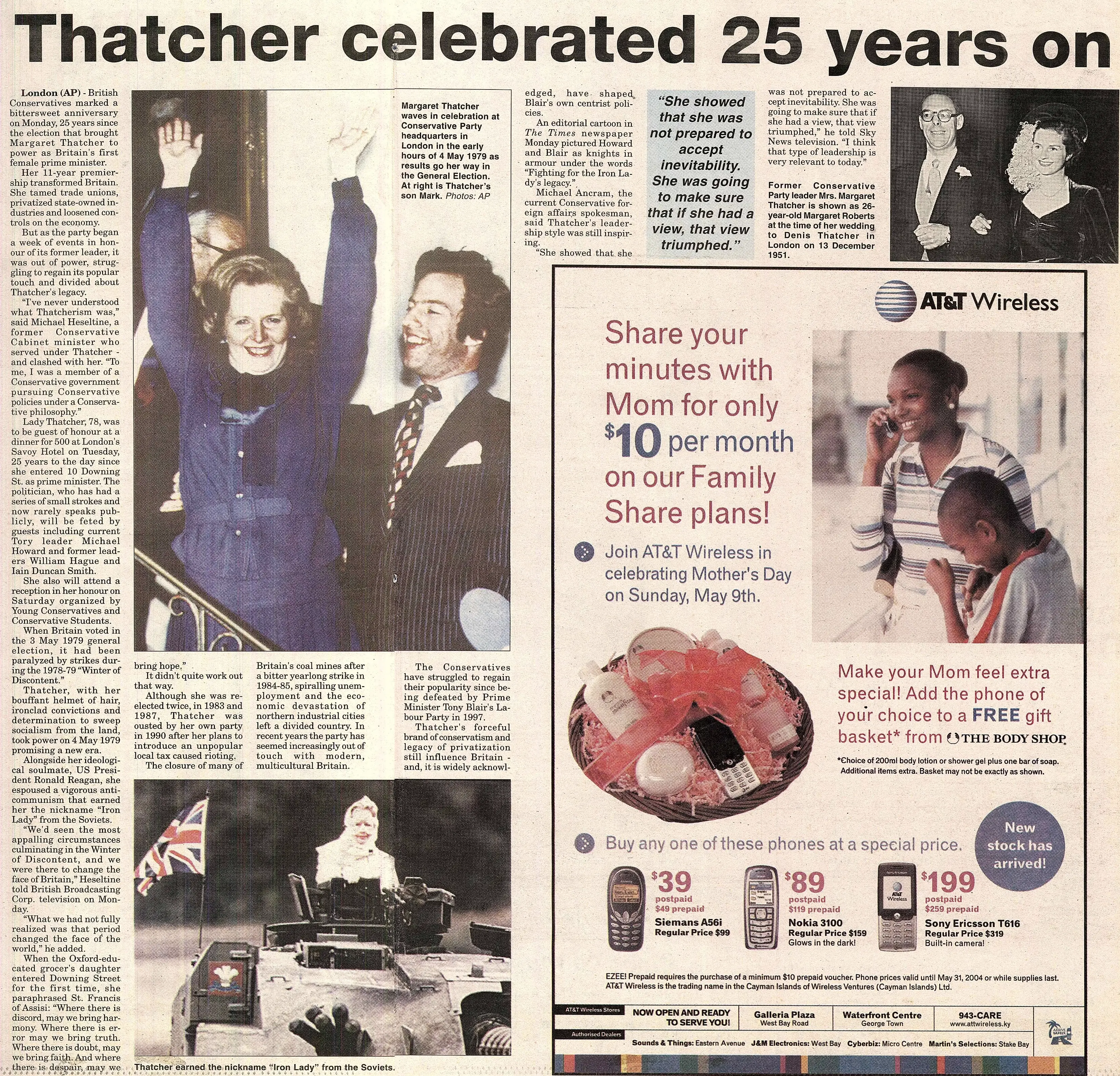
But as the party began a week of events in honour of its former leader, it was out of power, struggling to regain its popular touch and divided about Thatcher's legacy.
"I've never understood what Thatcherism was," said Michael Heseltine, a former Conservative Cabinet minister who served under Thatcher and clashed with her. "To me, I was a member of a Conservative government pursuing Conservative policies under a Conservative philosophy."
Lady Thatcher, 78, was to be guest of honour at a dinner for 500 at London's Savoy Hotel on Tuesday, 25 years to the day since she entered 10 Downing St. as prime minister. The politician, who has had a series of small strokes and now rarely speaks publicly, will be feted by guests including current Tory leader Michael Howard and former leaders William Hague and Iain Duncan Smith. She also will attend a reception in her honour on Saturday organized by Young Conservatives and Conservative Students. When Britain voted in the 3 May 1979 general election, it had been paralyzed by strikes during the 1978-79 "Winter of Discontent."
Thatcher, with her bouffant helmet of hair, ironclad convictions and determination to sweep socialism from the land, took power on 4 May 1979 promising a new era.
Alongside her ideological soulmate, US President Ronald Reagan, she espoused a vigorous anticommunism that earned her the nickname "Iron Lady" from the Soviets.
"We'd seen the most appalling circumstances culminating in the Winter of Discontent, and we were there to change the face of Britain," Heseltine told British Broadcasting Corp. television on Monday. "What we had not fully realized was that period changed the face of the world," he added.
When the Oxford-educated grocer's daughter entered Downing Street for the first time, she paraphrased St. Francis of Assisi: "Where there is discord, may we bring harmony. Where there is error may we bring truth. Where there is doubt, may we bring faith. And where there is despair, may we bring hope."
It didn't quite work out that way.
Although she was reelected twice, in 1983 and 1987, Thatcher was ousted by her own party in 1990 after her plans to introduce an unpopular local tax caused rioting.
The closure of many of Britain's coal mines after a bitter yearlong strike in 1984-85, spiralling unemployment and the economic devastation of northern industrial cities left a divided country.
In recent years the party has seemed increasingly out of touch with modern, multicultural Britain. The Conservatives have struggled to regain their popularity since being defeated by Prime Minister Tony Blair's Labour Party in 1997.
Thatcher's forceful brand of conservatism and legacy of privatization still influence Britain - and, it is widely acknowledged, have shaped Blair's own centrist policies.
An editorial cartoon in The Times newspaper Monday pictured Howard and Blair as knights in armour under the words "Fighting for the Iron Lady's legacy."
Michael Ancram, the current Conservative foreign affairs spokesman, said Thatcher's leadership style was still inspiring. "She showed that she "She showed that she was not prepared to accept inevitability.
She was going to make sure that if she had a view, that view triumphed." was not prepared to accept inevitability. She was going to make sure that if she had a view, that view triumphed," he told Sky News television. "I think that type of leadership is very relevant to today." Former Conservative Party leader Mrs. Margaret Thatcher is shown as 26-year-old Margaret Roberts at the time of her wedding to Denis Thatcher in London on 13 December 1951.