Here come the Greeks!
About the article
This is a digitised version of an article from The Cayman Compass's print archive. Occasionally, the digitisation process introduces transcription errors, or other problems.
See the article in its original context from May 2004.
Brought to you by

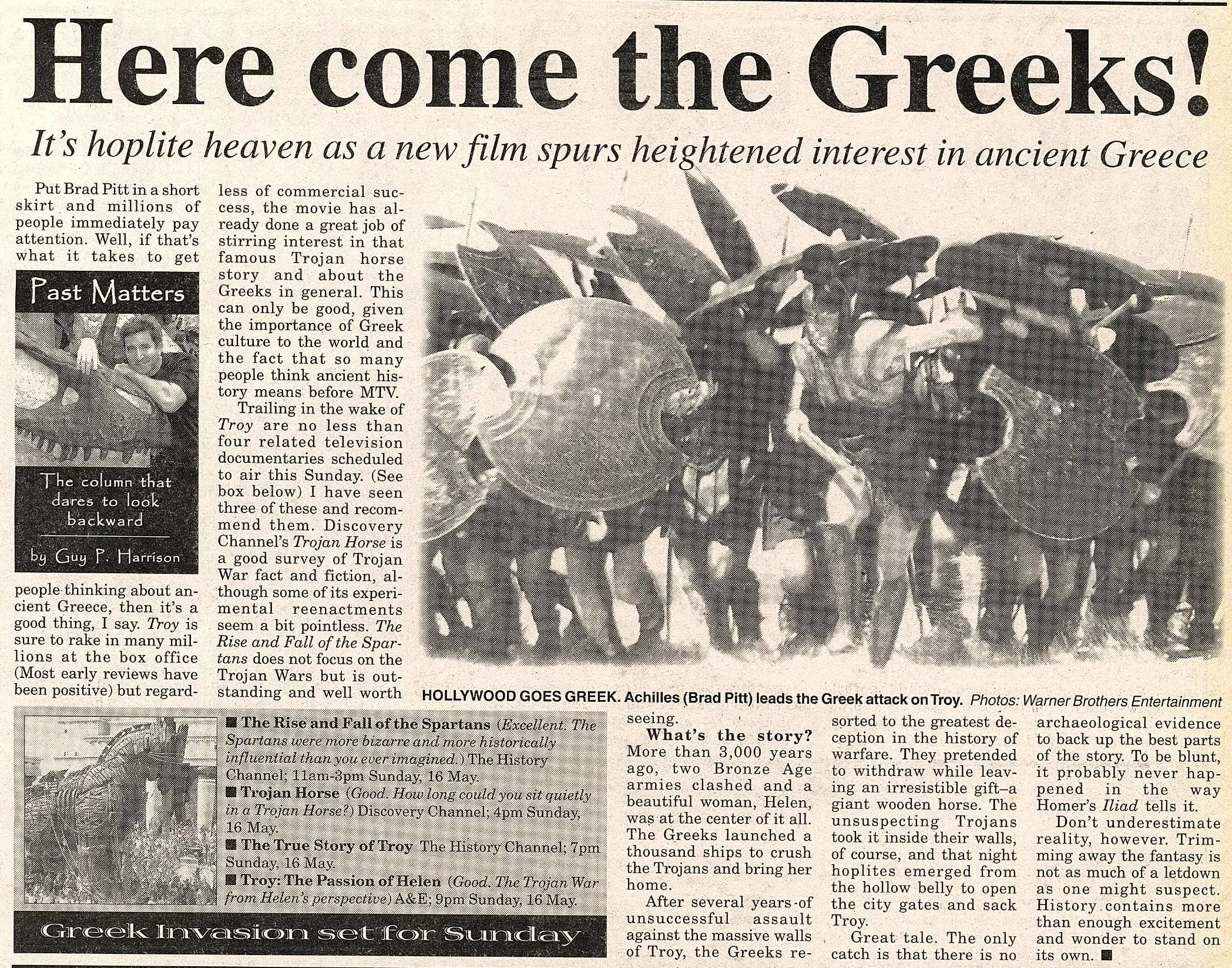
Trailing in the wake of Troy are no less than four related television documentaries scheduled to air this Sunday. (See box below) I have seen three of these and recommend them. Discovery Channel's Trojan Horse is a good survey of Trojan War fact and fiction, although some of its experimental reenactments seem a bit pointless. The Rise and Fall of the Spartans does not focus on the Trojan Wars but is outstanding and well worth The Rise and Fall of the Spartans (Excellent. The Spartans were more bizarre and more historically influential than you ever imagined.) The History Channel; 11am-3pm Sunday, 16 May.
■Trojan Horse (Good. How long could you sit quietly in a Trojan Horse?) Discovery Channel; 4pm Sunday, 16 May.
The True Story of Troy The History Channel; 7pm Sunday, 16 May.
■Troy: The Passion of Helen (Good. The Trojan War from Helen's perspective) A&E; 9pm Sunday, 16 May. seeing. What's the story?
More than 3,000 years ago, two Bronze Age armies clashed and a beautiful woman, Helen, was at the center of it all. The Greeks launched a thousand ships to crush the Trojans and bring her home.
After several years-of unsuccessful assault against the massive walls of Troy, the Greeks resorted to the greatest deception in the history of warfare. They pretended to withdraw while leaving an irresistible gift-a giant wooden horse. The unsuspecting Trojans took it inside their walls, of course, and that night hoplites emerged from the hollow belly to open the city gates and sack Troy.
Great tale. The only catch is that there is no archaeological evidence to back up the best parts of the story. To be blunt, it probably never happened in the way Homer's Iliad tells it.
Don't underestimate reality, however. Trimming away the fantasy is not as much of a letdown as one might suspect. History contains more than enough excitement and wonder to stand on its own.