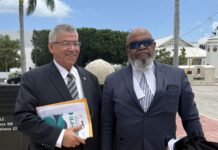
The prosecution in the McKeeva Bush rape trial has urged the jury to believe the woman who says the veteran politician raped her on a dark side road one night two decades ago, insisting that she would not have gone through the trauma of telling her story publicly unless it were true.
Eloise Marshall, KC, summing up the prosecution’s case to jurors in the Grand Court on Friday, challenged the jury to ask themselves why the woman would make this up, considering the embarrassment and distress involved in coming forward after all these years to tell what had happened to her.
She asked them to discount suggestions made by the defence counsel in relation to the claimant. As an example, she pointed to Bush’s lawyer, Jerome Lynch, KC, accusing the woman of lying in an online biography which noted she had been a member of a bar association in a US state.
Marshall said it had been proven later in the trial, and accepted by the defence, that the woman had, in fact, been a student member of that association, as she had repeatedly stated on the stand.
She said this had been raised to imply that the woman was a liar.
Police interview
She pointed to the woman’s police interview – a video recording of which was played to the jury over two-and-a-quarter hours earlier in the week – saying her distress over her recollections of the alleged sexual assault was obvious.
In the video, the woman broke down several times, crying and screaming as she answered probing police questions.
Marshall noted that, both during the police interview and during cross-examination by Lynch, the times the complainant was most emotional was when she spoke about becoming frozen as Bush made his alleged advances and “she had just laid back and let him do it”.
“She appears disgusted by that very fact,” Marshall told the jury. “And you might ask yourself the question, if she were lying, why would that be the thing that upsets her the most?”
She added that if the woman had been lying, she could have made up other elements to make her story more believable – such as saying Bush had threatened her or shoved her.
She reminded them that the woman had described Bush’s tone as “encouraging” when he told her to get out of the car, rather than as threatening. “Is that something that she would say … if she wanted to try to convince you of a lie?” she asked the jurors.
Referring to the raw emotions the woman displayed on the videoed interview, Marshall said this had been the first time the woman had spoken in detail about the rape, other than mentioning it to friends and family members.
She also pointed to the many details the woman had been unable to recall about the night in question when answering queries by the police and the defence, saying the incident had occurred more than 20 years ago, so it was not unusual that she would have forgotten details.
But, she argued, “the most abiding memory that she has of all this, she says, is when he was touching her, kissing her, and lying on top of her”.
Coming forward
During cross-examination by Lynch, the complainant had, at times, appeared calm and collected, and at other times responded angrily to the defence lawyer’s questions. Marshall acknowledged that, based on the woman’s demeanour and attitude during her time on the stand, the jury may think this was not the type of woman who would meekly do as she was told by an assailant.
But, Marshall said, in the intervening years, the complainant had studied law, sought counselling, and was a quite different person than the woman, who in her late 20s, had been a subservient figure who did what she was told – whether by her mother or an influential politician.
“It’s taken all that time to overcome the shame and the fear and worrying what others might think to take the step of coming forward to the police and to be able to withstand coming to court and being asked questions about what happened,” she told the jury.
“Imagine for one moment what it must have been like to be under that cross-examination and ask yourself this – why wouldn’t a woman want to report rape to the police? Perhaps the best example you can have is what you saw in this courtroom,” she said.
The cross-examination, which spanned two days, had been fractious, with the woman complaining that Lynch had been badgering her and trying to intimidate her, and him becoming annoyed by many of her responses.
“I’m going to suggest that despite the way in which she was cross-examined, she was very dignified most of the time,” Marshall said. “Yes, there were times when she was angry.”
During the cross-examination, the woman had spoken of her anger with her mother for telling her to drive Bush home that night, thereby putting her, she said, in a situation in which she had been raped.
The court had heard earlier that the woman had gone to the Sea Inn Bar in George Town some time in 1999 or 2000 to pick up her mother who had been drinking, and that her mother and others at the bar had decided that she should drive Bush home in his vehicle and then someone would pick her up at his house.
“It conjures a horrible image for you to imagine that when they were deciding who would drive McKeeva Bush home that night, that they should choose that she was the person to do it… How does anyone react to that? How does anyone react to it 20 years later? Imagine how angry you might be,” Marshall said.
Reaction to assault
During the cross-examination, the defence lawyer had questioned the woman on why she had not told her assailant to stop or put her hands up to fend him off. Addressing this, Marshall said, “We are long past the time when rape is just an offence committed by strangers jumping out of a bush, and we are long past assuming that women react the same way.”
She told the jurors. “What [the complainant] told you was this – ‘I reacted the only way my body would let me.'”
She added, “With a man, and not just any man, a powerful, important man in politics, when do you decide what the … right reaction is? And who’s to say what would have happened if she had fought?”
Dealing with why the woman had not reported the rape earlier, Marshall said the complainant had told the jury she’d been in denial. “She didn’t think anyone would believe her,” and knew she’d face ridicule and shame, she said.
She also asked the jury not to take any inference from the fact that both Bush and Lynch had highlighted that the woman had been a teenage mother, saying that was entirely irrelevant to whether or not she had been raped, and had only been mentioned to cast aspersions on her character.
Motive
Marshall also raised the fact that Bush had told police, when arrested, that he did not know the complainant. However, Bush stated in his testimony on Thursday that the first time he had spoken to her was in the early 2000s, when he says she verbally abused him on the steps of the Legislative Assembly, now Parliament, for giving away Caymanian status grants to Jamaican and Hondurans.
In his testimony, Bush had said, “She came up to me and said, ‘You gave our citizenships away to black Jamaicans, whoring Hondurans, and I’m going to get you out of this House’.”
Marshall queried why this had not been mentioned in his police interview or in the cross-examination of the woman, suggesting to the jury that this had been raised by Bush in an effort to make the woman appear racist and as though she had a vendetta against the West Bay West MP.
“He was trying to come up with a motive for why she lied,” Marshall told the jurors.
The court had heard earlier that the woman had political ambitions and had approached Progressives leader Roy McTaggart about running as a candidate. Marshall asked the jury why the complainant would falsely accuse Bush, who was a friend of her family, when he could clearly be an asset if she wanted a political career.
She said if anyone had any doubt about the woman’s assertion that she had been fearful about how she would be treated if she had reported the rape, the things Bush had said about her in the courtroom on Thursday was the “best piece of evidence” to support that, Marshall said.
“He called her sick, he called her all sorts of things, about her notoriety, about when she had children. And he told you that he, on the other hand, was important on the island,” she said.
“Imagine how difficult it is to stand up against someone who tells you that that’s who he is. But she did stand up. She did stand up to be heard, and that’s all she asks of you. That’s all I ask of you, that she be given a fair hearing.”
The defence will deliver its closing speech to the jury on Monday.
Bush has pleaded not guilty to one count of rape and one count of indecent assault.
Related Videos