Agencies tasked with ensuring good governance and fighting corruption in the Cayman Islands and Jamaica appear to be robust and numerous.
But according to both Cayman’s Auditor General Alastair Swarbrick and Jamaica’s former Contractor General Greg Christie, in practice, many of those agencies are either entirely dysfunctional or face various pressures from governments to look the other way.
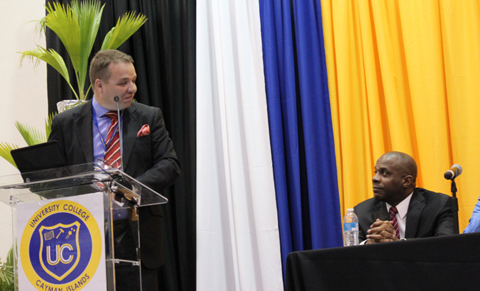
Both men spoke during a panel discussion at the University College of the Cayman Islands held last week on anti-corruption activities within the Caribbean and across the globe.
Mr. Christie, the Jamaican contractor general who required bodyguards 24-7 to ensure his personal safety while on the job, has often been an outspoken critic of government practices in Cayman’s closest neighbor to the east.
“Jamaica lacks strong and decisive leadership to do what is right for Jamaica as opposed to what is politically expedient,” Mr. Christie said.
The former contractor general identified a number of areas where Jamaica has gotten it wrong, including the political directorate for not holding leaders accountable for their actions, a general disrespect for the rule of law in the country and government decision-making that is “devoid of transparency” leading to institutionalized nepotism or cronyism.
“These are truths we need to face head on if we are to deal with this problem,” Mr. Christie said, fearing a “high and unforgiving price” will one day be extracted from Jamaica. “Foreign investors … will shy away, taking with them the only opportunities that a country such as Jamaica will ever have for achieving sustainable growth.”
Mr. Swarbrick, who has been less outspoken than Mr. Christie, cited several areas where Cayman has succeeded in the fight against corruption, including a stable legal system and judiciary, a proactive and free media and the appearance of at least some political will to address issues around corruption.
But the Cayman Islands Auditor General identified many of the same issues that his Jamaican counterpart fretted about, including the general lack of consequences for non-performance or outright violation of legal requirements, such as financial reporting standards set within Cayman’s Public Management and Finance Law.
Cayman’s public sector has not submitted a complete annual financial evaluation since 2005 as required under the law for various reasons including financial statements that, in the words of one local legislator, “weren’t worth the bus ticket they’re written on.”
“I can think of examples where individuals got rewarded for failure to perform their responsibility,” Mr. Swarbrick said, adding that one senior public official in Cayman’s government once told him that the Public Management and Finance Law was considered more of a “non-binding framework” than an actual legal requirement.
In addition, while good governance institutions like the auditor general’s office, the complaints commissioner, the information commissioner and the Anti-Corruption Commission are well established legally, Mr. Swarbrick said they may be on softer footing from a funding standpoint.
“The offices that support [anti-corruption] work are still legally part of core government and, as a result, there are levers government can use to restrict or impede that work,” he said.
Mr. Swarbrick was one of the few speakers at the three-day conference held at UCCI to opine a belief that corrupt activities could never fully be eradicated from society.
“I would like to eradicate it, but I’m a realist,” Mr. Swarbrick said. “Our target should be to contain [corruption] and minimize its impact.”

Related Videos