

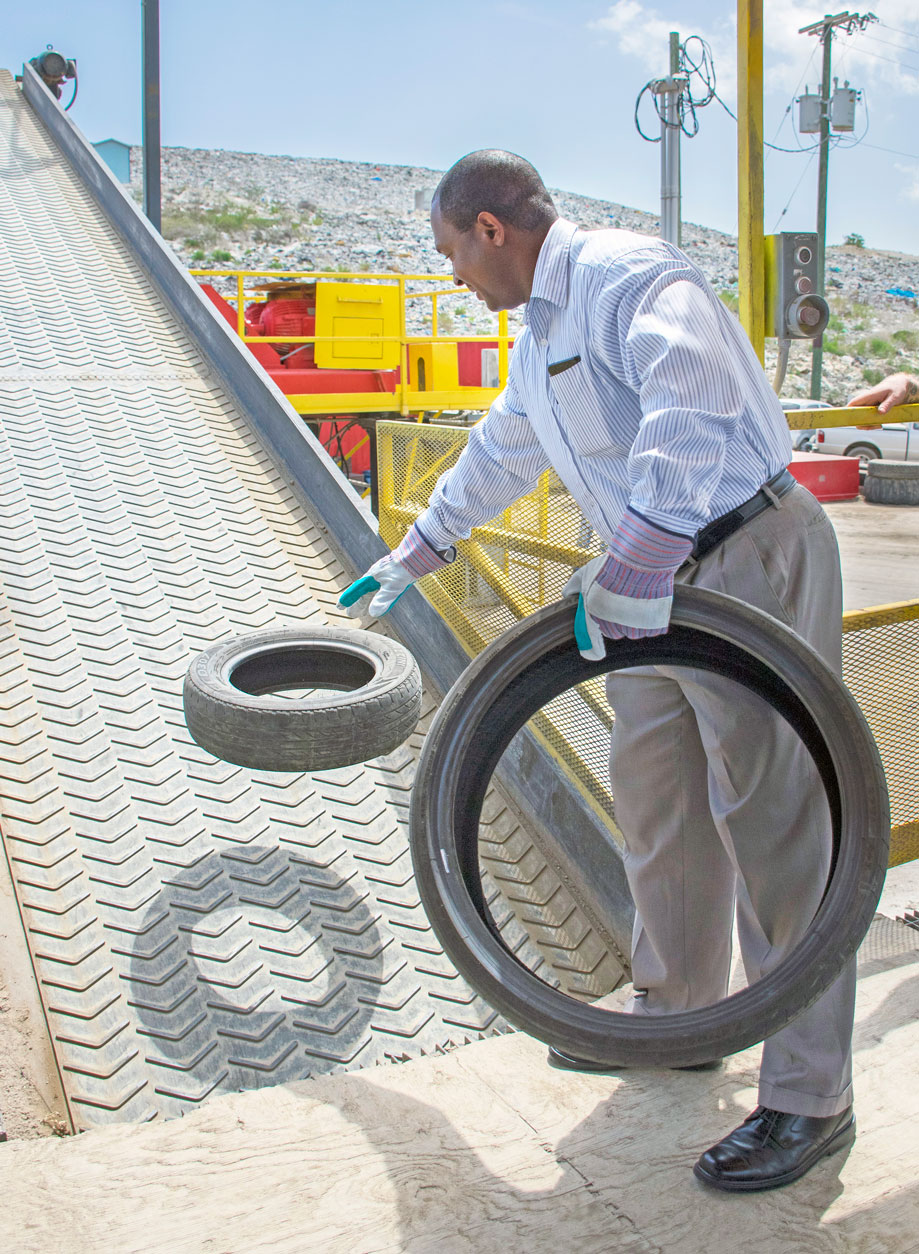
The last in a pile of 670,000 tires that once towered over the George Town landfill was tossed into the shredder Wednesday by Environment Minister Dwayne Seymour.
“We have eliminated an unsightly, particularly dangerous waste product,” Mr. Seymour said. “Rather than just disposing of this product, we were able to use it again.”
Nearly 6,700 metric tons (14.8 million pounds) of shredded tires have been produced since March 2017, when government contracted a private company to shred the tires and sell them for what’s known as Tire-Derived Aggregate – fill – to various developers.
Jim Schubert, the senior project manager for the government’s solid waste management system, said about 5,000 metric tons of shredded tires have already been sold to Davenport Development to fill the site of a condominium the company built in South Sound. The remaining 1,700 tons are expected to be sold to the Dart Enterprises Construction Company, or DECCO, as part of the Integrated Solid Waste Management Project, which aims to close Cayman’s current landfill and open a waste-to-energy plant.
The area previously occupied by the massive tire pile, which burst into flames on Dec. 20, 2013, sending black plumes of smoke around George Town for most of the day, will now be used for composting waste.
The large tire-shredding machine was brought in by Island Recycling company. Island Recycling’s managing director Jason Brown said the machine will be sent back to the U.S., now that the shredding project is complete.
Mr. Schubert said there will still be tires coming into the George Town landfill site before the waste-to-energy operation gets up and running.
“We estimate they come in at the rate of about one tire per person per year,” he said.
There will be a period of 18 months to two years when the tires will have to be stocked up again at the landfill. However, Mr. Schubert said it would take Cayman about 15 years for the tire waste to reach the same state it had got to by 2017.
When the waste-to-energy plant gets going, the tires, along with other construction and development-related refuse, will be burned in the incinerator to create a new power source. Minister Seymour said that will be just one way Cayman’s Integrated Solid Waste Management System will seek to reduce the amount of trash now piled up at the dump.
The new system will include the waste-to-energy plant, recycling and composting centers and a smaller landfill. The current massive landfill in George Town will be capped and covered with grass. The plan also calls for landfills in the Sister Islands to be closed and for the trash to be shipped to Grand Cayman.
“There will be a process for managing solid waste that works much differently from what obtains today,” Mr. Seymour said.
Negotiations on the waste management project between government and a private consortium have not been completed.
The consortium, led by Dart Enterprises, is in line to take over responsibility for waste management in the Cayman Islands in a 25-year deal.
Related Videos







Now it is time to shred the junk cars!
I guess that the dump is fixed now that Dart is taking it over for the next 25 years , why not 50 years or more ? In 25 years the new dump agreement and dump would be the same size it is today , and the Dart Enterprise would have everything it wanted to get /do , and no responsibilities left behind .
You Dart believers, it’s hard to accept the facts , I know .
What are environmental toxicity effects of TDA?
@L. Bell
That’s a very good question. There’s a lot of material available online about this but it all seems rather inconclusive. This is one of the more recent articles – http://adeptus.co.uk/shreded-tyres-health-risk-contamination/
My best guess (and that’s all it is) is that compared to the impact of the tons of various contaminents that have been dumped at Mt Trashmore over the years the tyres represent a drop in the proverbial ocean.
You are spot on about the Dump.
ASTM Specifications and research done at the University of Maine conclude the following:
“In summary, TDA placed above the water table would
be expected to have a negligible off-site effect on water quality
(31).
8.5 TDA placed below the water table has been studied at
three different sites (43). A statistical comparison was performed
(31) using procedures for censored environmental data
recommended by Helsel (40).
8.5.1 A statistical analysis of the data at these sites showed
that use of TDAdid not cause primary drinking water standards
for metals to be exceeded. Moreover, the data shows that TDA
was unlikely to increase levels of metals with primary drinking
water standards above naturally occurring background levels
(31).
8.5.2 For chemicals with secondary drinking water
standards, it is likely that TDA below the groundwater table
would increase the concentrations of iron, manganese, and
zinc. For water that is collected directly from TDA fill below
the groundwater table, it is likely that the concentrations of
manganese and iron will exceed their secondary drinking water
standards and PRG for tap water. The secondary drinking water
standards and PRG for zinc were not exceeded even for water
in direct contact with TDA. The rate at which metals leach
from TDA is the highest when constantly submerged, but
release rates decrease over time, where it significantly decreases
after eight months and becomes constant by the end of
15 months at very low values; iron and manganese will likely
be released from a submerged TDA fill at low, detectable rates
for the lifetime of typical civil engineering applications (41).
The concentration of iron, manganese, and zinc decreases to
near background levels by flowing only a short distance though
soil (0.6 to 3.3 m). For other chemicals with secondary
drinking water standards, a statistical comparison showed little
likelihood that TDA placed below the water table alters
naturally occurring background levels (31)”
“The rate at which metals leach
from TDA is the highest when constantly submerged, but
release rates decrease over time..”
I wonder if high temperatures year around and rains would increase metal leach from TDA straight into the coastal waters.
When you consider the state of much of the rest of the solid waste management programme this success seems to me to send out a clear message that the work is best done by the private sector.
This cost the taxpayer $1.47 million for a year’s contract with a local entrepreneur. Did Goverment investigate the profit margin on the contract?.
The fact that the island is trashed beyond the point of no return makes me want to weep. The tires are gone, but there is nothing you can do about the Dump itself. Even if it is capped, it would continue poisoning the air, ground and coastal waters for many decades. A mad scientist experiment with local residents being unwitted guinea pigs.
And if a WTE incinerator is built, after theDump is capped, I wouldn’t want to spend a day in Grand Cayman, taking into account the way things are done here and in the absense of regulations and oversight.
By the way, Bermuda incinerator operators had started their oversea training and experience long before the incinerator was built.
An incinerator, in essense, is a mini nuclear plant, and even properly operated WTEI under the watchful eye of a regulatory body is a very high health risk establishment.
Health Threat May Keep Incinerators from Turning Trash to Power https://www.scientificamerican.com/article/health-threat-may-keep-incinerators-from-turning-trash-to-power/