As Anti-Bullying Month comes to a close, Education Minister Juliana O’Connor-Connolly reiterated government’s commitment to “delivering supporting legislation” to address the issue in local schools.

However, for parents like Janet Sinclair Young, founder of United Against Bullying Foundation, the promised legislation to deal with bullying is long overdue.
“I truly believe it is not a priority, and it is disappointing because I have had discussions with several government entities regarding the issue of bullying and the grave effects it has on our children,” Sinclair Young said in an emailed response to the Cayman Compass.
Sinclair Young, who formed the foundation in 2018 after her son had been bullied in school for two years, said although the issue is widely known and discussed, there is continued inaction when it comes to making a real difference.
“I do feel that certain members of the public see and know that this is a really big issue but many tend to turn a blind eye, pretend it doesn’t exist or they are fearful of speaking out about it,” she said.
Talking is not enough
While Anti-Bullying Month, which is marked annually in October, highlights the issue and the psychological impacts that flow from being bullied, Sinclair Young said reports of this behaviour still continue to rise.
“I firmly believe that the absence of a law and a formal policy has contributed to an increase in bullying incidents. Again, if there are no consequences for the actions of the perpetrators they will continue to display the ‘bully’ behaviour. When others see that this behaviour goes unpunished they too will follow the trend,” she said.
She said since she started the foundation she has received at least two to three calls per week from parents seeking advice on how to address their children’s situation with bullying.
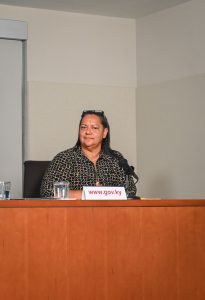
O’Connor-Connolly, who was also the education minister in the previous Progressives-led administration, said in her Anti-Bullying Month message that in November 2020, the Education Council approved the National Anti-Bullying Policy for students.
“The policy sets out schools’ responsibilities to counter bullying, establish consistent expectations and promote an understanding of all bullying-related issues. Since its introduction, all of our government schools and more than 70 per cent of independent educational institutions have used this critical document as a framework for developing their own anti-bullying policies,” she explained in her message.
She said there is governmental commitment to amend the Education Act, 2016, to include the National Anti-Bullying Policy and develop Anti-Bullying (Schools) Regulations.
However, no timeline has been given to make this happen.
In a further statement to the Compass, the Education Ministry stated, it “is working along with the relevant parties to advance the amendment of the Education Law, 2016 to include the National Anti-bullying Policy and develop the Anti-bullying (Schools) Regulations as soon as possible”.
José S. Griffith, director of the Cayman Islands Law Reform Commission, told the Compass that the final report from the commission’s ‘Bullying: Legislation, Policy or Both?’ exercise contained a draft Education (Amendment) Bill, 2020 and a draft Anti-Bullying (Schools) Regulations, 2020.
“Both… propose legislative measures to respond to the issues that touch and concern the incidence of bullying in all schools. The Commission is now functus officio (an official whose duty has expired) in this matter,” he said via an emailed statement.
He said it is now under the education ministry’s purview.
National Anti-Bullying Policy for schools
– All government, assisted and independent schools must have an anti-bullying policy
– All students and parents must feel supported when bullying is reported
– Must state that bullying will not be tolerated, in any school or other educational establishment
As for Sinclair Young, she said she has no hope that this will come to fruition.
“In this day and age where bullying is so prevalent and children are taking their own lives, I just can’t fathom why it’s taking the government so long to do something to protect our children. Why hasn’t anti-bullying legislation been made a priority?” she said.
Sinclair Young, whose son suffered physical abuse at the hands of bullies, said when the law changes come to fruition she would like to see teachers and heads of schools being held accountable.
“If bullying is not reported or addressed effectively, I would like to see consequences for the perpetrators and their parents… some type of fine or community service. I have realised if there are no consequences for this behaviour it will continue, because the perpetrators continue to get away with bad behaviour. This is why anti-bullying legislation is so important, and teachers and heads of school should not get to decide whether a law is passed or not,” she added.
The Law Commission’s report recommended school administrators and staff be fined $3,000 for failing to implement those provisions. Parents and students who do not abide by the law can be fined $1,000.
Efforts continue
Family Resource Centre staff continue to champion efforts to address bullying and provide support to affected families.

Charmaine Miller, FRC clinical supervisor, told the Compass the centre’s Stood Up campaign focusses on raising awareness and educating the public on bullying behaviour and how to stand up to bullying safely.
The campaign, she said, also stresses “the importance of just opening the dialogue around recognising the signs, and how to respond to it safely, whether it is in the workplace or in the school setting as well as just amongst one another, recognising that bullying is something that is not okay.
“It’s an intentional threat or behaviour where there’s an imbalance of power and control that obviously is negatively affecting somebody,” she added.
Based on previous conversations with parents, Sinclair Young said children do not want to speak about their experience with bullying publicly because of fear of being labelled.
“Even adults tend to label children as weak, or tell them that bullying is a part of growing up, it toughens your character, which is completely incorrect – not when you see the long-term effects this behaviour can have on children, that way of thinking is completely ludicrous,” she said.
“According to research, children who display the bullying behaviour at school are also the ones who are perpetrators of cyberbullying. The fact that you can hide your identity by posting things anonymously makes them feel untouchable, hence cyberbullying is on the rise,” she added.
Sinclair Young said getting this behaviour in schools “under control rests on the shoulders of the powers that be”.
She urged parents to take an active role in recognising the signs of bullying, as well as talk to their children about bullying.
“Explain what bullying is… tell them bullying is unacceptable, and if they witness bullying or experience the behaviour they should report it to an adult. Parents should check in with their kids often, ask them how their day was, listen to them and get to know their friends. Check in with their teacher; if your child is complaining of a belly ache or not wanting to go to school, find out from a teacher what is happening,” she said.
Related Videos