

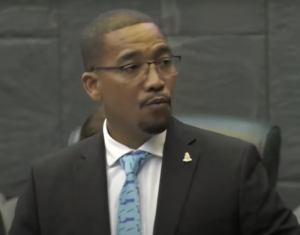
Tourism Minister Kenneth Bryan has urged companies in the tourism sector to hire Caymanians in what he called a “carrot approach” of collaboration.
Bryan cited a survey of more than 3,000 displaced tourism workers, which showed that about two-thirds had previously worked in stayover tourism and the remainder in the cruise sector.
All were ready to go back to work in the industry and available to fill vacant roles. Close to 700 had upskilled during the lockdown period by participating in one or more of the 50 training courses that government had offered, the tourism minister said during the budget debate in Parliament on Monday.
Government is paying a monthly stipend of $1,500 to hospitality workers who lost their jobs during the pandemic. This is costing the public purse about $5.5 million each month.
The primary reason for reopening Cayman’s borders at this time, Bryan said, was to bring back jobs and get Caymanians back to work in a safe manner.
“The objective is not to just reopen and kickstart tourism, but to safely remain open without having to lock down in a matter of weeks or months as other jurisdictions have had to do.”
That meant lateral flow tests will form an important part of overall safety protocols for the foreseeable future until the pandemic has been brought under control.
Fully vaccinated travellers coming to Cayman have to undergo lateral flow, also known as rapid antigen, tests on the second, fifth and 10th day of their trip.
He noted that the tourism sector has the potential to make a big difference in the lives of thousands of Caymanians.
‘Committed’ to jobs for Caymanians
“I’m also committed to transforming the face of our tourism industry and encouraging Caymanians to become more involved and invested in our tourism product and industry.”
Bryan said the ultimate goal of government is to see a substantially higher percentage of Caymanians included in the tourism workforce, where they are able to contribute to and benefit from the tourism industry.
Tourism surveys confirmed that the industry was lacking heavily in local participation. Because tourism was first and foremost about selling the Caymanian experience, “Who better to promote and deliver that experience than a Caymanian?” he asked.
The tourism minister expects that many of the displaced workers will be able to return to their old jobs.
“The way I see it, those who wish to return to their former employment should seamlessly be reabsorbed as long as the company is still trading in the Cayman Islands. They should have no reason not to rehire past employees.”
He said government now has the data and knows how many Caymanians worked in the industry before.
‘Stringent measures’
“If we find for some reason or another that they are not being absorbed back into the workforce or excuses are being made to justify work permits for jobs that we know Caymanians are available and qualified for, then stringent measures will have to be looked at to ensure that our people are given their rightful chance to be employed.”
Bryan said he trusts the private sector’s view would align with the government’s expectations in this regard. “Because my preference is to work collaboratively with all concerned. That is what you call the carrot approach.”
He said, “I hope that we will never have to go down that bumpy road with industry players, but if we find ourselves in that position, this administration will not shy away from doing what is right for our people.”
The 2022/23 budget will include $887,000 in funding for training programmes in the sector.
As a part of government’s efforts to ‘Caymanise’ the tourism sector, the Department of Tourism will expand the current national tourism education strategy and also promote greater Caymanian ownership of tourism-related businesses, the minister added.
Focus on quality and sustainability
Bryan said there would be a focus on quality over quantity in the tourism rebuilding phase.
During the record days of tourism with half a million stayover visitors and 2 million cruise tourist per year, overcrowding and a negative impact on the environment had already been visible, the tourism minister said.
“I’m not saying that growth is bad, but a high rate of growth over a short timeframe is simply not sustainable. Mass tourism levels put far too much pressure on our infrastructure and our natural attractions.”
This new focus will give Cayman the chance to “reimagine tourism under a far more sustainable model”.
Targeting more affluent visitors that will be part of that strategy also meant that investments in infrastructure, such as upgrades to the general aviation terminal, were needed.
The tourism department aims to attract about 40% of the 2019 tourist arrivals within the first 12 months of the border reopening. This would bring in about $15 million in tourism-related taxes.
Related Videos










The smartest Caymanians in the room always understood that when a door closes, two windows open later. They see a work permit holder come in and recognize within a year, that person’s toil will pay for 2 Caymanian’s to have an opportunities they would never have had without the permit holder first getting hired. That simple philosophy has made the Cayman miracle possible. Bermuda and Bahamas treat every job taken by a foreigner like a crime against their people to be corrected. Look where that greed has gotten those places. If you are greedy, you will be needy. Hard to believe how obvious and simple this is – yet we keep biasing to the same bahaviours.