The strong growth rebound since the economic crisis in 2020 prompted by the COVID-19 pandemic may soon moderate in several major economies, according to the latest OECD composite leading indicators (CLIs).
These cyclical indicators combine relevant factors for each economy, such as order books, confidence indicators, building permits, long-term interest rates, new car registrations and others, to anticipate fluctuations in economic activity over the next six to nine months.
In November and December of 2021, the CLIs indicated that many economies are approaching their post-pandemic growth peak, and some may have already passed it.
The moderation is mainly the result of persisting uncertainties around the impact of the Omicron COVID-19 variant on the economy. This has caused greater volatility among the components of the leading indicators, which are more of a directional indicator than a precise measure.
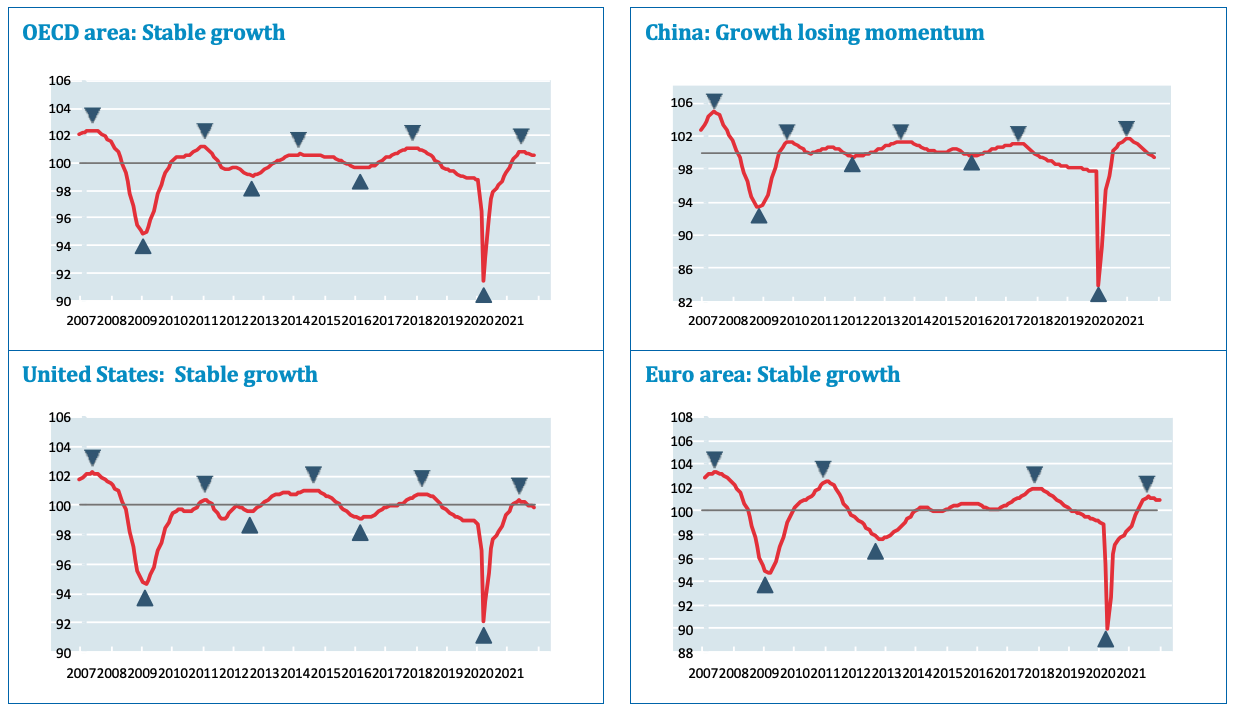 The latest CLIs for Canada, Germany, Italy and the United Kingdom all point to a drop in economic activity, while Japan and the Euro area may have passed the top level of activity, but the CLIs signal stable growth.
In the United States, the CLI also indicates stable growth, although the CLI level is now below its long-term trend. In France, stable growth around trend seems in prospect, the OECD reported.
Long-term indicators continue to rise in major emerging market economies, with stable growth in India.
However, in Russia, indications are growth is now moderating, and China’s economy is losing momentum.
Chinese gross domestic product growth reached its slowest pace at in 18 months of 4% year on year in the final quarter of 2021. This compares to 6.5% a year earlier.
In Brazil, expectations are for a sharp growth slowdown.
Related Videos