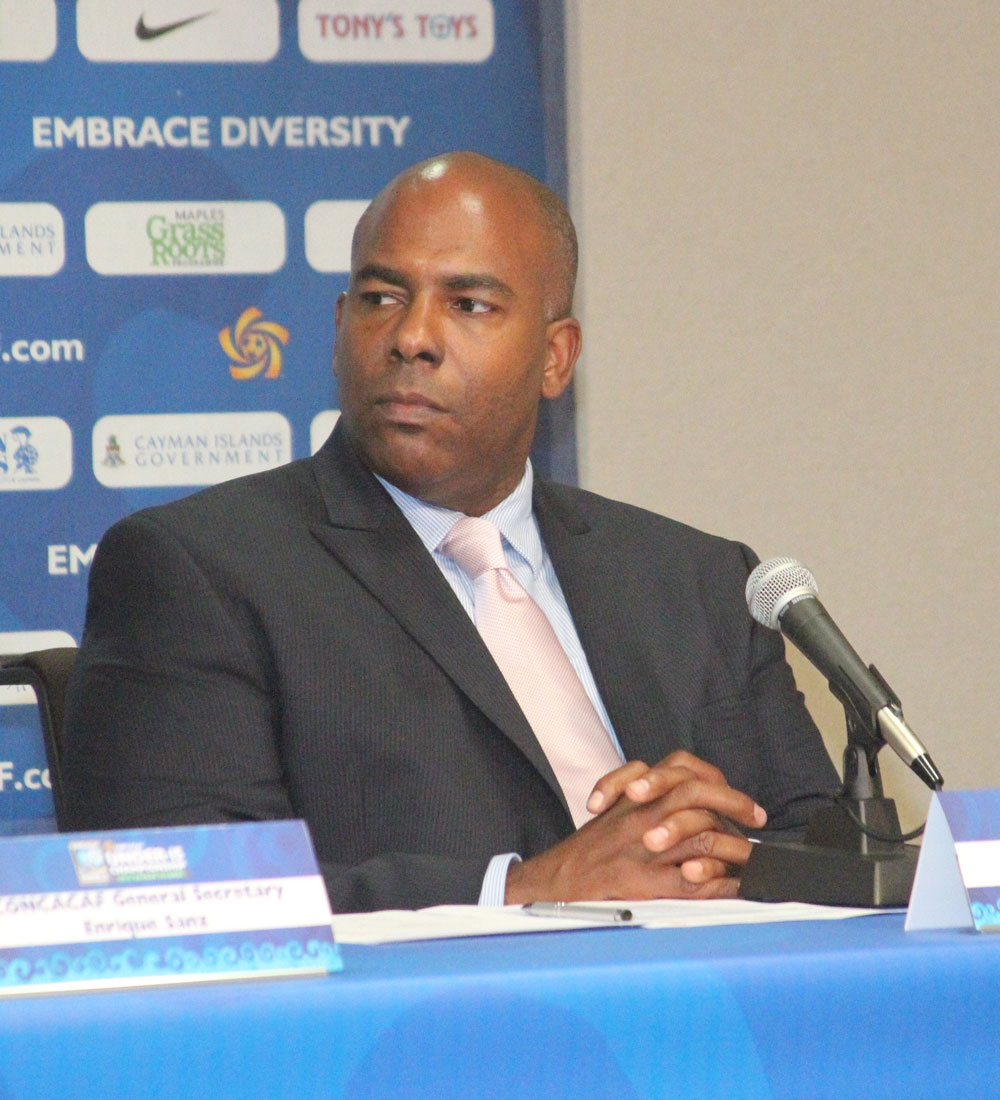
Former Cayman Islands Football Association executive Bruce Blake has concluded his four-day testimony in an ongoing fraud trial in which he denied money laundering-related and false accounting charges.
Blake took to the stand to go through examples of work he said he carried out on behalf of Canover Watson to justify why he issued invoices for US$140,000 for legal and consultancy services to Watson’s Panama company, Forward Sports International Management Inc.
The Crown accuses Watson of having used the company to issue false invoices worth US$1.54 million to football confederation CONCACAF for football equipment that was never delivered.
Blake is charged with helping Watson launder the allegedly stolen funds and making false statements to CIFA’s auditors about the origin of two US$600,000 sponsorship payments-turned loan agreements used to pay down a loan the football association had with Fidelity Bank.
Purported invoices for legal and consultancy work
Emails showed, and Watson testified, that he had relied on Blake for advice and to review and draft several contracts and agreements.
The court heard that Watson made two wire transfers for US$300,000 and US$200,000 from his Panama company to a Cayman National Bank account belonging to Blake’s Cayman company M-Management.
Blake told the jury that he first heard of an attempt by Watson to wire the money when Cayman National contacted him.
The bank refused to process the transactions without underlying documentation and reasons for the payments because the amounts significantly exceeded the account’s monthly throughput limit of CI$10,000.
The Crown asserts that Blake submitted false invoices and lied to the bank to have the funds released.
The documents submitted to the bank included Blake’s invoices for US$50,000, US$60,000 and US$30,000 purportedly for unspecified legal and accounting services and sales commission.
Blake claimed the references to sales commission were errors that must have been the result of him using a template.
Repeated error
The Crown showed that the alleged error was repeated multiple times in a second, different-looking invoice and in an email to Cayman National Bank.
In the email, Blake stated that he had a business relationship with Forward Sports in Pakistan through an affiliate in Panama and was engaged in helping the company sell sports equipment.
Blake said it was just a manner of speaking and he had not tried to mislead the bank, but admitted that it was “an error”.
He also forwarded to the bank an invoice Watson had sent him from Forward Sports in Pakistan to CONCACAF for US$375,000. In an email, Watson told Blake that the “other $125K” was for his legal and consulting fees.
Watson testified that the US$300,000 wire transfer was to be passed on from Blake’s account to Forward Sports in Pakistan for an equipment production order.
Watson said the detour was necessary because Panamanian banks refused to transact with Pakistan.
However, neither he nor Blake could explain why Watson could not simply transfer the money to his own bank account in Cayman or one of his own companies.
Alleged secret involvement
The Crown alleges that was because Watson wanted to keep his involvement with his Panama companies secret.
Cayman National Bank sent back the wire transfers but ultimately processed Blake’s invoices.
Blake said Watson had later told him that US$50,000 was sent to him in error and to forward it to Watson’s company TCB Construction, which Blake did.
Watson testified that Blake’s payment of CI$42,000 to TCB was for work on Blake’s land in Crystal Harbour, which Blake denied.
To support his invoices to the bank, Blake submitted a consultancy agreement with Forward Sports Inc in Panama to, as he said, formalise his relationship with the Forward Sports companies.
The agreement was signed by Shakeel Khawaja, a sales manager for Forward Sports in Pakistan, who told the court that he had never seen the agreement and never signed it.
Watson said he had inserted the signature, claiming he had Khawaja’s permission to do so as his business partner in charge of dealing with legal agreements.
Asked why he submitted a consultancy agreement for Forward Sports Inc, when he had done work for, and invoiced, Watson’s company Forward Sports International Management Inc, Blake said he believed the companies were connected.
Both defendants confirmed that no such agreement existed between M-Management and Forward Sports International Management.
Crown alleges bogus CIFA loans
Blake denied he was involved in the negotiations of two US$600,000 sponsorship payments to CIFA that were later converted into loans, even though he signed the loan agreements on behalf of the football association.
The payments, made in October and November of 2013, were each used a day after they were received by the association to pay down a loan with Fidelity Bank. That loan was ultimately personally guaranteed by then-CIFA treasurer Watson and CIFA and CONCACAF president Jeffrey Webb.
Sponsorship agreements drafted by Blake were never executed.
CIFA had presented the payments first as sponsorship and then as loans from football manufacturer Forward Sports in Pakistan and US travel company Cartan Global.
CIFA’s auditors, Rankin Berkower, reported the payments to the Anti-Corruption Commission after Cartan said it had paid the US$600,000 as a gift and Khawaja said Forward Sports had made no payment at all.
Watson told the court that both loans in fact came from his personal companies in Panama – Forward Sports International Management Inc and Cartan International Management Inc.
While he had first solicited the US$600,000 payment from Cartan in the US, Watson said, he decided to convert that payment into a loan when he learned on 27 Jan. 2014 that Cartan had applied the sum to his profit share in a Panamanian joint venture with Cartan.
Blake denied that an email he sent to Watson the following day, 28 Jan. 2014, under the subject line ‘loan agreement template’ was related to the loan agreements drafted by Watson for the Cartan and Forward Sports loans to CIFA.
Blake claimed he signed the agreements some time in December 2013 or January 2014.
Watson said Blake signed the agreements in February 2014. Both loan agreements were backdated to 31 Dec. 2013, when the prosecution says no loans were even contemplated.
‘Non-existent’ originals
Watson told the jury he recreated the original loan agreements for the purposes of the CIFA audit in August 2014 by inserting the signatures of Blake and a Panamanian nominee director, because he did not have access to originals.
The Crown alleges those originals never existed and Watson and Blake later “cooked up” fake loan agreements to deceive the auditors about the provenance of the funds.
Crown Counsel Eloise Marshall questioned what Blake’s reaction had been when he learned that US$1.2 million of “free money” had suddenly turned into a replacement loan for CIFA.
Blake responded it was simply what “the parties decided” and he told Watson that he just wanted it to be properly documented. He claimed that it was still a good deal for CIFA because the loan terms were better than those of the Fidelity loan.
Blake said while he knew that Watson had a relationship with both companies, he did not know that he was the sole beneficial owner and had trusted him.
The prosecution pointed out that Blake was one of the parties involved, having signed the agreements on behalf of CIFA. He had also never done any due diligence or contacted the lender companies when CIFA made no repayments on the purported loans.
“You were coming up with ideas, you and Mr. Watson, of how to get this money out of Panama into CIFA and pay down the loan. Yes? And the best way to do it for your benefit and Mr. Watson’s is to make it not sponsorship which you can’t get back but a loan,” Marshall said.
Related Videos