Updated estimates of global cross-border investment holdings show a growing exposure of investors in developed countries to China, often using investment structures offshore.
The Global Capital Allocation Project at Stanford, Columbia and the University of Chicago highlights in a research brief that 11% of the US external portfolio of stocks and bonds is invested in China.
These investments are made predominantly through offshore vehicles in the Cayman Islands.
The researchers said their estimates for the years 2018 to 2020 were based on the unwinding of positions “in tax havens that otherwise obfuscate the true underlying economic relationships”.
Corporations often raise capital, especially from foreign investors, through subsidiaries in financial centres such as the Cayman Islands, Bermuda and Ireland.
While the investments are channelled through offshore structures to other countries, official statistics typically count them as liabilities of financial centres to the rest of the world, giving the impression that the capital was in fact used there.
Based on their updates of the scale of these financing operations and the types of investors buying offshore assets, “exposure to China is much larger than commonly understood”, the research project said.
The direct holdings of securities issued in China are comparatively small compared to indirect holdings through investments offshore.
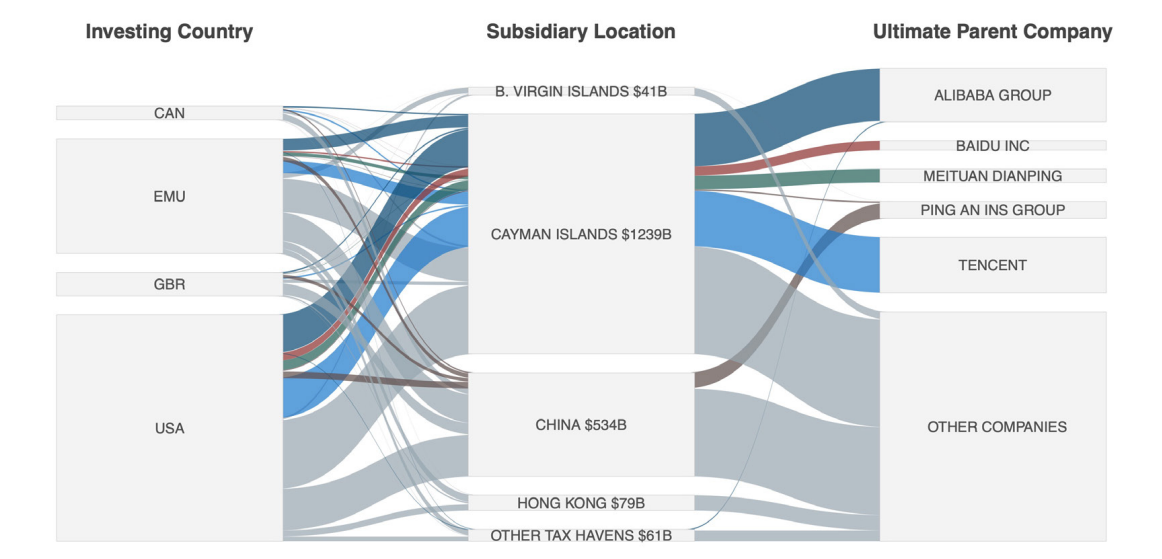 The research lab estimates that almost $1.24 trillion is invested in Chinese companies via their subsidiaries in the Cayman Islands.
This compares to only $534 billion invested directly in China, leading the researchers to conclude that “The Cayman Islands play a major role in this flow of capital from western investors to Chinese corporations”.
About half of the investment flows to China through Cayman have gone to larger corporations like Alibaba, Tencent or Baidu, which all have issued equity via a Cayman company.
Even though the researchers repeat the term “tax haven” in association with these financing operations, they acknowledge that Chinese offshore affiliates are not used for tax reasons but to avoid China’s restrictions on raising capital from foreign investors.
“These so-called variable interest entity (VIE) structures have grown enormously in size and present specific risks for investors. These unconventional corporate structures have recently been under scrutiny by the US Securities and Exchange Commission,” the note said.
Variable interest entities (VIEs) are widely used by Chinese tech companies since the year 2000 to avoid local regulations preventing foreign capital investments in companies engaged in key industries like telecommunications or media.
In this structure, the offshore entity is owned by investors in the US or Hong Kong stock markets, where the company is listed. Because the offshore entity only has a contractual relationship with the Chinese parent company, rather than one based on ownership, the structure has unique investment risks.
“The sums involved, the involvement of retail investors and mutual funds, and the shaky shareholder rights these structures imply, clearly point to a need for regulation,” the researchers said, according to Bloomberg.
Steve McIntosh, CEO of Cayman Finance, commented that the researchers appear to have discovered something that will come as a surprise to almost no one else: That investment funds and financing vehicles, some of which are domiciled in Cayman, raise capital that is invested in companies around the world, including China.
“Investing directly into developing countries like China can be very risky for international investors unfamiliar with the jurisdiction. Sophisticated investors prefer to invest through the Cayman Islands because our legal and regulatory regimes and world-class service providers help mitigate the risk,” McIntosh said.
“To suggest that anyone would be better off if only more companies invested directly into China, or if investors were not free to decide for themselves where to invest, is frankly absurd.”
EDITOR’S NOTE: The article was amended to include the comment by Cayman Finance
Related Videos