


Cayman Brac residents Leanna Jackson and Evol Miller are being hailed as heroes after they rescued three Cuban refugees floating on debris in the open ocean off Cayman Brac.
Two of the missing men were found more than 30 miles off the Sister Islands, severely dehydrated and clinging to life. They are believed to have been in the water for more than 24 hours.
The couple answered a call for help from another Cuban refugee who raised the alarm after swimming more than 30 miles through the night on Saturday to reach Cayman Brac.
The man, who was found ashore in Spot Bay on the north-easterly tip of Cayman Brac around 7am, reported that his makeshift vessel had broken apart two days into an open ocean crossing from Cuba.
He indicated that nine other passengers were in the water and believed to have drowned.
His pleas for help resulted in a search and rescue operation being launched with the scrambling of both police helicopters and multiple boats from the Coast Guard and fire services, with the assistance of Customs and Border Control.
Despite the inbound help from Grand Cayman, the race against the clock meant the first round of help could only come from the residents of Cayman Brac.
In a series of events akin to Cayman’s legendary tale of The Wreck of the Ten Sail – in which islanders took to the high seas risking life and limb to help distressed strangers – Jackson, Miller and the wider community of fishermen as well as private boat owners on Cayman Brac answered the call for help.
Ultimately eight out of the ten Cubans said to have been on board the craft were located and rescued. Two were still missing, feared lost at sea, Sunday night.
“While we were working on our boat out by Scotts Dock, one of the immigration officers who we are friends with told us about the Cubans and asked if we mind helping,” Jackson told the Cayman Compass.
She added, “We said yes because that’s who we are. We could never see someone in need of help and not assist, if it is in our power to do so.”
Found ‘clinging to life’
In a matter of minutes Jackson, 32, and her partner Miller, 26, went home and returned with their three-seater jet ski and set out in search of the missing men.
Miller, who is not a man of many words, is an avid fisherman who knows Cayman Brac’s waters like the back of his hand. This was not his first rescue.
“I once helped to rescue some friends who had engine troubles about 80 miles offshore down by Pickle Bank,” he said.
With his in-depth knowledge of Cayman Brac’s waterways, it wasn’t long before they found the first two men 35 miles offshore.
“We were out for about 30 minutes when we saw them clinging to life on a piece of styrofoam, which they had tied together after their boat broke apart,” said Jackson. “It wasn’t big enough to hold them both, so they were taking turns. One person was resting on it while the other person was dangling nearby holding on to it.”
She says the men were visibly dehydrated, exhausted, and could only get a few words out.
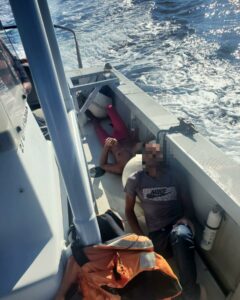
“I speak a little Spanish, and I’m not entirely sure but they said they had left Cuba about three days ago, and on the second night the boat started to give them trouble and broke apart,” she said.
Having loaded one person onto the spare seat, while the second sat on the back steps, Miller and Jackson headed back to land.
“We handed them over to the officers who started to take care of them, and then we went back out,” she said.
Fifteen minutes later, this time halfway between Little Cayman and Cayman Brac, they found a third person, who was also clinging to a piece of styrofoam.
“When we found him, he was pouring water all over himself to cool down, so we got him loaded on and took him back,” said Jackson.
When they returned, the fire department had launched its boat, and both police helicopters were scouring the horizon.
“We figured we had done our part, so we left it to the officers and went home,” she said.
During the course of the day, the search and rescue team would go on to find another three persons in the waters off Cayman Brac and Little Cayman, with the assistance of private boat owners.
The eighth refugee was found on land in Cayman Brac and also taken into custody and given medical treatment.
Two others, said to have been on board the stricken craft, had not been found Sunday night and are believed to have drowned.
An update for the Coast Guard service indicated that no further survivors were found Sunday and the continued operation was now considered a ‘search and recovery’ exercise, based on the amount of time the missing individuals had been in the water.
To help or not to help
International conventions to which the Cayman Islands are a party, via the UK, and an undisclosed Memorandum of Understanding between the Cayman and Cuban governments limit the amount of help Cuban refugees can receive in Cayman’s waters.
As covered in the Cuban-Cayman Connection series, there is a multitude of reasons which compel Cuban nationals to flee their homeland in droves on a cross-Caribbean journey to Central America, where they embark on a deadly and arduous trek through jungles and deserts to the US-Mexico border at a cost of up to US$15,000 per person.
In that mammoth journey, the Cayman Islands is a convenient stopover for hundreds of refugees.
In instances where a Cuban refugee arrives in Cayman’s waters but remains in their vessel, they are free to leave after resting up, provided that CBC officials are confident their boat can make the open water journey safely.
In cases where the boat is deemed unfit for travel, and/or where a person deboards the boat and officially lands in Cayman, they are then taken into custody and processed in accordance with Cayman’s immigration laws.
Revised laws have given the CBC director and a designated officer stronger powers of discretion when deciding whether a Cuban refugee is a genuine asylum seeker fearing political persecution or life-threatening danger, or an economic refugee case seeking to circumvent the immigration system for financial gain.
In the current case, it’s difficult to say whether the men intended to bypass Cayman, or if it was an inevitable case of illegal immigration. But the circumstances were such that sanctioned help was needed.
“People are people, and yes as an employer of a person on a work permit I understand that there is a right way for people to enter the country,” said Jackson.
She added, “I’m not going to give the men [a] car and say ‘make your getaway’, but at the same time we couldn’t not help, and we are glad we did.
“Given the chance we would do it again.”
Related Videos








Thank you Ms. Jackson and Mr. Miller for your “brave heart” in rescuing these perishing Freedom Seekers for certain death at sea. May God bless you, and all other such volunteers, with many years of good Health and Prosperity. You are “Good Samaritans”, and the entire community appreciates your quick action and dedication.