


Of all the issues plaguing the Cayman Islands, former Police Commissioner Derek Byrne said he was most worried about a “disproportionate” level of sexual offences, specifically against children.
Byrne’s parting words of concern are borne out by the latest data, which show more sexual offences are being detected and prosecuted with each passing year. But he suspects that for every successful detection and prosecution, several more offences go unreported for a multitude of reasons.
Women who say they are sexual assault victims but have chosen not to report their cases, told the Compass they don’t believe Cayman “as a society is truly ready to tackle this issue”.
Like the wider world, it is thought that the vast majority of sexual offences are underreported. Child-safeguarding experts believe that to get more people to come forward, Cayman needs a national rethink and to reprioritise how to protect children.
The recurring nightmare of a ‘helpless child’
“There are two nightmares that plague me most nights; the first is when I was raped by my uncle at the age of 14, and the second is when I did a self-abortion at home two months later after I found out I was pregnant with his child,” said one woman, whose identity the Compass is not releasing.
“Some nights it’s just one long horrible dream that I’m trapped in, and when I do wake up I’m shaking and drenched in sweat,” she said, pausing as if reliving the ordeal.
“When it happened, it felt like my whole world was crashing down around me and inside me,” she said. “I kept thinking, ‘Why is this happening to me, what did I do wrong and how can I make it stop?’ But there was nothing I could have done. I was just a helpless young child.”
Now 21, she said she still feels like that “helpless young child” incapable of speaking up and equally unable to forgive, forget or move on.
“It’s been so long now that I’m afraid no one would believe me if I said something, and if I do say something, my family will fall apart,” she said. “I don’t get along with them anymore. Don’t get me wrong, I love them, but they love him, and this would just hurt everyone and what good is that?”
She added, “What if I reported it and he gets found not guilty, then I would be made to look like the liar and have to deal with that as well.”
She told the Compass that she learned about the abortion pills from her older cousin, who was raped by a family friend at the age of 16. Her cousin became pregnant and decided not to report the matter – choosing instead to self-abort.
As previously documented by the Compass, a highly efficient, expensive black market for abortion pills exists in Cayman. The legislation in Florida banning abortions after 15 weeks – and the possible enacting of a more-restrictive six-week cutoff – has resulted in the demand for the pills to increase significantly, and makes it more difficult for women in Cayman to travel to that state to get an abortion.
“I get a call almost every week, sometimes it’s from cheating partners who don’t want to get caught, or young girls who are afraid their lives will be ruined. But a lot of times it’s also young girls who were assaulted and can’t handle the fuss of telling the family or going to police,” said a supplier, whose identity the Compass is also not releasing.
The supplier, who says she is a victim herself, said she also didn’t report her assault. She told the Compass she got into the illegal pharmaceutical market to help victims without causing more emotional anguish.
She is one of numerous illegal pill providers, who, she says tell similar stories.
Statistics don’t paint accurate picture
Cases of minors being sexually assaulted are abundant, and feature a variety of assailants who have committed those unspeakable acts.
One only needs to take a cursory glance at court records or the Compass archives to find stories of children being raped or molested by their fathers, grandfathers and extended family members, as well as neighbours, teachers, coaches, home repairmen, fast-food workers… the list is seemingly endless.
But despite the well-documented cases of sexual abuse, there is no way to know the true prevalence of these offences against minors.
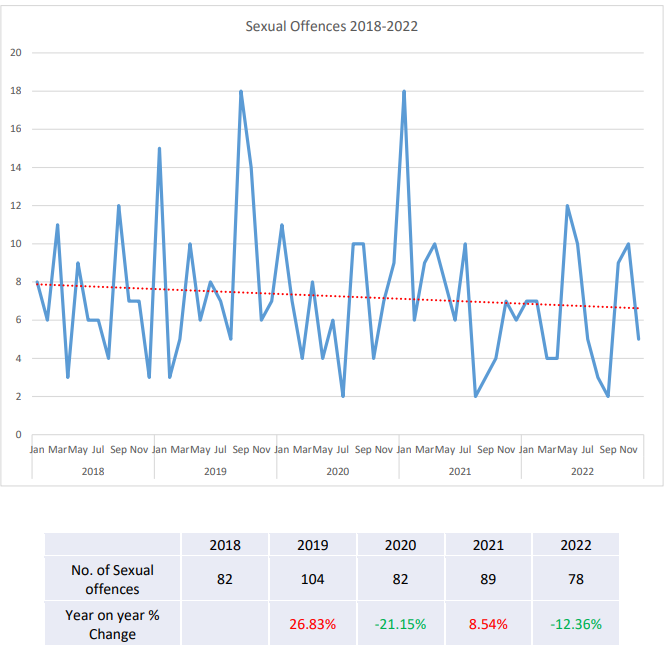
According to the RCIPS from 2018 to 2022 there were 435 reported serious sexual offences, of which there were 71 reported cases of rape. The 104 reported sexual offences in 2019 represented the highest number over those five years, while in 2022 there were 19 reported rapes, the highest over that time period.
However, 2023 will likely shatter those numbers as the Compass understands that between January and June, 157 sexual offences were reported.
The RCIPS statistics do not reveal how many of the reported sexual assaults were against minors, but the numbers show an overall increase in that type of offending.
“I have concerns about the number of sexual crimes that are on island that involve children,” said Byrne. “I have to say I’m really concerned about the level of it. It seems disproportionate to me, the whole issue.”
According to the World Health Organization, one in five women and one in 13 men report having been sexually abused below the aged of 17 – comparable national statistics from a regulating health body are not available in Cayman.
However, the National Drug Council, through its biannual Cayman Islands Student Drug Use Survey, states that “significantly more girls reported sexual abuse than boys” in 2022.
According to the NDC, 3,608 students from 19 government and private schools in Years 7 to 13 participated in the survey. Of that number, 1,934 students (989 girls and 929 boys) in Years 9 to 13 participated in an Adverse Childhood Experience survey which featured questions about sexual abuse.
Results from the survey show that approximately 13.4% of girls and 4.3% of boys reported sexual abuse.
It is not clear if any of the cases contained in the NDC report were acted upon.
While the survey is not scientific, the NDC states that it adheres to best practices used in public health research by utilising validated scales and tools, and its results place Cayman worse than the global average of 11% for girls, but slightly better than the 5% for boys.
Rethinking child safeguarding
In 2017, the RCIPS rethought child safeguarding and introduced the Multi-Agency Safeguarding Hub, following the mishandling of a number of earlier child abuse cases. Since then, there have been numerous successful prosecutions for sexual abuse of minors and adults.
But the MASH unit can only investigate the matters that are presented to it, a limitation that Dr. Shreya Nauhria, the Cayman Islands Red Cross child protection manager, believes can be addressed with a combined approach from parents, guardians and other childcare providers.
“That list doesn’t just end there, the responsibility to protect children and the wider community from sexual abuse is shared by everyone,” said Nauhria, the mother of a 7-year-old boy, who gave up practising as a dentist to tend to her son who is developmentally delayed.
That path eventually led her to volunteer with the Alex Panton Foundation, and then take on her role with the Red Cross, where she was able to rid herself of common misconceptions.
“You might think, [because you] work in a law firm, or an accounting firm, or even a construction site and that because these jobs don’t typically place its workers in contact with children, child safeguarding is not a matter for this business,” said Nauhria.
“But you would be wrong to think so. These employees, outside of their job, are inevitably going to come across children, and if they are trained about the warning signs then they will be able to speak up. The benefit to the wider society is with the future generation of workers who will one day fill the jobs at these same companies.”
‘Public health issue’
Nauhria provides free Darkness to Light training through the Red Cross. She said the programme, which originated in the US, is now in global demand as an effective tool to help train people on how to safeguard children.
“Safeguarding children isn’t a parental issue, it isn’t a society or community issue, it’s a public health issue and until we start thinking about it in that light, we will never be able to break down the stigmas and stereotypes that make coming forward so difficult for many victims, young or old, women or men.”
Nauhria’s take is novel for Cayman. She suggests that the community views the threat of child sexual abuse, and overall abuse, as similar to that posed by COVID.
“When COVID first arrived, everyone was afraid and unsure of what to do. This is like the case [for] many victims, who are initially shocked and often shut down in fear,” she said.
“But after the community got over the initial shock of COVID, there were laws passed when the government stepped in and tried to help the people get through [it]. We have also passed that stage as well [for child sexual abuse].”
She added, “There is a national minimum standard that you will see in all government schools, and programmes that must deal with child care such as summer camps, even after-school programmes. Thanks to the Department of Education Services this is also a requirement for all private schools; however, the government schools are often more thorough.”
Nauhria believes that Cayman’s victory against COVID-19 was made possible when the business community rallied alongside the government – each introducing its own COVID-19 policy in line with Public Health recommendations.
“Now imagine if every company in Cayman had a child safeguarding policy, that required all their staff to get trained in a course like Darkness to Light,” she said, noting that would provide the necessary tools for many more parents and the wider community.
“So, if they see something they could say something,” she added.
Such a suggestion is feasible but, absent legislation from Parliament, would require the support of the business community. Unfortunately, though, sexual offences against minors won’t pause while laws and policies catch up.
Therefore, Nauhria believes for now parents must take protection into their own hands.
“Activities need to be observable and interruptible,” she said. “Yes, as children they need to learn about having privacy, but as a parent, you are responsible for others who come into their environment.”
Editor’s Note: For more information about the Darkness to Light programme, email the Cayman Islands Red Cross at [email protected] or call 949-6785.
Related Videos











Is it not true that many cases involving family members are not reported for fear of bringing shame on the families involved?.