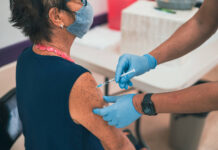
The Public Health Department says it is monitoring an increase in respiratory illnesses in the Cayman Islands.
In a statement issued on Friday, 22 Dec., the department said health agencies in the region were reporting increasing circulation of influenza and COVID-19.
Chief Medical Officer Dr. Nick Gent said the Ministry of Health and Wellness is keeping an eye on developments relating to COVID-19, after the World Health Organisation on 19 Dec. classified the new JN.1 strain of COVID as a “variant of interest”. JN.1 is a subvariant of Omicron.
He said, in relation to JN.1, there was “nothing to be particularly worried about at this stage, and our aim is to inform the public and remind them to continue to adhere to the best practices that we learned during the height of pandemic”.
Along with being monitored due to its parent lineage of BA.2.86 – another COVID-19 variant of interest – JN.1 is being given special attention due to the increasing transmission compared to other strains.
“JN.1 has an additional mutation in the spike protein compared to BA.2.86, it has been identified in 41 countries so far, and is becoming one of the most commonly detected variants in the United States,” Cayman’s national epidemiologist Rachel Corbett said in the statement.
“There is no evidence that this strain results in more severe disease. Current vaccines are expected to be effective against JN.1 and the public health risk is considered low,” she added.
The statement noted that the Ministry of Health and Wellness expects that respiratory illnesses will continue to increase over the course of the holiday season and in January due to travel, the influx of arrivals on island, and an increase in the number and size of gatherings.
There is currently no COVID-19 vaccines available on island. Public Health said it would inform the public when those vaccines become available.
Flu vaccines
Meanwhile, the Public Health Department is encouraging vulnerable groups to get vaccinated against influenza, and to take measures to protect themselves and others from infections.
Free flu vaccines are available at district health centres throughout Cayman.
On Wednesday, Thursday and Friday, 27-29 Dec., people can avail of the vaccines at the health centres from 2pm to 4pm. Vaccines will also be available for free on Saturday, 23 Dec., at at Cost U Less, from 1pm to 5:30pm, and on Friday, 29 Dec., at Foster’s Republix in West Bay from 5pm to 9pm.
Below is the remaining schedule for December (click to enlarge).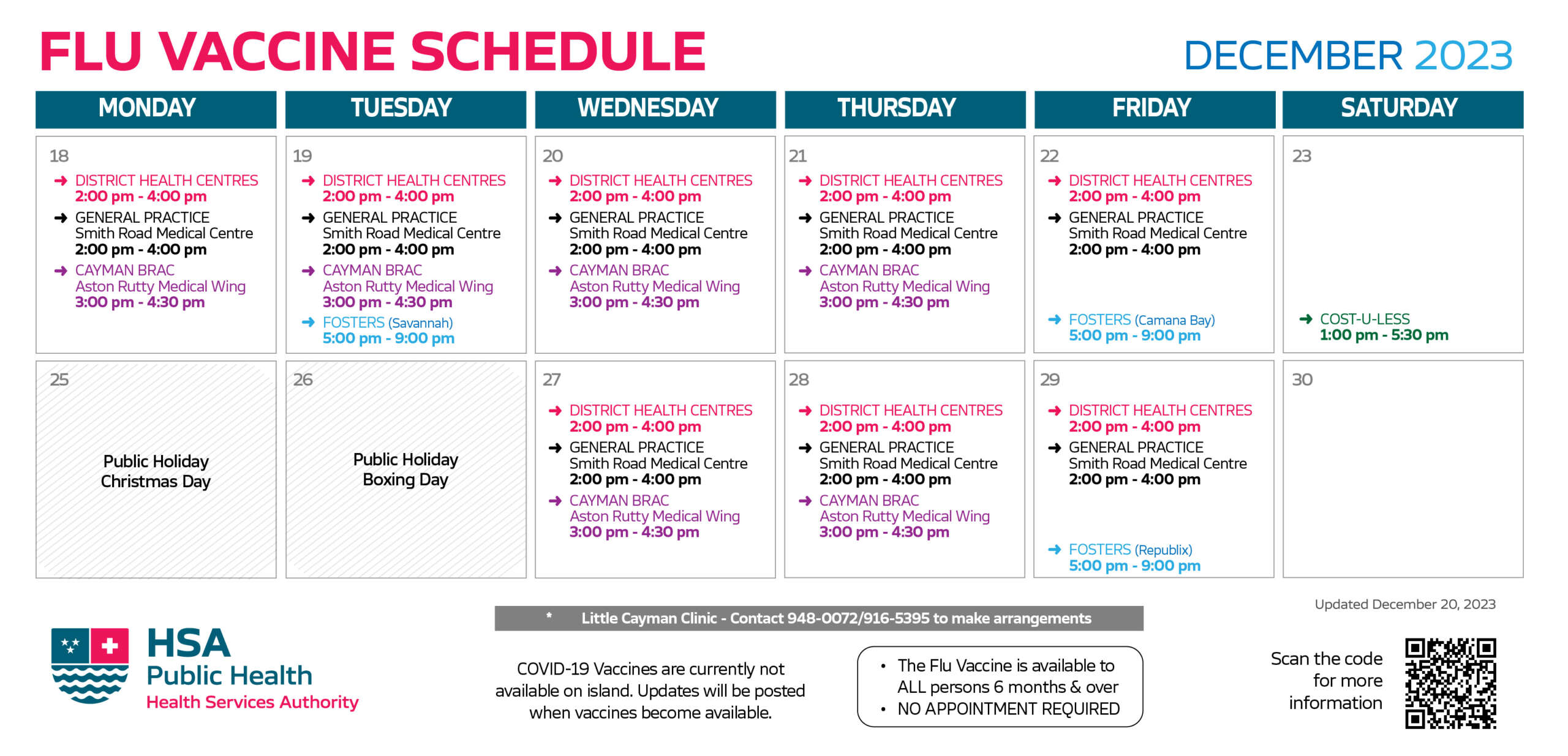 In the New Year, flu shots will be available at all district health centres Monday to Friday from 2pm to 4pm.
Dengue
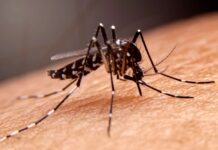
The Public Health Department says it is also continuing to monitor dengue cases locally.
As of 18 Dec., the department had investigated 169 reports of dengue fever, and 35 of those cases had been confirmed. Of the confirmed cases, 23 had been acquired locally and 12 were imported cases.
The department encouraged residents to “take personal responsibility in helping to mitigate the impact in the community” by preventing and protecting against further spread of the mosquito-borne disease.
“It is important that we ensure our surroundings are clean and free of mosquito breeding sites,” Therese Prehay, health promotion officer at Public Health, said in the statement. “Everyone should take it upon themselves to empty, dispose of, or cover any receptacles or containers capable of storing even small amounts of water. This includes used tyres, water storage drums, flowerpots, and tanks, as these are ideal breeding sites for mosquitoes.
“Therefore, these key actions will help prevent mosquitoes breeding, thereby keeping yourself, your families and your community safe.”
The Public Health Department stated that, in the coming weeks, it would be working with communities to mobilise persons to help prevent mosquito-breeding sites in and around homes.
The department issued the following advisory:
For high risk individuals, which includes infants and young children, people who are 65 years and older, pregnant women and those with certain underlying chronic conditions, vaccination is the best defence in the prevention of influenza and COVID-19.
However, people should also practise everyday preventive measures, including covering your coughs and sneezes, staying away from individuals who are ill, and partaking in frequent hand washing or using alcohol gels. People may also choose to wear a well-fitting mask as an added precaution.
Practise respiratory hygiene (cover mouth/nose when coughing/sneezing, use masks when appropriate, use tissues and dispose of them properly, wash/sanitise hands before/after touching mouth/nose).
General advice on respiratory illness
Respiratory infections affect everyone in different ways. Your symptoms may be minor, while another person may need immediate medical treatment. The common signs of a respiratory infection include:
- Chest or nasal congestion
- Wet or dry cough
- Runny nose
- Fatigue
- Body aches
- Low-grade fever
- Sore throat
General advice for COVID-19:
Remain at home if symptomatic (having or showing symptoms of fever), coughing, running nose, muscle aches, chills).
Return to work after being symptom free for a minimum of 24 hours (if having a fever, 24 hours from when the fever breaks).
Related Videos