


By Simon Cawdery, Compass Columnist

Cayman markets itself as an international financial centre, a vibrant economic hub and a luxury tourism destination, where people live, work and vacation in peace and safety. Indeed, Cayman’s tourism slogan is ‘Caymankind’.
On the face of it, this seems inherently true. Tourists and business people often respond, when asked, that they feel safer in Cayman compared to other destinations. The majority of people who live and work here rarely experience crime or danger.
Perfection in paradise, then?
Unfortunately, the raw data tells a less favourable story. Cayman is, for most, a tranquil and serene destination. Yet Cayman also has an underbelly of issues that are perhaps not-often-enough exposed, discussed or resolved.
Take a simple statistic: How many murders did Cayman have in 2022? According to the RCIPS Annual Crime and Traffic Statistical Report for that year, there were four. To determine whether this is a big or small number, we need some context: Let’s compare Cayman’s murder rate (the number of murders per 100,000 people) with that of other, selected countries.
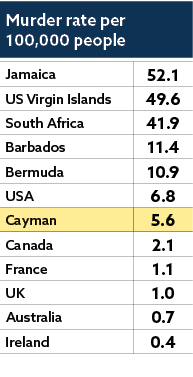 As the above table shows, when we ‘standardise’ the data to make it comparable, the reality is that Cayman’s numbers look less impressive. It is true that these numbers are low relative to its neighbours and arguable peers (such as Bermuda and Barbados) from a tourism perspective. But should Cayman be satisfied with a murder rate just below the US?
Wouldn’t a better goal for Cayman be to seek to replicate the rates of other countries, such as Canada, the UK, Australia or Ireland, and not be satisfied with US-comparable murder rates? The US is, after all, unique amongst rich countries in having high levels of violent crime. Other countries (rich and poor) have substantially lower rates of murders.
It isn’t just murders where Cayman has problems. Our second data point hints at the underlying problem. Firearm crime in Cayman (meaning incidents where crimes are committed, and firearms are involved) is very high.
Looking at the data from Cayman (the RCIPS’s aforementioned report) and the UK (the Office of National Statistics), in 2022 Cayman had 58 firearms-enabled crimes committed. That is to say that 58 crimes occurred where firearms were used (such as, for instance, murder, robbery or assault). Standardised, that is approximately 81 per 100,000 people. In the UK, the number of firearms crimes was 5,750. That, standardised, equals 10 per 100,000 people.
Just pause for a moment to compare those two numbers. The UK has eight times fewer firearms offences than Cayman per 100,000 people. That’s a truly remarkable difference for two countries with similar policing and criminal-justice styles. The only logical reason I can think of, is that there must be many more guns in the Cayman Islands than in the UK, on a standardised basis. Of course, getting an accurate estimate on the number of illegal guns is clearly difficult (illegal guns are not, after all, easy to count), so some assumptions are inevitable in this regard.
The reasons
The data paints a bleak picture. What we think of as a peaceful island in the Caribbean Sea actually, in aggregate, more closely resembles the US for its dangerous-crime levels. There will be many readers of this article who will say they have never witnessed crime or criminal activity and definitely nothing involving violence or firearms. The simple reality is that Cayman’s crime generally occurs out of view of the affluence of Seven Mile Beach or the gated communities of the canal fronts. But out of view, and perhaps out of mind for some, doesn’t make it any less undesirable for those it affects or for what it does to businesses and people affected.
A common response to undesirable crime levels is to call for more police officers and more funding. But, as evidenced in a prior article on education spending in Cayman, more money doesn’t always equal better outcomes. ‘More funding and more police’ is a refrain issued by legislators across the world of all political stripes. Interestingly though, in Cayman, the level of police officers is already unusually high.
Any country-based police force needs a certain hierarchy in place, and that same hierarchy will require staffing which takes away from front-line policing. Therefore, when we compare Cayman’s police levels per 100,000 with the UK, the numbers are inevitably going to be distorted by the need to staff that structure. It’s not possible from the data to disentangle those items and thus it is important to review the data through a nuanced lens and with this perspective in mind.
All that having been said, the actual numbers are still rather stark, as shown in the table below:
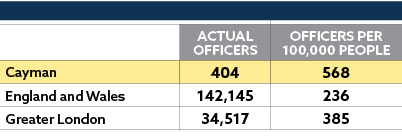
The Greater London number is rather interesting because of the unique responsibilities faced. It arguably makes a better comparison than the broader UK as it addresses the reasonable complaint that a small island (as explained) needs to have many services staffed. The police force in Greater London, unlike in rural towns, has to deal with embassies, public protests, national monuments, public officials, counter terrorism, and other specialised matters. The data shows that Greater London has a greater ratio of police to population than the rest of the UK (which intuitively makes sense). Thus, comparing Cayman to Greater London is more reasonable than comparing it to England and Wales in aggregate.
Whilst data such as this, for the reasons given, is fraught with complexity, what the data doesn’t show is that Cayman lacks police resources. Its ratio of 568 per 100,000 people is almost 50% higher per person than the Greater London police force. It may be the case that resourcing is too low. The raw data, however, doesn’t unambiguously lean that way. Rather, the data indicates that Cayman has reasonably high levels of resources for its population.
What, then, might be the problem?
Given that Cayman has a firearms-crime problem, this intuitively means that Cayman must have an illegal-guns problem. Too many illegal guns are in Cayman, too many illegal guns are coming to Cayman, and too many illegal guns are being used in criminal activity. Yet, Cayman’s firearms laws are draconian. If you are caught with a gun or ammunition, it’s a mandatory prison sentence. Clearly, though, that’s not stopping the criminal activity. If it were, simply put, we would have fewer gun crimes.
This logically means that Cayman is likely failing to stem the flow of guns into the jurisdiction. According to the RCIPS report on crime, the majority of violent, firearms-related crime is to do with gang- and drug-related activity. This article is not the place to discuss drug policy per se, but if the RCIPS report’s conclusions are correct, then logically a policy or an approach that provides enhanced monitoring of drug routes and gun-smuggling routes would benefit Cayman.
For many years, Cayman has had data that shows the level of gun crime on the islands. Weekly, we read stories about ‘shots fired at… ’. As the years go by, the data repeats and doesn’t seemingly improve. It seems logical therefore to conclude that Cayman must be doing something wrong. Our policies and focuses can’t be in the right areas for, if they were, then we would have gun crime levels similar to Canada or the UK, yet we have gun crime levels akin to the US. The specifics of what is wrong are complex and beyond the scope of this article. But that leaves some obvious questions: Are we scanning or searching enough shipments? Are we spending resources in the right areas?
Detection and accountability
One example is Cayman’s police helicopter fleet. Cayman has had police helicopters for a number of years. They are, no doubt, once airborne, extremely helpful in supporting the apprehension of suspects, as well as being useful tools in search-and-rescue or humanitarian missions.
But what happens when they are not airborne? Helicopters are notoriously maintenance-heavy (compared to airplanes) and require considerable human and mechanical resources to maintain. Helicopters can also only operate for a very small part of a day, owing to fuel and resource limitations. This begs the question: When the helicopter is inoperable, who then is patrolling Cayman’s coastal waters or the streets? It seems odd that we rely for our airborne surveillance on helicopters which, by design, have limited patrolling range and flying time, for an island surrounded by hundreds of miles of water, which is being infiltrated by ‘criminal gangs, by boat, for drugs and gun purposes’. I suspect the drug and gun runners do not generously wait until the helicopter is airborne before commencing their infiltration of our island!
Our detection policy seems outdated and costly. Cayman could have a small fleet of unmanned drones with high tech imaging equipment and software which can fly for multiple hours on end, all controlled from an on-island control centre. A squadron of such reconnaissance drones could patrol Cayman’s borders and provide 24/7 surveillance capabilities, thus enabling an improvement in the ability of our police and border force to spot illegal craft entering Cayman’s waters (and, by extension, illegal guns entering Cayman).
With today’s imaging technology, such drones could notify the coast guard or police of unusual activity at day or night and ensure a continuous monitoring of our territorial waters. There could be smaller drones used over land for apprehending suspects. Alternatively, the emergency responders could have small drones that they can launch from their cars (similar to what many teenagers use on a daily basis) rather than having to call and wait on the helicopter.
Old technology
Cayman seems to have built its response system using decades-old costly technology when new, lightweight, less expensive and smarter technology already exists that could potentially better help to solve the gun flow and resulting gun crime and murder problem in Cayman.
A second potential hurdle to improved crime rates is accountability. Who is actually accountable in Cayman for crime? The answer may intuitively seem to be the police commissioner, but who does the police commissioner report to? In most countries the police service is accountable to the elected representatives of the people. Yet in Cayman, it isn’t. Only the governor can replace the police commissioner. No matter if all elected representatives are dissatisfied with the performance of Cayman’s police, there is in practice nothing they can do to change the direction if the governor objects. Without accountability from the elected representatives and citizens of the Cayman Islands, how can Caymanians expect to exert influence and achieve crime management that reflects their concerns? After all, the governor is appointed not by the people but by the British government.
This leads me into the third issue of priorities. Are the police actively patrolling the high-risk areas and targeting the crimes that we all care about? Road-traffic incidents in Cayman are horrifically high (although, frankly, without a coherent public transportation policy it really won’t change) and it’s not unreasonable for the police to put focus in that area. However, are we deploying human capital where it can make the biggest difference? Does it make sense to deploy dozens of officers on streets waiting to catch a speeding motorist when cameras can do the same job, thus enabling the redeployment of such resources? Some may argue about privacy with respect to traffic cameras, but ask those same people whether they would like to reduce murders and gun crimes. Choices have to be made. Resources are never unlimited.
Crime is a just a statistic until it touches an individual, at which point it becomes heartbreaking and terrifying. Oversight, accountability and innovation are essential tools to ensure Cayman’s population gets value for money and crime levels it deserves. The statistics and data currently paint a rather depressing picture for an island that could do so much better.
Simon Cawdery, CFA, is an investment manager and governance professional who lives and works in the Cayman Islands. He writes regularly for the Compass.
Related Videos













Good article. Let’s see if anything changes.
All good ideas. But here’s a simple reason why criminals go unpunished. Fear of reprisal.
There’s no doubt that multiple people know who these gun-toting criminals are. But if they tell the police and the criminal is arrested then that person is immediately released on bail; free to find out and intimidate the witness who told the police.
Weeks later the person doesn’t show up for trial; why would they? And the police try to find them; warning the public that they are armed and dangerous.
Keep people arrested for serious crimes in prison till trial.
The corollary is that the trial should be quick. Within a few months at most.
Thank you for covering this subject – it is arguably the most important topic for the longevity and prosperity of the island. The government seems more concerned about preventing investors (who likely account for zero percent of the crime) from residency and citizenship. Why would the government not welcome people who want to be here, bring significant money to the economy and commit zero crime?
To your point – throwing money at social programs does not always fix issues (as demonstrated by the United States). Bad actors will be bad actors and the only deterrent is strict enforcement of laws, harsh punishments and a strong police presence.
Cayman Islands will become Jamaica, Bahamas, etc if the government does not get a handle on crime (regardless of local on local or against tourist – the fear and stigma is the same). Couple crime with the extraordinary cost associated with Cayman and the incentive to visit will melt away along with all of the revenue it generates for this otherwise beautiful island. Guess what happens to an impoverished island where tourism dries up and investors leave (because it’s not safe)….
I am so happy Cayman Compass is talking about this now. Maybe government and locals will assess priorities of what actions will protect this beautiful island (and it’s reputation).
Here is my simplistic solution – get tough on crime with harsh sentences (aggressively patrol high crime areas) and welcome independently wealthy investors who want to become residence and citizens which bring more money to support the economy and government.
The vast majority of local Caymanians I’ve met are the most wonderful hardworking, caring individuals I’ve met anywhere in the world. I pray the government will address this issue before it’s too late and grateful Cayman Compass is bringing attention to it.
The police should know who the gangs are. It is a small island. They should be pro active in taking these guns away
Since the police know the location of the gangsters in Grand Cayman, the government should be proactive in letting the police to arrest them and place them in prison once these gangsters are convicted in court.
If the so called gangsters come from other countries they should be deported permanently from the Cayman Islands once their crimes are convicted in court.
The government of the caymans needs to be more enforceable as it is done in the UK.
Key topic is that the Cayman Islands government and police need to work in unison.
Enforcement seems to be and will remain the biggest issue…The Cayman Penal Code (2019) has an entire section devoted to Gangs “Part VIII-Anti-Gang Provisions;Sec 229-233″…Firearms issues are contained in “Part III – Offenses Against Public Order;Sec 78-73,208,244…Additionally The Firearms Law (2008) Part IV-Possession and use of Firearms,Sec 15-18 addresses firearms issues with the Judicial Administration, Cayman Island Sentencing Guidelines, Violent Offenses section , presenting punishment guidlines…RCIP, the Court and the Govenor need to unite to stem this wave of violence before it becomes a tsunami…Dr. Finley