

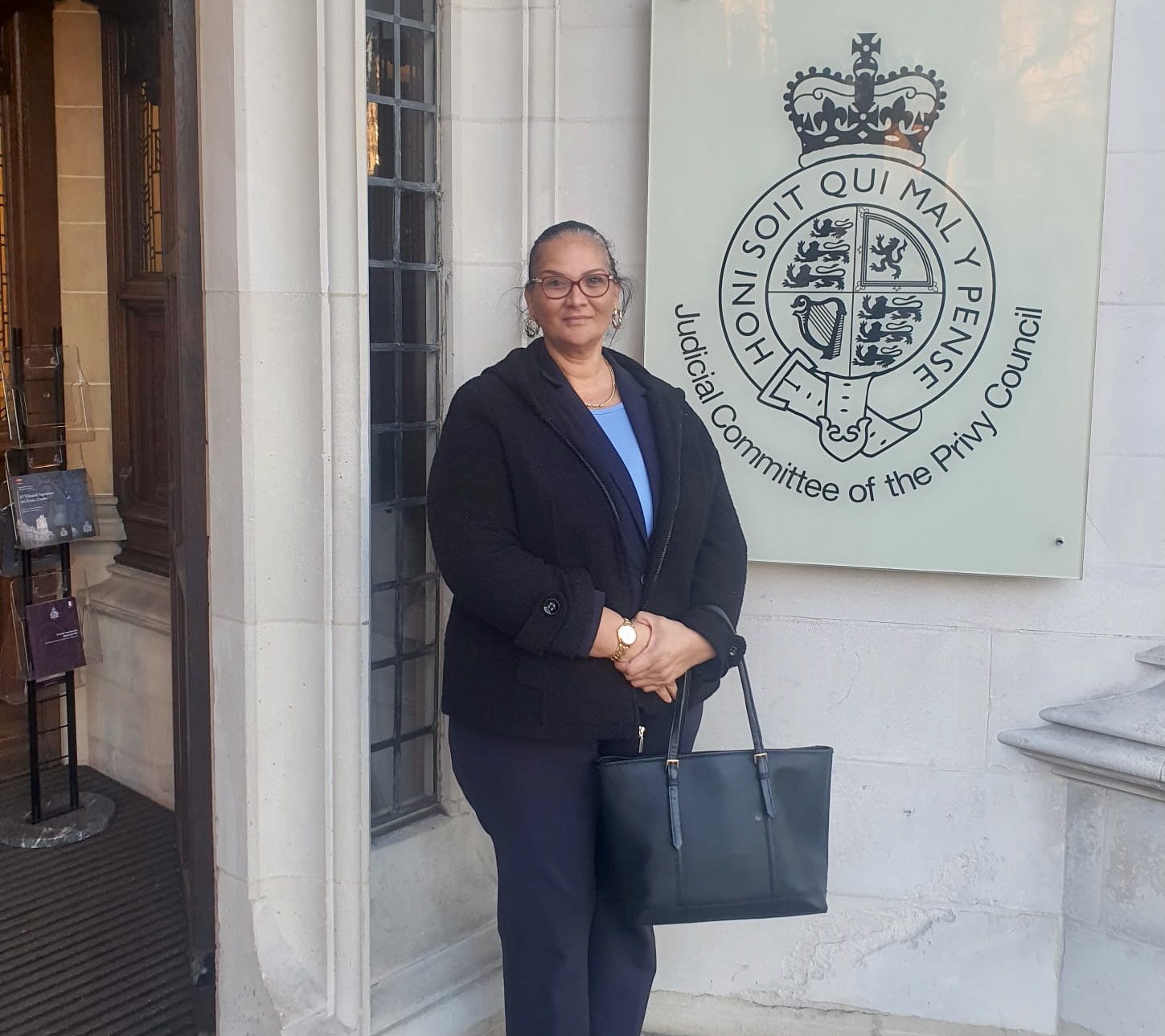
The lawyer who challenged the governor’s right to pass legislation for Cayman suggests the fight is not over after her defeat in the Privy Council.
Kattina Anglin challenged the governor’s use of Section 81 power in the Constitution to unilaterally pass a bill legalising civil partnerships, after it had been voted down in Cayman’s Parliament.

The UK Privy Council, the highest court of appeal for Cayman, sided with the governor in a ruling announced last month that indicated the Constitution does give the UK representative power to pass laws for Cayman in some instances.
The case turned on whether the Domestic Partnerships Bill was a matter of local legislation, which should rightly be devolved to Cayman’s Parliament, or was an international matter because of the human rights implications and the UK’s international treaty obligations, which put it within the sphere of influence of the governor.
Anglin maintains that this was an issue that should have been left to the legislature. She has until the end of October to decide whether to take the fight to the European Court of Human Rights.
It is something that she says she is considering, if the costs can be managed.
Beyond that, she believes Cayman needs to have a discussion about constitutional reform. The issue is about more than same-sex marriage, she insists.
“We have to decide as a people who we want to be ruled by and how we want that to happen,” she said.
“My belief is that the people we have elected are in the best possible position to make a considered judgment on what is right for the Cayman Islands, especially on matters that are ethical or controversial.”
Though she feels strongly about the issue of same-sex relationships, Anglin believes it would have been better for a different topic to be the ‘test case’ on the separation of powers between the UK and Cayman.
If the issue at stake had been animal welfare, coral reefs or fishing rights, for example, she believes more people would have engaged with the wider issue of how Cayman is ruled.
“Sex is always going to be an emotive issue, but the reality is that this is about something more fundamental,” she added.
Reforming the Constitution
She said more education was needed on the political functions of the UK and the Cayman Islands so there is a greater understanding of the current framework.
She added, “The question we could ask now is, do we need constitutional reform?”
She cites Bermuda, Saint Helena and Montserrat as three territories that do not have an equivalent of Section 81 of the Constitution – the power the governor invoked to pass the civil partnerships legislation.
She said the UK retains the right to rule for all of its territories through an Order in Council – a measure it took to outlaw capital punishment and to legalise same-sex relationships in previous decades.
In some respects, it is a question of greater or lesser degrees of independence. Bermuda and devolved assemblies, like Northern Ireland for instance, have greater independence than Cayman.
Asked specifically about the tension around protecting human rights of minorities through parliaments that depend on majority popular opinion for their position, she suggested the power should still ultimately lie with the elected body. She said Cayman’s 19 MPs had been elected by their people and had a responsibility to make those ethical and moral judgments.
She added that movement on human rights questions often happens at a differing pace in differing jurisdictions.
Anglin cited the multi-decade effort in the UK to pass an assisted dying bill as a point of comparison.
“This has been a decades-long process and the legislature has been allowed to go back and forth until it passes, if that ever happens,” she said.
She suggests this would have been the proper thing to do with the same-sex partnership legislation.
“They could have taken the comments from the MPs and gone back and redrafted and consulted with the public and tried again.”
Diplomatic efforts at reform
Ironically, the removal of Section 81 from the Constitution was up for discussion in diplomatic talks between Cayman and the UK until the impasse over same-sex partnerships raised its head.
In 2020, then-Premier Alden McLaughlin and then-Governor Martyn Roper both commented publicly that Section 81 was on the table in constitutional talks. But the failure of the legislature to pass civil partnership legislation meant that the UK pulled out of that discussion.
Roper told the Compass at the time, “It was a very united and effective Cayman delegation that went to London that had a big impact on the UK. Cayman was talking with one voice. What we’ve just seen in the Legislative Assembly clearly will give some pause for reflection because the legislators have not followed through on their obligations to follow the rule of law.”
McLaughlin later revealed that the UK had been close to agreeing to nix the controversial section but ultimately decided not to.
“I am a pragmatist and so I have come to accept that Section 81 will remain in the Constitution, but I will always regret the opportunity that we as legislators and as a country have lost. Hopefully, some future government will be able to achieve what we came so close to doing, and have Section 81 removed,” McLaughlin said.
- This article has been amended to correct the definition of Orders in Council
Related Videos












There is only one way to cure this problem, but do we want to take it?.
‘The issue is about more than same-sex marriage, she insists.’ – it’s safe to say that it is about same-sex marriage when she’s gone through the extreme effort of taking it to the Privy Counsel.
Part of the reason that Cayman’s financial services sector is seen as so trusted internationally is because it has that same UK oversight. I’m not sure what she’s trying to do would benefit our economy.