


A new hardline approach on work permits is fuelling panic and uncertainty in the business community, industry leaders have claimed.
Business owners across multiple sectors are raising the alarm over what they view as a sudden and largely unexplained shift in policy.
They warn the strategy could backfire, shrinking rather than expanding opportunities for Caymanians – an allegation government leaders dispute, saying their plan aims to safeguard and create jobs for locals.
Labour Minister Michael Myles said he made no apologies for his stance, insisting that “hundreds of graduates” are returning home from school each year to find they can’t get work.
“What successive governments have done over the past decade is turn a blind eye to enforcement. Companies are accustomed to circumventing the immigration system and getting away with it. I will not be doing this,” he said.
While there is support for Myles’ passion and ambition on employment, several business leaders cautioned that the blunt approach risked doing more harm than good.
The Compass spoke to eight different business owners, the majority of them Caymanian, representing a wide cross section of the economy, from construction and retail to law and finance. We have allowed them to remain anonymous to enable them to speak freely. Many of them had strikingly similar concerns about recent decisions and rhetoric around immigration in general.
The employers, collectively responsible for thousands of jobs, including both Caymanians and work-permit holders, have said that an increasing number of permits are being deferred or refused outright, even when there are no local applicants.
They also claim that ‘Regulation 6’ clauses under the Immigration Regulations, requiring employers to train a Caymanian replacement for a permit holder – a tool that was previously used sparingly – are now being attached to more than half of applications, regardless of whether or not there is an appropriate applicant.
Employers in the financial services, construction and retail industries said the regulation appeared to being applied indiscriminately, creating uncertainty and delays and resulting in some roles being relocated overseas.
Every employer that spoke to the Compass said they had invested significantly in training and hiring Caymanians. But with almost 60,000 jobs in the workforce and just over 1,000 people out of work, they say it is damaging and impractical to deny work permits – especially for jobs that have been advertised and attracted no local applicants.
Some were supportive of the ‘Reg 6’ provisions as a means of encouraging mentoring and succession planning. But several said the clauses were being applied impractically, without reference to the size of the firm, the requirements of the role, or whether or not there was anyone qualified or available to take the apprentice position.
As of the end of July of this year, WORC had approved 21,150 work permits, refused 2,754 and deferred 955. Data from WORC shows a significant increase in deferrals over the course of the year.
In January, for instance, 3,730 work permits were approved, 370 refused and 5 deferred.
In July 2,829 were approved, 463 refused and 659 deferred. The number of applications deferred in July was double the number for the rest of the year combined.
Premier: ‘Government is listening’
Asked about the impact on businesses, Myles was unapologetic. He said his goal is simply to ensure Caymanians are given priority in their own country.

“What I am doing is enforcing the law,” Myles said. “Organisations are simply not doing succession planning … So what I have said to the boards is, we’re going to start to enforce the law … Every Caymanian must be employed before anyone else gets employed. Every Caymanian must be trained before anyone else gets trained.”
Premier André Ebanks said the government’s approach to immigration reform would be collaborative and consultative – and that it was not simply about employment.
“I was shown a stat that nearly half of the existing population was added in the last 15 years,” Ebanks said. “How do we properly manage that? … How do we better manage how you become a citizen, and on what grounds you assimilate to be a citizen?”
Ebanks, speaking on CompassTV on 11 Sept., backed Myles’ approach, saying the minister had uncovered “serious” abuses by some companies, but he stressed that the reforms would ultimately be balanced with faster processing and other incentives for firms that do the right thing.
He said government wants to avoid penalising businesses that already hire and train Caymanians, and is exploring ways to reward them with quicker permit approvals.

“What we’d like to see is an incentive system … they’ll get an efficient turnaround time if their policies are fair and modernised within the new framework.”
Ebanks said this approach would be part of a broader reform package designed to make immigration “fairer and more accountable” without undermining businesses that contribute positively to the economy.
Ebanks insisted the reforms were not intended to drive jobs or businesses away, and stressed they would be shaped through consultation.
“Government is listening,” the premier insisted.
He added, “We need to have a system that brings on board necessary labour where needed, particularly in sectors that are key to the economy, but also protects those who are in the system, like Caymanians.”
‘A blanket approach’
Right now, employers say the approach on work permits makes no such distinction between firms that invest heavily in nurturing Caymanian talent and those that do not.
They say Regulation 6 conditions – once used sparingly in cases where companies had clearly failed to develop local talent – are now being applied almost automatically, even for executive level roles.
“I’ve never seen Regulation 6s given out like this,” said one employer. “It used to be position-specific. Now it’s a very blanket approach which doesn’t address the labour needs of the market.”
He said the condition could be very effective when used strategically but over the last few months it has been applied without discretion to an increasing number of permits.
“Right now it is being used like a machete, when what we need is a scalpel.”
In other cases, small firms claim they are being effectively asked to hire two people for one position – one to do the job and the other to be trained as their replacement – something, they say, is neither practical nor affordable.
A third concern centres on ‘final permit’ clauses being attached to approvals, which some employers fear will prevent them from retaining long-serving staff.
Alastair David, an immigration lawyer with HSM Chambers, said he had successfully challenged such conditions in the past and currently has a case before to the Immigration Appeals Tribunal where a decision is hoped to be promulgated shortly.
He said the work permit board was legally required to consider each application on its own merits in light of the circumstances at the time and by seeking to bind a future decision the board are arguably acting unlawfully.
Focus on a strong economy
The businesses who spoke to us for this story had some differences of opinion over the right strategy..
One characterised the government’s position as a level of interventionism in business decisions that is inappropriate and counterproductive.
“You can’t have a situation where government is telling business who to hire for what position. It is a recipe for disaster. They tried it in Cuba and it doesn’t work. The government’s role is to ensure a strong economy – and the evidence shows that means more variety of opportunity and more jobs for everyone. A rising tide lifts all boats.”
Others were more sympathetic to the approach and said they were more than willing to help with the training and mentoring of Caymanians. But they said more support and coordination were needed to align businesses with the right applicants and to ensure meaningful partnerships in training and mentoring that would achieve sustainable long-term results.
The data picture
Data analysis shows that work permits have risen dramatically over the past 10 years as the number of jobs in the economy has risen.
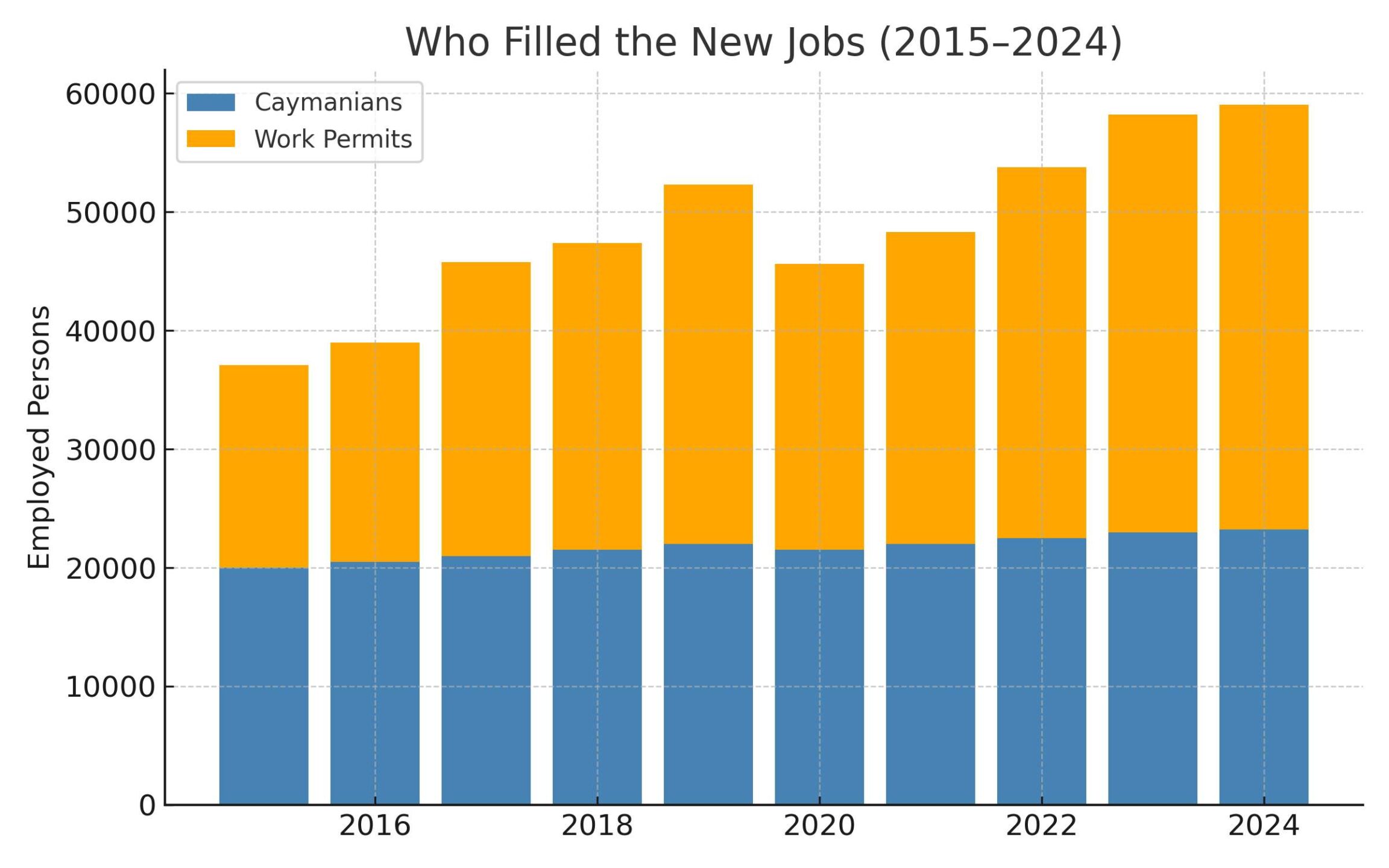
Cayman has created an average of more than 2,000 new jobs each year over the past decade with that economic growth largely fuelled by immigration.
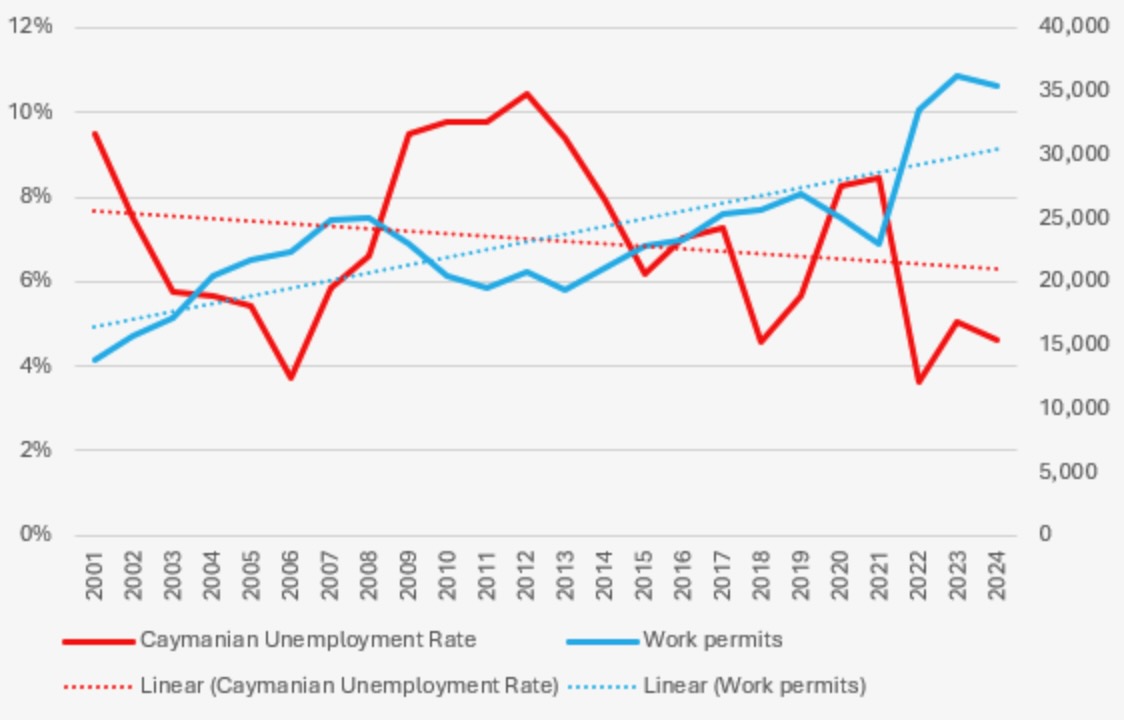
The Caymanian unemployment numbers have fluctuated over the years, peaking at just over 2,000 in the wake of the US financial crisis in 2013. Since then, work permits have surged but Caymanian unemployment has decreased, suggesting permits are fuelling growth and creating jobs across the board, not displacing locals.
Analysis of Economics and Statistics Office data suggests that 70% of those out of work have no post-high school education, and 55% have no job training.
A separate Labour Market Report by the WORC department drew similar conclusions.
“Most unemployed Caymanians had high school or lower qualifications, highlighting the continued influence of education on employment outcomes,” the report noted.
“While low overall unemployment signals labour market strength, the data point to persistent challenges for Caymanians, especially among youth and those with lower educational attainment.”
In those circumstances, firms argue that the current approach to permits is heavy-handed and more focus is needed on training school leavers rather than matching them with opportunities they are ill suited for.
Asked about the data – sourced from the ESO Labour Force Survey published at the end of last year – Myles said it didn‘t reflect the true picture.
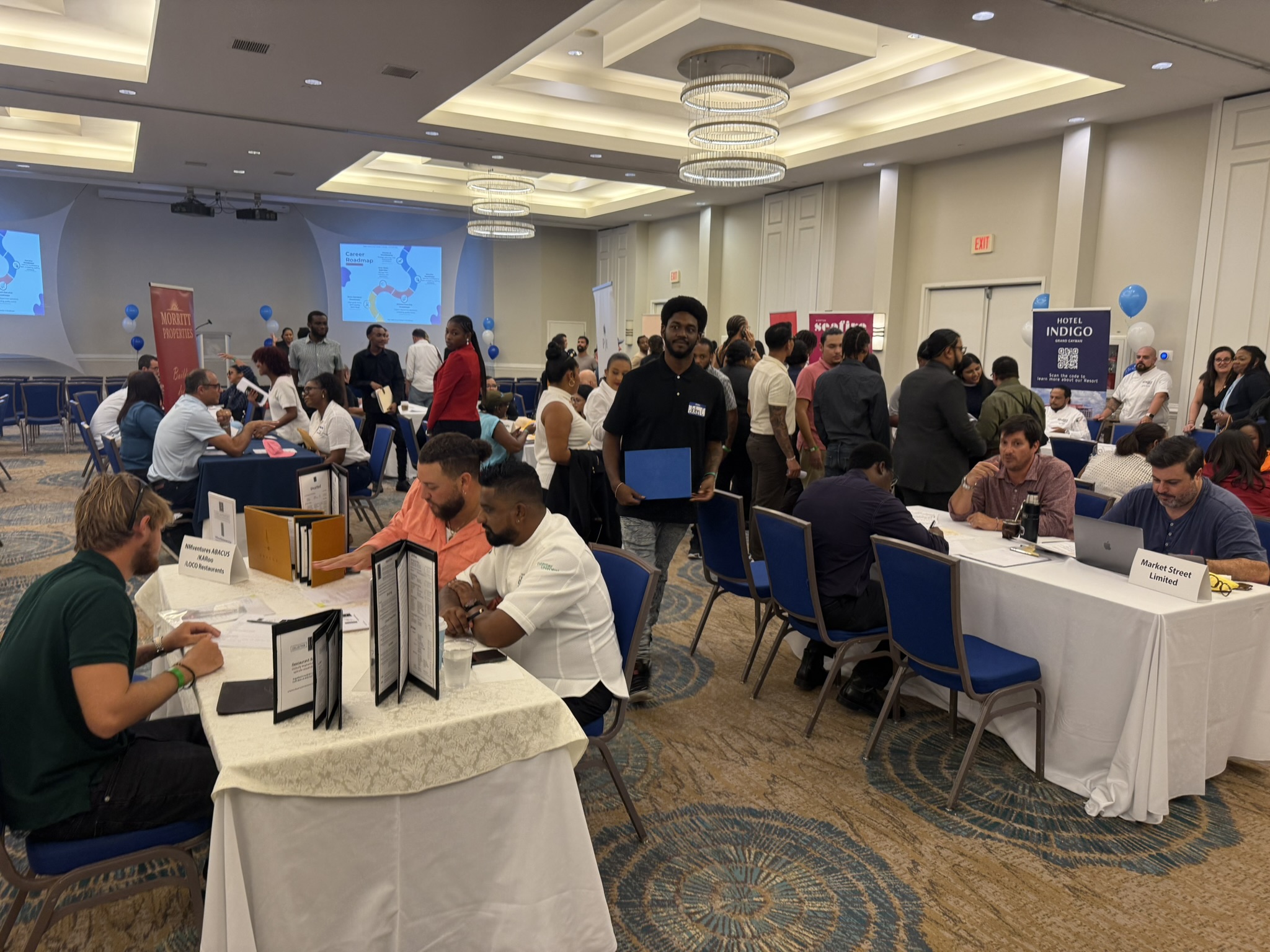
“We have hundreds of graduates every year coming home with qualifications and experience and cannot get a job,” he claimed. Myles added that more than 300 graduates, most of whom were unemployed, had attended the tourism jobs fair last week.
One area that the Economics and Statistics Office data doesn’t necessarily illustrate is the feeling from some Caymanians that they are overlooked in the work place – an issue the Compass has reported on in detail.
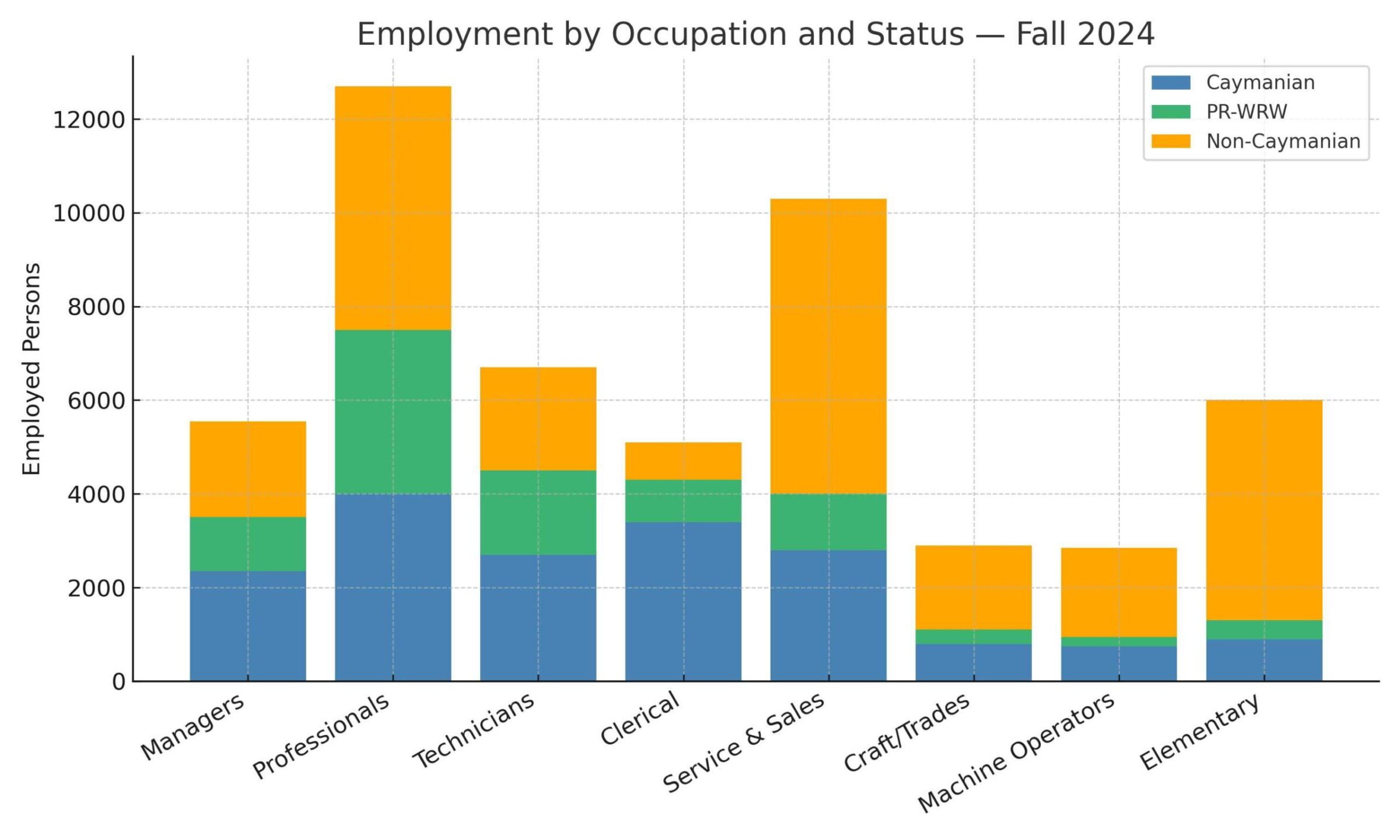
The glass ceiling effect is illustrated, to a degree, in the ESO data which shows that while Caymanians earn more on average, they are less represented in senior private-sector and specialist roles.
Complaints of discrimination against Caymanian staff
Officials have pointed to persistent complaints from Caymanian workers about mistreatment and lack of opportunity as justification for a tougher stance on permits
The Compass has reviewed multiple confidential complaints sent to the labour boards describing what Caymanian staff say are entrenched patterns of discrimination, intimidation and misuse of the work-permit system. Some Caymanians said they were hired for professional roles but relegated to menial tasks, or denied promotions and training while less-experienced expatriates were fast-tracked into leadership roles.
Others alleged a culture of fear and retaliation, claiming Caymanians have been fired after filing complaints.
One group of local real estate agents alleged they are systematically denied high-value listings, client bases and basic entry-level support that expatriate agents receive, making it almost impossible for Caymanians to build careers in the industry.
Myles has cited cases like these in arguing that reform is long overdue.
‘We can’t hire people who don’t apply’
Many of the business owners that spoke to the Compass said they were sympathetic with Myles’ ambition to get young Caymanians into work, but feel they are being punished for the sins of others and that a more nuanced approach is needed.
Employers report a sharp rise in outright refusals and deferrals, often with no explanation beyond boilerplate wording that the board believes a Caymanian could fill the job – even when none applied and all advertising requirements were met.
One small-business owner said it took “three or four rounds of back and forth” to get permits approved, while another said his company had begun offshoring some administrative roles rather than risk losing staff.
“They are not saying, ‘Go look for a Caymanian.’ We’ve already looked and literally didn’t find any applicants. Zero. You can’t hire somebody that doesn’t apply.”
They warn that those jobs won’t come back.
“Any time a job gets offshored, it’s permanent,” he said. “It never comes back – and with it goes the spending in the local economy.”
A white-collar business owner said more needed to be done in terms of investing in training and education at a national level.
“If government responsibly apportioned a part of the revenue it generates from work-permit fees to improving the education system and upskilling people, we would likely see dramatic improvements to the unemployment rate.”
‘Reputation is at stake’
Caymanians should not be left behind as Cayman grows, business leaders agreed, but they said the strategy needs to be sustainable and executed in a way that does not damage Cayman’s economy or reputation – otherwise the long-term consequences could be greater than the current unemployment problem.
The broader concern, they said, is the reputation of the islands as a good place to do business – something that has underpinned its economic growth over the past decade.
“The current climate is making Cayman less desirable for top international talent, which Cayman will always have to rely on … The same applies to Cayman’s reputation as a jurisdiction for doing business. It is key for the hiring process to be as seamless as possible to encourage foreign investment,” said one business owner.
Another warned, “I think this is going to be a situation where we see a lot less people willing to invest in Cayman if they feel they don’t have government support.
“I am not sure I have ever seen rhetoric like it is now. It is very in line with Bermuda, and the swiftness of these actions without any real consultation or communication is probably the key. No one really seems to know what’s coming down the line.”
Myles dismissed suggestions that anyone would leave.
“No one is leaving this country … Your responsibility as an organisation is to hire people. And if you don’t want to do that, you don’t need to be doing business in the Cayman Islands.”
Related Videos












Keep things as they are now and just work on making Cayman Government a shinning example of all or close to all Caymanian employees and see how it goes and assess the data thereafter. Do not fiddle or wreck the private sector for politics. Caymanians need to be taught to compete in a global workplace not be spoon fed or babied just because they are Caymanians and get opportunities handed to them they did not truly earn. I absolutely respect the fact that Government is seeking to make more Caymanians be placed into jobs and I ultimately support Caymanians in the workplace and being helped to be placed ahead of a new comer foreign individual. However, the Cayman Islands is not a communist or socialist counrty and employers have the right to hire or not hire who they want representing their company. Cayman and the Government have to understand too that the majority of these major companies doing business here are not Cayman owned. Cayman actually has no solid industry, no exports, no natural resources or mines or do any major export of agricultural products. Cayman without these companies doing business is nothing. We may be classed as a major financial centre of the world but Cayman or Caymanians do not own those institutions or industries. So Cayman really has nothing and our GPD is dependent on these companies and businesses the work permits they get and the imports of everything we need to operate these companies and facilitate all our lifestyles comfortably. The only reason many companies come to do business here is that we are tax free and our dollar is high and stable and we are close to the US Canada and Latin America. These companies doing business here is what pays almost all the bills for Cayman and civil servants salaries and welfare benefits to unemployed Caymanians. However, these companies at any time can just pick up and leave. So stepping on toes and making it hard for companies to operate efficiently and continue to contribute to our economy which is actually their economy that they made for Cayman, in Cayman, will only seriously effect all Cayman and Caymanians if we are to burn bridges. Cayman is an island so all we have are bridges between us and the rest of the world. You burn them once there’s no second chance.
Policymakers need to be more specific about the goal and the current state. For example, is the goal to reduce unemployment from 5% to 3%? What is realistic?
Myles’ insistence that it can reduced to zero is absurd and makes him seem like a dangerous fanatic.
As one employer referenced, the only country to attain zero unemployment was communist Cuba and just look at what was required to achieve it and how that worked out.
Unfortunately there will always be people who don’t, won’t or can’t work. So insisting that they do and holding the entire economy of the country to ransom is not just an exercise in futility but also a recipe for economic decline.
Government needs to start Vocational education in High Schools. So high school graduates have job opportunities..
Vocational Classes in:
1) Electrical trade
2) Carpentry and cabinet shop
3) Plumbing trade
4) Architectural CAD drafting
5) Accounting
6) Medical assistants trading
7) Heavy equipment trading
8) Welding metal shop
I own a small financial services company employing 6 Caymanians and 3 expats. The expat jobs are inherently more skilled, require degrees and certifications. I announced 2 weeks back that I’m closing up shop and moving to Bermuda.
Myles rhetoric has been enough. I don’t see a future for my business in the environment he is creating, stifling work permits. I’m happy to hire all Caymanians but it’s literally impossible for these skilled jobs. I already can’t get some of my local employees to show up on time or have a drive to work.
It’s been fun while the business lasted for the past 15 years but under Michael Myles, it’s time to move on from Cayman. I’m wishing the best of luck to both my local and expat employees as I’ve told them and are there to support them.
Michael at the preliminaries I really didn’t believed you had the fortitude but what a breath of fresh air! A man made by the people for the people! Keep going my brother!
Let’s get all the returning University graduates filling those construction, cleaners, nanny, food service, janitorial jobs STAT! Congratulations Cayman, you will start destroying the economy. What happened to the Hospitality Job Fair? What are the results? What about the Undersubscribed Cayman Finance program?
With all due respect, Mr. Miles’ math skills aren’t great.
The vast discrepancy between the number of available jobs and the qualified local-born workforce indicates that a blanket mandate is impractical and would cripple the economy.
If a Government wants an employer to hire 2 people for one position, they should be funding the training.
Prioritizing equity over merit in hiring can have grave consequences, dilute professional standards by lowering them to meet representation goals.
One factor that is undeniable, is that the current approach on work permits will bring more votes to those behind it. We all want more Caymanians employed but going overboard with restrictive policies which seems to be the case, will have a negative effect, particularly on Govt’s main source of income. i.e the Financial Sector. We have heard many times over the years of complaints of Caymanian staff of discrimination, and some will be true, but they should be backed up with firm evidence provided to the labour boards who should take then action against the employer. How many times has this happened?.
This will simply lead to financial services businesses onshoring workers. If it is too dificult to get people on island, they will simply stay at the other office locations and work there. Audit firms, law firms, fund admin shops ect.
To some extents though, great for me as a Caymanian. I’ll now ask for a pay rise because my employer cant risk trying to get a replacement!
Government is focused on a small few. The vast majority of Caymanians work hard, own businesses, have solid employment. Why are we not hearing from Caymanians whose businesses will be harmed by the inability to staff? Government wants to keep the financial sector her and paying fees, how many are Caymanian? A minority government needs to be careful
What I am about to write might be controversial but I think it would be great if investment in this island and in the construction sector cools down a bit. As a long term resident and someone who is concerned about the natural environment, I don’t see any tangible value for most of the long term residents here of these extractive and opportunistic businesses. How many Vela type developments does this island want/need. Zero is the answer.. So who cares if some financial services providers move away or some construction company is unhappy with stricter laws? Also look at all the trash on the side of the road. When you important people from all over the world you also import the problems that those countries have. I support Michael Myles
I know business owners with Reg 6 conditions on their permit. Their companies employ Caymanians and do much good for the economy, but they literally wouldn’t be able to function without their owners. These people are very able to pack up the businesses and move to Bermuda or the BVI, leaving their Caymanian employees jobless. Myles’ approach isn’t measured and it’s doing more harm to the economy than good. For him to say “no one is leaving” is contradictory and daft – isn’t that the intended end result of a Reg 6 and ‘final permit’ clause?