

High insurance rates and the costs involved in retrofitting e-bikes and e-scooters are impacting business that sell and rent the machines.
Several people involved in the business say they are divided over the need to impose rules enforcing motorbike-style indicators and brake lights on low-powered e-scooters.
Julio Acevedo, owner of CayScooter, said he backed the need for stricter rules on fast e-bikes – but did not see the need for low-powered e-scooters to be treated the same.
But Acevedo, whose company at present has only a small fleet of e-bikes, added that the cost of insurance per bike from Indigo, the only company he could find that insured the vehicles, was high at $300 a vehicle.
“We definitely have to do what the law says, so we’re going to license all of them,” he said.
Acevedo, however, added, “Right now, the price is not fair … each bike is $300 each for the insurance.
“At the moment, we only have seven bikes, but we’re planning to grow before the next tourist season comes. The most expensive thing is going to be insurance.”
Acevedo added that the rules stipulated equipment such as indicators and a horn, similar to those required for motorcycles.
“They don’t come from the manufacturer like that, so we’ll need to attach another brand’s indicators, which can be done. A company in George Town can supply them.”
Acevedo has no objections to the equipment required for e-bikes. “I would say e-bikes should have everything like a motorcycle – they’re quite fast and travel at 45kph an hour.
“Regular bicycles don’t need all that because they don’t go so fast.”
However, he doesn’t feel e-scooters should have the same requirements. “I would say regular e-scooters don’t need all that either. They only do about 15mph.”
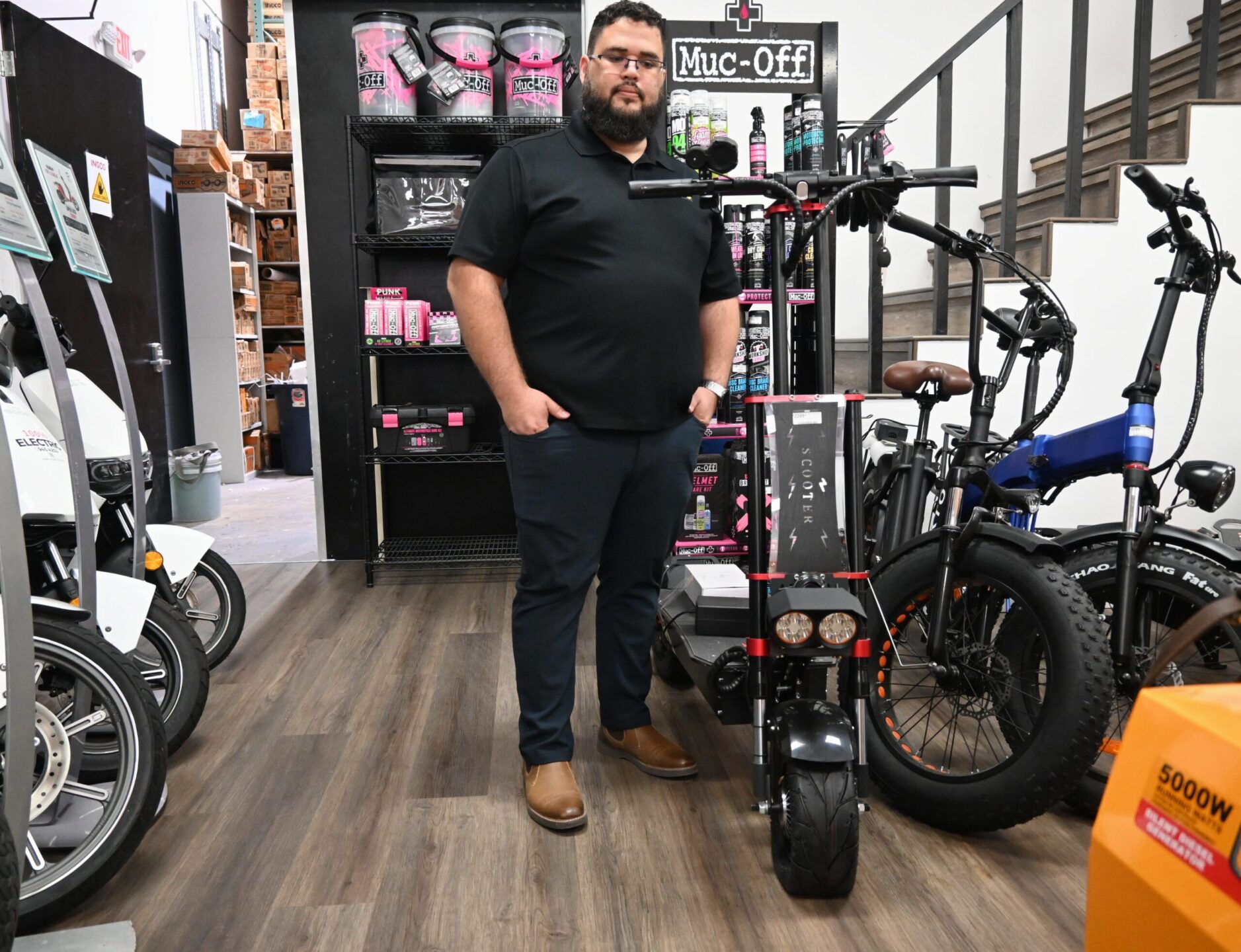
Although many of the scooters seen on Cayman’s roads are the kind that go only as fast as 15mph, others types can go faster.
Clark Hydes, of electric bike and scooter retailer Super Soco, said the firm’s scooters had headlights and horns, indicators at the back, but not at the front and also lacked rear view mirrors, which needed to be retro-fitted.
Hydes said the firm’s scooters had high-capacity batteries, capable of pushing the most powerful machines to 52mph, so added features improved safety.
He said many of the additions required by the Cayman government were “not things that come with the bikes or the scooters”.
He added Super Soco, based in George Town, had to rewire the lights to install front indicators, which were available from AET Outlet.
Getting the e-bikes and e-scooters insured was also difficult, Hydes said.
“We called five companies before we got Indigo and no one could tell us what the bikes and scooters needed until we took them to the licensing department and we figured out we needed lights and indicators.”
Hydes added, “That was a bit of a problem, although you can see where the government is coming from. But there was no clarification about processes, the insurance and what they wanted to see on the bikes.”
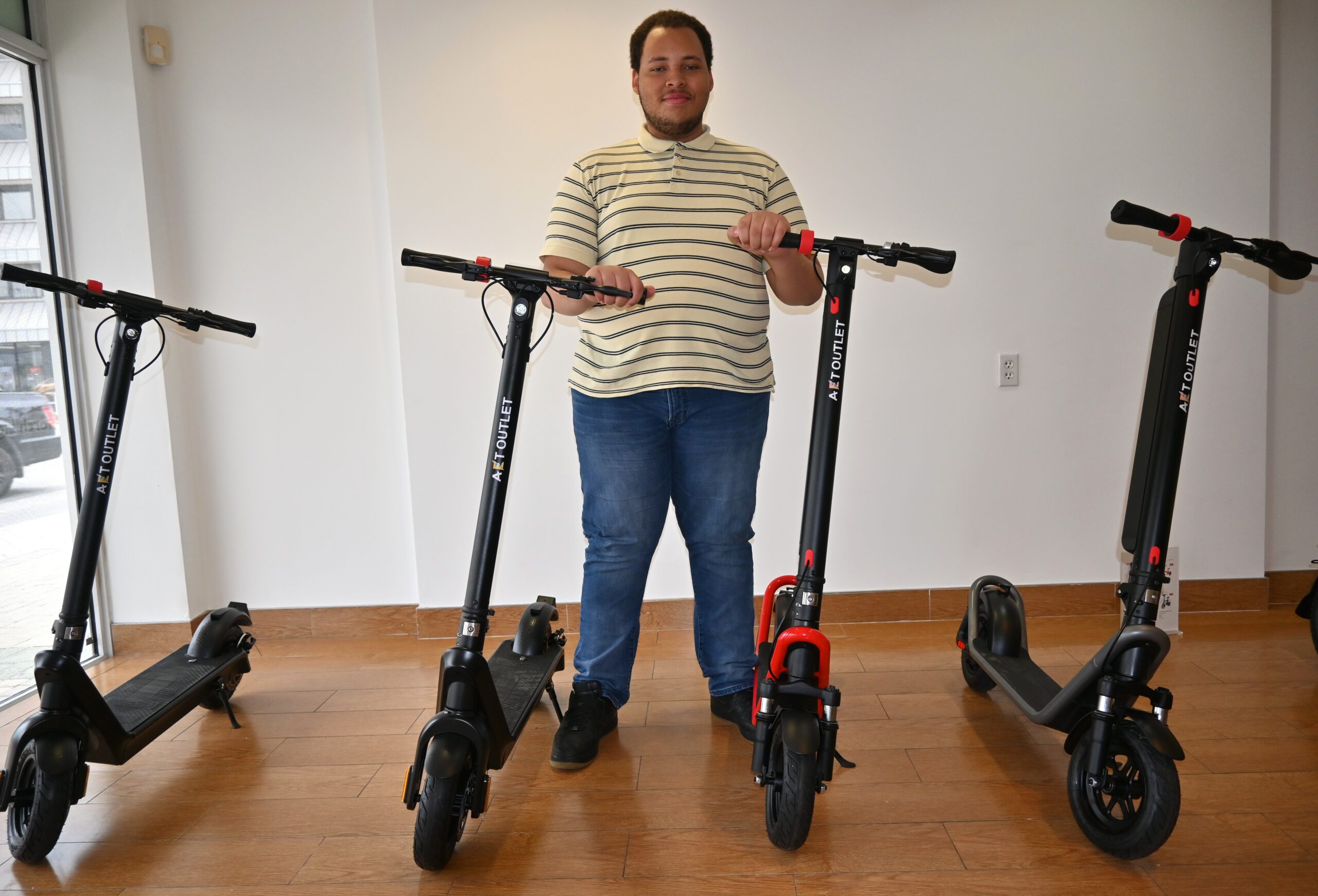
Samson Ebanks-Stewart of e-bike and e-scooter retailer AET Outlet on Edward Street in George Town, said, “I think it’s needless for the government to have to make this change for people just to ride a scooter or a bike.”
He added the machines were good value transport, but the cost of adding the required extras, including helmets, would impose an extra burden on buyers and put them on a par with motorcycles.
Ebanks-Stewart said, “They are not motorbikes – that’s my personal opinion.”
He added, “The majority of people have been talking about what they need to add on to their scooters, but some have been talking about licensing and insurance on these.”
Ebanks-Stewart said AET Outlet could supply after-market indicator kits which complied with Cayman law.
“We’re definitely expecting to sell a lot of them,” he said.
Enforcement coming
Enforcement of the law requiring the insuring, licensing and inspections of e-bikes and e-scooters – the provisions for which were already in the Traffic Act – was originally scheduled to start on 16 Jan., but was pushed back to 1 March by the Royal Cayman Islands Police Service.
Part of the reason for the delay was that only one insurance company – Indigo Insurance – offered insurance on e-bikes and e-scooters as of the original enforcement date. However, the Ministry of Planning, Lands, Agriculture, Housing & Infrastructure met with insurance companies on 12 Jan. and issued a press release saying that “additional insurers are expected to come online in the coming days and weeks”.
UK rules
It is illegal in the UK for privately owned e-scooters to be ridden on public roads, pavements, or cycle lanes, although it is legal to sell and buy them for use on private land.
Police can seize e-scooters used illegally and offenders may face fines and penalty points on their driving licence.
The UK has trial areas for rental e-scooters, but they are limited to specific areas, including parts of cities such as London and in Birmingham, Liverpool and Newcastle.
Rental users in trial areas are permitted to use cycle lanes and public roads, but riders must be at least 18 and hold a UK full or provisional driving licence and the machines must be insured.
It is legal to ride an e-bike in the UK without a driving licence, but only pedal assist models, not throttle-controlled.
They are also restricted to a maximum power output of 250 watts and limited to a top speed of 15.5mph and can be ridden by people aged 14 or older. Only the lights normally carried on a pedal cycle are needed.
Riders of e-bikes with throttle controls or more powerful motors need vehicle tax and insurance under the UK Road Traffic Act, and operators need a driving licence and motorcycle helmet, although indicators are only required for some categories.
Related Videos








Congrats, vote for these government officials and they will put your business to close, prevent people from getting to work and are against going green with the environment.
Cayman ebike and scooter market is dead. Government is hurting citizens more than helping them.
Imagine being a dive instructor as a Caymanian and you take a scooter to work. Now you have to pay the government more money and insurance. They are overreaching here just to push more people into cars. People in the government likely own some car dealerships on island.
NCFC is sitting back, staying quiet and making incompetent Civil Servants destroy their mandate to make things more affordable.
NCFC = National Coalition For Caymanians, or No Consideration For Caymanians, or No Change For Cayman or Not Capable of Furthering Change.
Which one will your legacy be NCFC?
Rein-in and retire these WOS Civil Servants!
“Hydes said the firm’s scooters had high-capacity batteries, capable of pushing the most powerful machines to 52mph, so added features improved safety.”
No scooter can be safe at anything close to 52 mph.
There needs to be a maximum speed limit for scooters and ebikes. Perhaps 20 mph for scooters and 25 mph for ebikes.