Topic: economy
Rahn: Why some problems seem never to be solved
Public choice economists recognize that most people have some concern for others, but their main motive – whether they are voters, politicians, lobbyists or bureaucrats – is self-interest.

EDITORIAL – Getting government out of the ‘bedroom business’
If this government is, as it claims to be, “of and for the people,” it needs to re-examine what its regulatory policies are doing to the very people it purports to represent.

Morici: Dollar will hold as reserve currency
Sorry Bitcoin, offshore dollars were a private currency for years – largely virtual, without official government sanction and lightly regulated – long before initial coin offerings came along. And it’s run by much more trustworthy and careful people.

Will: What might a socialist American government do?
Socialism requires – actually, socialism is – industrial policy, whereby government picks winners and losers in conformity with the government’s vision of how the future ought to be rationally planned.
Rahn: The unthinking and the unobservant
Can you think of one socialist experiment that worked in the last several hundred years?
Morici: Paying off the mortgage, but not too quickly
If hard times hit, you are out of a job and over-extended, credit card balances can be more easily renegotiated than mortgage debt. Student loans, unlike most other debt, are not dischargeable in bankruptcy.

EDITORIAL – Cayman’s success depends on growth and diversity
It is good that Premier McLaughlin has correctly recognized the increasingly cosmopolitan makeup of our growing society, and the growing diversity among the Caymanian half of our population.
Morici: Trump economy is doing fine
Nonpartisan research predating the Trump candidacy indicates the 15 percent cut in taxes on business profits enabled by corporate reforms should increase investment between 7.5 percent and 15 percent.

Rooney: Facing the realities of a changing world
As an economist and – yes, as a globalist – I have a lot of confidence in the entrepreneurial spirit of Americans. I think we will find a new path to growth, upgrade our workforce’s skills, and ultimately the wage-productivity gap will close.

EDITORIAL – Welcoming the world to Cayman
Cayman did not simply break our previous record for airplane arrivals in the first quarter of this year – it shattered them, putting us on pace for a fifth-straight record-breaking year.
Will: Is the US trapped in a debt spiral?
The Congressional Budget Office projects that new federal borrowing over the next 10 years will total $12.4 trillion and that at the end of 2028, the debt will be $28.7 trillion – 96 percent of GDP, up from 39 percent in 2008.

A deeper understanding of global debt
The scary-sounding global debt numbers were a bit of a publicity stunt; they got our attention, even if they were intellectually misleading.
Morici: The optimists may be right
Economists mostly sort into two camps – those who believe the post-World War II period was exceptional and those at the White House and a few others (count me in) who believe the best is yet to come.
Rahn: Protecting capital gains from inflation
A capital gains tax, in effect, raises the risk and price of the investment, resulting in lower investment and slower growth and job creation.

Mitchell: Debt, deficits and public finance
The threat is not the red ink. The real danger is an ever-increasing burden of government spending, driven by entitlements.

EDITORIAL – UK wins ‘war’ against EU … then surrenders
Perhaps half-hearted Brexit officials secretly hope, if they manage to bungle the negotiations sufficiently, that the people of the U.K. will change their minds about leaving the EU.
Mitchell: Globalism, good and bad
Globalism (or globalization, or internationalism, or the policies of “Davos Man,,” or whatever you want to call it) increasingly is perceived to be about more than free trade and comity between nations. In the minds of market-oriented people, it is getting linked with other policies that cause considerable angst.
Rahn: More meanness from government
Given how few people are actually convicted of money-laundering, the overwhelming evidence is that 99 percent of the people being forced to submit to these costly and time-consuming proposed regulations will not be guilty of money-laundering, terrorism or whatever, and thus should not be harassed by government.
Morici: The next fiscal crisis
Uncle Sam’s incessant borrowing – just like irresponsible home mortgages in the 2000s – could again send financial institutions barreling over a cliff.

Thiessen: Protect public workers from unions’ coercion
Liberals say conservatives are trying to use the court to break the power of public sector unions. But if the only way they can maintain their political power is through coercion, then they do not deserve that power in the first place.
Rahn: A tale of two countries and their economic freedom
The tragedy is that the people of Venezuela should be enjoying a very high per capita income, as are the Norwegians, if they had made better political choices.
Will: Why good economic news is bad
All news is economic news, because everything affects the economy, or reveals attitudes or behaviors that soon will affect it. And all economic news is bad – especially good economic news, because it gives rise to bad behavior.
Will: Protectionism ensures no bad deed goes unrewarded
Fomenting spurious anxieties about national security is the first refuge of rent-seeking scoundrels who tart up their protectionism as patriotism when they inveigle government into lining their pockets with money extracted from their fellow citizens.

EDITORIAL – Paying homage to Cayman’s essential ‘invisible’ giant
With continued good fortune, perseverance and high-quality education, we have no doubt that Cayman — energized and enabled by our financial services sector — will not only build on our half-century of success, but will surpass even those “miraculous” accomplishments.
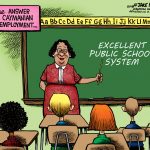
Unemployment answer
Today's editorial cartoon
Morici: When politicians abuse inequality
Overall, the Trump administration and Republican Congress – much like President Bush and his Republican Congress before them – are hardly addressing the genuine concerns of the great mass of voters who put them in power. Yet, the clients and executive class of the liberal state see the GOP as an existential threat to their systems of privileges and persecution so carefully erected during the Clinton and Obama years.

EDITORIAL – Blue skies ahead: Record arrivals fill local coffers
The cruise industry, along with stayover travel, are the two legs upon which Cayman’s hospitality sector stands.
Will: US needs balanced-budget amendment more than ever
No one knows at what percentage the debt’s deleterious effect on economic growth becomes severe; no sensible person doubts that there is such a point.

Mitchell: Hopes and fears for policy in 2018
Let’s speculate about potential victories and defeats in 2018.
Rahn: The end of government ‘Monopoly money’
The energy and the intelligence are on the side of the entrepreneurs, not on the side of the government regulators. Ultimately, government central banks and financial agencies are going to lose this battle.

Letter: The contributions of Nick Duggan
The recent 50th anniversary of the bank is a reminder of this gentleman, and one of Cayman’s finest citizens.

It is time to scrap the Jones Act
Congress is thinking about giving Puerto Rico a new five-year exemption from the law. That is the least it should do.

EDITORIAL – Butterfield Bank: A half-century of service to Cayman
Congratulations to Butterfield on its “golden” anniversary in the Cayman Islands. Here’s to your next 50 years.

EDITORIAL – One EU ‘blacklist’ and 47 shades of gray
There’s good news, there’s bad news and then there’s … gray news. Developments out of Brussels this week fell in the last category, as the European Union placed the Cayman Islands on a so-called “graylist” — meaning our government has made certain commitments in writing to address EU criteria on tax transparency and “fairness."
Will: Republicans’ tax wager is worth the gamble
Economics is a science of incentives, and like all sciences it is never “settled.”
Mitchell: The best reasons to support tax havens
The late Mancur Olsen was a very accomplished academic economist who described the unfortunate tendency of vote-seeking governments to behave like “stationary bandits,” seeking to extract the maximum amount of money from taxpayers.
Morici: Treating US Congress as a harbinger of recession
These days, politics poses more threats to the economy than the machinations of the bond market as measured by the slope of the yield curve or any other metric.
Morici: Economic nationalism is a losing strategy
Instead of rallying American allies to confront China’s mercantilism through joint action, Mr. Trump has bullied Mexico, South Korea and Canada, pulled America out of the Trans-Pacific Partnership and derailed free trade talks with the EU.
EDITORIAL – Pension ‘exodus’: Bad idea, worse execution
We imagine that Moses’ leading the Israelites out of Egypt was a more orderly affair than Cayman’s “pension exodus” – where hundreds of expatriate workers are packing their bags and leaving, so as to avoid being swept up in last year’s changes to the National Pensions Law.
Rahn: The myth of growing income inequality
The current GDP measures were largely developed in the 1930s. But they do not accurately measure relative well-being in the new technological world.

It is time for Facebook to raise the curtain
Democracy requires both free speech and free association. We cannot save democracy by sacrificing one for the other.
US must confront China to achieve 4 percent growth
Either China commits to opening up its markets to U.S. goods and investments on a fully reciprocal basis and balancing bilateral trade over three years, or the United States should unilaterally impose a system of import licenses.
EDITORIAL – Rejecting ‘prejudice’: The day our premier spoke for all of Cayman
Are some individuals in Cayman “better off” than others? Of course. Is almost everyone in Cayman – to a man, woman and child – “better off” now than they would have been in Cayman’s economy of 60 years ago?
Also of course.
On tax reform, US Republicans are ‘defining victory down’
They should have made the case for large reforms that annoy democratically – almost everyone, simultaneously – but for a large purpose.
Will: The radiating mischief of protectionism
What a tangled web we weave when first we practice to deceive ourselves into believing that corporate welfare can be seemly.
EDITORIAL – The ‘Bermuda Papers’? Journalism, hacking or financial voyeurism
In anticipation of the sound and the fury that will no doubt define international news coverage of a data breach at Appleby law firm, here are a few of our thoughts on the matter of “leaks,” “hacks” and offshore exposes under the guise of investigative journalism.
Morici: Robots and artificial intelligence will not be the end of work
AI will not replace doctors, but it will permit them to treat more patients more effectively and at lower costs. And somehow, I do not think people are quite ready to leave life and death decisions to an iPhone app.
Rahn: Hiding scandalous behavior behind noble causes
Part of the solution is to shrink the size of the rogue institutions while requiring greater transparency and accountability.

EDITORIAL – A prescription for a healthier and happier Cayman
Not unlike the major systems of the human body (circulatory, nervous, digestive, etc.), our individual health and well-being is influenced by several interdependent “systems.” And speaking more broadly, so is the healthcare profile of the Cayman Islands.
Mitchell: A tragic, continuing story of fiscal decay
Billions of dollars of wealth have already left New Jersey because of bad tax policy. Yet politicians in Trenton blindly want to make the state even less attractive.
Rahn: Don’t underestimate the sizzle of tax cuts
Congress should not let itself be bound by the CBO projections of the tax changes, given that the office is still using models that fail to adequately account for changes in behavior.

EDITORIAL – Company’s coming: ‘Dressing up’ Cayman for unexpected guests
Quick, Cayman: Lay out the good napkins and set extra places at the table. Unexpected guests are coming – 250,000 of them.

EDITORIAL – Standing up to the bullies in Brussels
Make no mistake about it. The EU and its regulatory henchmen (read “OECD”) are not trying to export their failed economic policies. They are trying to export their failed left-leaning social policies.
Mitchell: Tax cuts, cherry-picked data and interesting admissions
Even though Republicans are not serious about controlling spending and even though I don’t think the GOP tax cut will come anywhere close to “paying for itself,” the tax cuts are still a good idea.

Economy shows signs of broad-based growth in first quarter
Cayman’s gross domestic product grew by 2 percent in the first quarter of this year compared to the same period in 2016. The construction sector, wholesale and retail trade and utilities contributed most to the growth.
Mitchell: Prosperity in a post-Brexit world
The bottom line is that the UK has plenty of negotiating power to get a good outcome.

EDITORIAL – ‘Barkers rangers’: Pruning back big government
Barkers’ infamous “park rangers” have become “lone rangers” — striking out on their own to form a private landscaping business. In so doing, they’ve made a small stand against government growth and scored a victory for free enterprise.
Morici: Forget triple-A, US bonds deserve a rating of ‘F’
The upcoming showdowns over Medicaid, other entitlements and cuts to other federal spending as part of efforts to raise the debt ceiling and to define targets for spending in the 2018 fiscal year appropriation bills will reveal the Republican majority’s stomach for spending reform and courage to lead the country out of the fiscal wilderness.
Mitchell: Macron’s reforms sure to boost job growth in France
France has all sorts of rules that “protect” employees, but the net effect is that workers suffer because these laws discourage entrepreneurs from creating jobs.
Rahn: The tax cut the US cannot do without
Without cutting our noncompetitive corporate tax rate, businesses will continue to move to the rest of the world, leaving fewer jobs for Americans and less to tax.
Morici: When workers cannot or will not compete, investment suffers
Skepticism is growing among economists – and more importantly business decision makers – that Mr. Trump and Republicans in Congress will appreciably lower the cost of investing in the United States.
Time for Trump to embrace free trade
According to one study, 88 percent of manufacturing job losses are the result of improved productivity, not rapacious Chinese.

Letter: Think before approving changes to our shoreline
Let us work together — building wisely for the future, as our forefathers built up Cayman — from the Islands Time Forgot to the financial leaders of the world.

The German Miracle: Proof of how far an economy can get on a few...
Today's German economy shows how far you can get on a few modest labor reforms such as those passed 15 years ago by social-democratic Chancellor Gerhard Schröder.
Morici: Low interest rates will affect retirees’ portfolios
Investors more than 10 years from retirement should consider how much cash they need on hand to cover about six months of expenses or upcoming college tuition and beyond that, sink their money into the stock market.
Rahn: The price-level dilemma
In sum, monetary policy as we have known it is broken and is unlikely to be put back together again in a satisfactory way.

College isn’t the only way to achieve your dreams
While college is an important and desirable rite of passage for many, policymakers must pay more attention to the segment of the population that is looking for different pathways into the middle class.

A key issue in the US tax debate
Even good-faith policy prescriptions suffer from the same flaw, which is that productivity remains one of the least understood and, indeed, least precisely measured concepts in all of economics.

Old ideas about foreign trade are being retired
According to Hausmann and Hidalgo, countries are better off when they can make a multitude of things.

Target a broader tourism market
Yes, stay-over numbers may stay steady or increase for a while, but eventually, when the only product available is high-end, will that volume of tourists continue to arrive?
Mitchell: New Zealand’s road map for sweeping pro-market reform
New Zealand's reforms are - or at least should be - a road map for Greece to follow.
The real victims of class-warfare taxation
Harsh taxes on yachts backfire because the people being targeted have considerable ability to escape the tax by simply choosing to buy yachts, staff yachts, and sail yachts where taxes aren’t so onerous.