

Topic: Richard W. Rahn
Rahn: Escaping from New York
When it comes to taxes and government services, people’s feet tell more than their mouths.
Rahn: Government debt is the true crisis
Greece provides us with a good example of what happens when government spending grows faster than income, and debt reaches an unsustainable level.
Rahn: Mueller’s excessive, theatrical and costly raid
Civil libertarians and others were correctly outraged about the heavy-handed tactics.
Rahn: Correcting the mistake of 1765
The current troubles in the U.K. can be traced back to a fateful decision of King George III and the British Parliament in 1765 with the imposition of the Stamp Act on the American colonies. The Stamp Act placed a direct tax on printed materials, including legal documents, magazines, playing cards, newspapers and many other types of paper.
Rahn: When socialism is romanticized
Restrictions on who was allowed to vote, based on property ownership or literacy, were over time viewed as unfair and eventually abolished, leading to the current crop of elected officials – no more needs to be said.
Rahn: The return of the tax bullies
Over time, tax abuse by governments is corrected either by violent revolts (e.g. the American Revolution) or by passive resistance (tax avoidance or evasion).
Rahn: Genocide, slavery and immigration
The open borders movement is not just a child of the American left but also has many adherents among libertarians.
Rahn: The uncertainty tax
Business students are taught, when making an investment decision, that what is important is the expected after-tax rate of return after adjusting for risk and uncertainty.
Rahn: Bureaucracy run rampant
The British noticed that being part of the EU was making them relatively poorer with a great loss in national and individual freedom – so they revolted by voting to leave.
Rahn: The battle against death and taxes
Average life expectancy is a good proxy for how effective a healthcare system is.
Rahn: The democracy myth
Many Swiss are sufficiently alarmed about the loss of their sovereignty that they recently voted on a referendum that would have required Swiss law to take precedence over international law and treaties.
Rahn: Measuring public officials’ performance
The question is, why do so few of them actually undertake the obvious reforms necessary? Even if some leaders care little about their own citizens, one would expect their own egos to drive them to make major constructive changes.
Rahn: The limits of our economic knowledge
Rather than a small yearly amount of inflation – given the change in what people now buy in goods and services and the benefits that they obtain, it can be argued we have actually had a massive amount of deflation – meaning a much larger increase in living standards than has been reported.
Rahn: Tech offers hope for Central America
Richard W. Rahn
As I write this, there is a caravan of several thousand people coming north, primarily from El Salvador, Guatemala and Honduras, with...
Rahn: Who makes and enforces the rules?
A major reason for the Brexit vote in the U.K. was that after a thousand years of being in charge of their own destiny, Englishmen were finding, among other things, the shape and size of the cucumbers they were being allowed to sell was being dictated by unelected EU bureaucrats in Brussels.
Rahn: Bad news sells, but optimism wins
There is a rational explanation as to why the owners of major media often act in ways seemingly contradictory to their public advocacy.
Rahn: The rush to cryptocurrencies
Many governments, such as Chinese, Russian, Swiss and others, as well as millions of private individuals and companies want to free themselves from the U.S. financial yoke. Hence, the search for a functional cryptocurrency.
Rahn: A tale of two pairs of states
People voting with their feet is the strongest indication of whether they approve or disapprove of the policies of any state or country.
Rahn: When bureaucratic bullies are in charge
The problem is many of the EU countries have excessively high and prosperity-destroying tax-systems, and hate the competition from countries that provide high levels of government service with far lower tax rates and more efficient systems.
Rahn: Prosperity and the rule of law
I would bet, unless China institutes a true rule of law, that economic growth will slow and eventually cease – without the country ever becoming rich on a per capita income basis.
Rahn: Eat endangered species
Under the current system, a landowner finding an endangered species on his or her property has a strong incentive to kill it before the government becomes aware that it is on the landowner’s property, which they then might lock up.
Rahn: The ‘new normal’ that wasn’t
The “new normal” is 2 percent economic growth, as we were endlessly told by Hillary Clinton and Barack Obama supporters in 2016.
Rahn: Why some problems seem never to be solved
Public choice economists recognize that most people have some concern for others, but their main motive – whether they are voters, politicians, lobbyists or bureaucrats – is self-interest.

Rahn: Whose law do you follow?
Increasing numbers of people find themselves in legal never-never land, where they cannot follow the law of their home country without violating the law of another country for which they can be prosecuted.
Rahn: The unthinking and the unobservant
Can you think of one socialist experiment that worked in the last several hundred years?
Rahn: Taking aim at the real polluters
Two of the world’s biggest polluters are China and Russia. You would think that U.S. environmental groups would be major critics of these countries; yet, the reality is some take money from entities controlled by these governments and disseminate their propaganda.
Rahn: Watergate redux
The current election scandal is motivated by many of the same impulses that drove the Watergate lawbreakers.
Rahn: A skilled hand with the US-Swiss mix
The Swiss have developed a very effective constitutional mechanism to restrain the ever-growing pressures (that all countries face) to increase the size of government that others should adopt.
Rahn: Toward a better cryptocurrency
Cryptocurrencies, such as bitcoin, can serve as a unit of account and a medium of exchange, but not as a store of value – as long as there is nothing more than an algorithm to anchor them.
Rahn: Allocating global capital
Ironically, international institutions which have been established to promote more productive investment in poorer nations are having in many cases the opposite effect.
Rahn: Abolishing campaign contribution limits
Any determined person can legally get around the campaign finance restrictions with the aid of a smart lawyer.
Rahn: Protecting capital gains from inflation
A capital gains tax, in effect, raises the risk and price of the investment, resulting in lower investment and slower growth and job creation.
Rahn: Almost everything is better than you think
In 1914, just over a century ago, the average worker had to work about three hours to buy a bushel of wheat. Today it takes five minutes for the average American worker to buy that same bushel of wheat.
Rahn: Who is corrupt?
H.L. Mencken wrote, “every election is sort of an advance auction on stolen goods.”
Rahn: More meanness from government
Given how few people are actually convicted of money-laundering, the overwhelming evidence is that 99 percent of the people being forced to submit to these costly and time-consuming proposed regulations will not be guilty of money-laundering, terrorism or whatever, and thus should not be harassed by government.
Rahn: With his tariff proposals, Trump misses the trade basics
Why does Virginia import oranges from Florida rather than grow its own? Why does the U.S. import almost all of its coffee and cocoa beans from countries in tropical climates rather than grow its own? Why does the U.S. import most of its primary aluminum rather than produce its own?
Rahn: Tax and financial sharing among governments
Rather than criminalize the financial activities of foreigners who are obeying their own countries laws, and try to enact more self-defeating rules in the increasingly elusive quest to define “income,” government fiscal agents should concentrate on only attempting to tax part of consumption.
Rahn: A tale of two countries and their economic freedom
The tragedy is that the people of Venezuela should be enjoying a very high per capita income, as are the Norwegians, if they had made better political choices.
Rahn: Immigration and ‘rathole’ countries
Without some reasonable controls on the nation’s borders, the US will always be overrun with more people than can be easily absorbed.
Rahn: Better facts, more humor
The next time someone says something you find offensive, realize that we are all insensitive at times, take a deep breath, assume that they meant no harm, and let it be.
Rahn: The end of government ‘Monopoly money’
The energy and the intelligence are on the side of the entrepreneurs, not on the side of the government regulators. Ultimately, government central banks and financial agencies are going to lose this battle.
Rahn: Choosing political allegiance over the economic reality
Why do members of the media (e.g., The New York Times editorial page) give more credence to those who failed in their past predictions than those who got it right? Is it political bias or ignorance of history that causes the reality disconnect?
Rahn: The myth of growing income inequality
The current GDP measures were largely developed in the 1930s. But they do not accurately measure relative well-being in the new technological world.
Rahn: Claiming entitlement to their own facts
What is particularly sad and disturbing is that so many in the media also suffer from cognitive dissonance, in that they have an inability to recognize anything that President Trump or the congressional Republicans do correctly (and they really do some things correctly).
Rahn: An exception to the ‘no free lunch’ rule
There are a few actions one can take that have no downside, only an upside. Economists teach students, “There is no free lunch,” meaning an action that might be beneficial to some may well be harmful to others. A
Rahn: Schooling the US in economic freedom
Once again, there is more evidence that economic freedom leads to success. Many of the former communist countries of Central and Eastern Europe and the Soviet Union have made enormous economic progress from the time they became free almost three decades ago.
Rahn: Hiding scandalous behavior behind noble causes
Part of the solution is to shrink the size of the rogue institutions while requiring greater transparency and accountability.
Rahn: Don’t underestimate the sizzle of tax cuts
Congress should not let itself be bound by the CBO projections of the tax changes, given that the office is still using models that fail to adequately account for changes in behavior.
Rahn: Prudence must guide disaster responses and adaptations
Life is all about accessing the probabilities of the risks and costs and benefits of alternative courses of action.
Rahn: The tax cut the US cannot do without
Without cutting our noncompetitive corporate tax rate, businesses will continue to move to the rest of the world, leaving fewer jobs for Americans and less to tax.
Rahn: The price-level dilemma
In sum, monetary policy as we have known it is broken and is unlikely to be put back together again in a satisfactory way.
Rahn: The insurance compulsion
A reason to severely limit government’s role in insuring against individual risk is that history shows free markets can provide insurance for most things more efficiently and without compulsion.
The innovation destroyers
Because the SEC has made it so costly, time consuming, and restrictive for entrepreneurs to issue stock, they, of course, try to find other ways to raise capital.
Rahn: Crony capitalism against the real thing
The opponents of capitalism have succeeded in clouding the minds of many, by failing to distinguish between free-market capitalism and crony capitalism.
Rahn: When legal protections begin to disappear
Real rule of law only exists if the laws are few enough in number, clearly written as to be readily understood by those subject to them, and equally enforced.
Rahn: Economic forecasts appear to be fake, sloppy or unknowable
Richard W. Rahn
The Congressional Budget Office (CBO) projected that 21 million people would be enrolled in the Obamacare insurance exchanges by 2016, back when...
Destroying financial privacy
Do you want your relatives, friends, business competitors and government bureaucrats to know precisely how much wealth you have, in what form, and how you spend all of your money?
Population death spiral
It is hard to succeed if everyone is leaving. Some of the former communist countries are suffering from a population death spiral, with double-digit population declines over the last 25 years, as can be seen in the enclosed table.
European divergence
Despite the attempts to unify Europe into an economic and partial political whole over the past 70 years, the grand experiment is unraveling.
Rahn: Prosperous Panama – Success can be traced to use of U.S. dollar
Panama has come a long way in a short time, more than doubling its per capita gross domestic product in the past decade. At the end of June 2016, it opened the new canal next to the old one that could no longer accommodate the current generation of post-Panamax ships.
‘Privatizing’ money: Interest grows in private, money-like products
We all think we know what money is, but economists have many different definitions of money (e.g., M1, M2, M4, and others) – and the problem is getting worse. Is the U.S. paper dollar you have in your wallet money?
Rahn: Corruption and prosperity
What is the single most important determinate as to whether a country is rich or poor? It is not the level of government spending, taxation, regulation or monetary stability – even though those factors are very important. It is the rule of law, whereby the rules are known and fair, equally applied to all, and where corruption is not tolerated.
Rahn: When voters have regret
Four years from now, will you regret having voted for the person you chose this year for president? In decision theory, there is a concept called “regret,” which is the emotion experienced when realizing that an alternative course of action would have likely resulted in a more favorable outcome.
Rahn: An election-related reality check
Back in 1978, when a big cut in the capital gains tax rate was being debated, CBO projected huge revenue losses. The tax cut actually resulted in big revenue gains, because it was a discretionary tax, and unlocked much frozen capital and changed the incentive structure.
Rahn: Why equal justice matters
More than two years ago, several independent researchers, investigative journalists and columnists (including yours truly) began providing evidence and reporting on apparent funds from Russian government-controlled entities funneling into U.S. environmental groups.

EDITORIAL – Yet another Brussels blunder
From one financial services-dependent jurisdiction to another, we in the Cayman Islands can certainly commiserate with the frustration that people in Ireland may feel at the latest economic assault from Brussels.
Rahn: Tax malpractice in the EU
Over the long run, abolishing or at least drastically lowering the corporate income tax rate is more likely to increase government revenue – because of higher growth and better allocation of resources.
Rahn: The case for free trade
When governments impose trade restrictions in the form of tariffs, quotas and other taxes or regulations, the cost of goods and services rises for consumers, producers tend to make lower profits and thus hire fewer workers at lower wages.
Rahn: The world is better than you think
It is not hard to argue that mankind has made very little progress in governance over the last 2,500 years [...] But at the same time, enormous progress has occurred in science and technology, making life better for all of us.
Rahn: The fatal sickness of ‘free stuff’
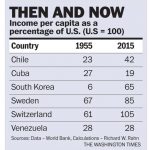
The amazing and disappointing fact is that every student or even casual observer of socialism knows that it always fails because it destroys the incentives for hard work, creativity and initiative.

EDITORIAL – How rich countries (mis)manage to go broke
The world has experienced the “tech bubble,” “housing bubble” and even the “tulip bubble." Now, we have the “government bubble.”
Rahn: The next financial crisis
The end is near – depending on how you define “near” and where you live.






