

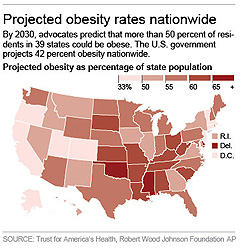
A group campaigning against obesity in the United States predicts that by 2030 more than half the people in 39 states will be obese — not merely overweight, but obese.
The state of Mississippi is expected to retain its crown as the fattest state in the nation for at least two more decades. The report predicts 67 per cent of that state’s adults will be obese by 2030; that would be an astounding increase from Mississippi’s current 35 per cent obesity rate.
The new projections were released Tuesday by Trust for America’s Health and the Robert Wood Johnson Foundation. The two organisations regularly report on obesity to raise awareness, and they rely on government figures.
But in this case, their dismal forecast goes beyond the 42 per cent national obesity level that federal health officials project by 2030.
About two-thirds of Americans are overweight now. That includes those who are obese, a group that accounts for about 36 per cent. Obesity rates have been holding steady in recent years.
Cayman struggles
The Cayman Islands is also faced with unhealthy lifestyles and overweight residents.
Dr. Diane Hislop-Chestnut said recently that the obesity rates of children, especially very young children, in Cayman were of major concern.
Last year, of the 533 children who entered primary school for the first time, nearly 30 per cent were overweight or obese. The school entry screenings showed that 13.7 per cent of the children aged between 3 and 6 – although the majority were 4 years old – were obese and 88 pupils, or 15.9 per cent, were overweight. The statistics on this year’s new school enrolments are being collated.
Also, last year, among children ages 10 to 13, 35.4 per cent were classified as overweight or obese.
“This is something we have to work together as a community to change,” said Dr. Hislop-Chestnut.
American projections
Trust for America’s Health officials said their projections are based in part on state-by-state surveys by the Centers for Disease Control and Prevention from 1999 through 2010. Those numbers come from what residents say are their height and weight when asked by interviewers over the phone. People aren’t always so accurate about that.
The researchers then looked at other national data in which residents were actually weighed and measured and they made adjustments for how much people in each state might fudge the truth about their weight. They also tried to apply recent trends in obesity rates, along with other factors, to make the predictions.
Officials with Trust for America’s Health said they believe their projections are reasonable.
But their outlook suggests that even in the thinnest state — Colorado, where about one-fifth of residents are obese — 45 per cent are predicted to be obese by 2030. That means that every state would have an obesity rate higher than 44 per cent.
Perhaps more surprising — Delaware is expected to have obesity levels nearly as high as Mississippi. Delaware currently is in the middle of the pack when it comes to self-reported obesity rates.
The report didn’t detail why some states’ rates were expected to jump more than others. It also didn’t calculate an average adult obesity rate for the entire nation in 2030, as the CDC did a few months ago when it predicted 42 per cent overall. But a researcher who worked on the Trust for America’s Health study acknowledged that report’s numbers point toward a figure close to 50 percent.
CDC officials declined to comment on the new report.
Whichever estimates you trust most, it’s clear that the nation’s weight problem is going to continue, escalating the number of cases of diabetes, heart disease and stroke, said Jeff Levi, executive director of Trust for America’s Health.
By 2030, medical costs from treating obesity-related diseases are likely to increase by $48 billion, to $66 billion per year, his report said.
The focus of so much of the ongoing debate about health care is over controlling costs, Levi said. “… We can only achieve it by addressing obesity. Otherwise, we’re just tinkering around the margins.”

Related Videos












A junkfood tax is needed now!
Come on Cayman, we can beat this – I reckon by 2020 we can crack this!
Looks like another situation where we should expect a lead from our Premier to do something about it.