Retired Privy Council judge Lady Arden of Heswall, who was among the panel of UK judges who ruled last month that Cayman’s Constitution does not provide a right for same-sex marriage, defended the decision, stating it is for legislators, not judges, to create laws.
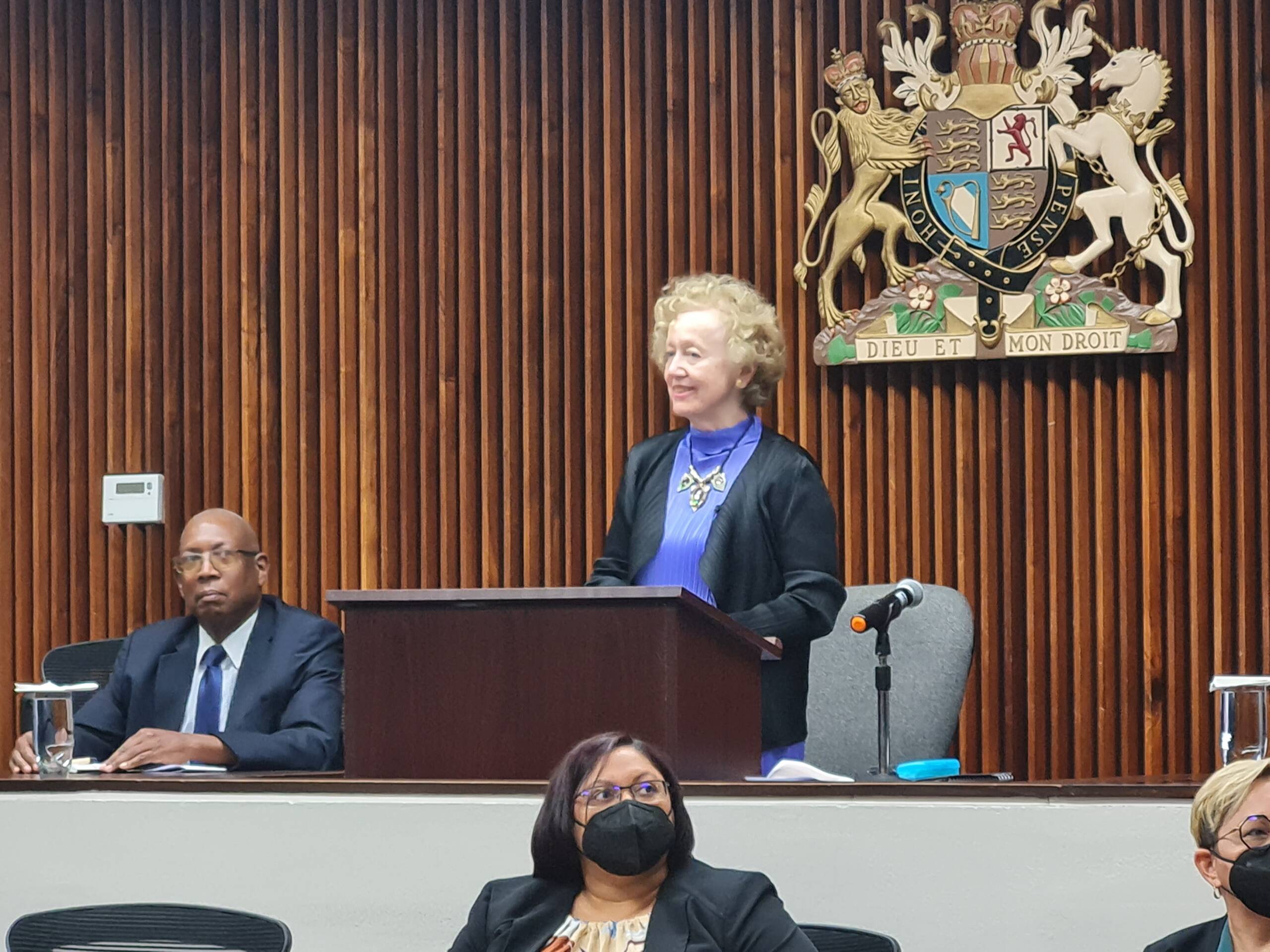
Speaking as the Cayman Islands Grand Court distinguished guest lecturer on Friday, 25 March, Lady Arden told scores of notable members of Cayman’s legal fraternity that a key turning point in the verdict was the principle of separation of powers.
In her lecture, titled ‘Taking stock of recent jurisprudence of the Judicial Committee of the Privy Council’, she warned that if the courts were allowed to make legislation, “the law could become a judge’s plaything” which could result in undermining the will of Parliament and the wider community.
During a brief question-and-answer segment, LGBTQ+ advocate Leonardo Raznovich of Colours Caribbean asked Lady Arden, “Are you failing to understand or are you reluctant to provide equality to minorities who have been persecuted throughout centuries?”
In her reply, Lady Arden said it was not appropriate to discuss the Privy Council ruling beyond what was already expressed in the judgment itself, and noted that a same-sex marriage law was still a possibility for the Cayman Islands so long as it was brought about by the legislature and not by a judge.
She declined to answer a follow-up question about her personal views on whether same-sex marriage should have been introduced.
Lady Arden’s comments come less than a month after she and four other Privy Council judges ruled against same-sex couple Chantelle Day and Vickie Bodden Bush, who initiated a legal challenge against Cayman’s marriage law.
The path to a Privy Council decision
The Privy Council is regarded as the final court of appeal, throughout England and Wales and several Overseas Territories.
Its primary role is to hear complex cases on issues of how the law across each jurisdiction is to be interpreted by providing an objective review of cases.
The process to have a matter appear before the Privy Council, in the case of the Cayman Islands, would first require the matter to pass through various forms of committees.
Cayman’s judicial system has four levels, the first being the Summary Court, which deals with large volumes of minor offences, such as assault, small thefts and traffic collisions.
Above the Summary Court is the Grand Court, where more serious matters, such as rape, murder, theft and/or drug offences involving large amounts, are dealt with. At this stage, a defendant is entitled to a trial by a jury of peers, whereas at the Summary Court level only judge-alone trials are held. The Grand Court also serves as a court of appeal for Summary Court matters. Both the Grand Court and Summary Court are divided into civil and criminal matters.
Above the Grand Court is the Court of Appeal. Unlike the Summary Court and Grand Court, which sees one judge presiding over each case, the appeals court has three judges sitting at the same time reviewing a case. Most matters ultimately end at this stage, because for a matter to progress to the Privy Council, it must first obtain permission from the Council.
Related Videos