
When crypto fund Three Arrows Capital was put into liquidation in May, creditors and investors with the fund were left wondering how much of their money they would eventually get back.
The investment fund used leverage – in other words, borrowed money – to invest in a wide spectrum of digital assets and crypto projects. Some of these led to the fund’s downfall.
The company’s $200 million holdings of stablecoin Terra/Luna (UST), a supposedly less-risky cryptocurrency, evaporated.
The value of digital assets left in the fund remains depressed as the collapse of UST exacerbated the effects of a wider sell-off in the market in the first half of this year.
This caused a domino effect among connected cryptocurrency businesses, not least those that lent money to Three Arrows.
One aspect of the fund’s portfolio is quirky, even in the world of crypto assets.
Three Arrows held a collection of NFTs, non-fungible tokens containing digital art.
NFTs – a market emerges
Non-fungible tokens are unique items verified and secured by a blockchain, the same technology that is underlying cryptocurrencies.
In contrast to cryptocurrencies like bitcoin, which are fungible – just like a US$100 bill can be exchanged for another, one bitcoin is replaceable by the next – NFTs represent unique code that can provide a secure record of ownership for a specific item.
This makes NFTs suitable for representing unique and therefore scarce assets, like art or other collectibles.
They can also be used to represent digital identities or certificates, which could encompass anything from licences and degrees to voting rights. There are many projects in development that aim to employ NFTs as an authentication mechanism, for copyright ownership or as a control tool to manage a supply chain.
The token asset can be both digital or physical, like real estate or fine art, which is bought and sold using the token and subsequently transferred off the blockchain.
So far NFTs have gained popularity as collectibles and trading activity mushroomed during last year’s crypto market bull run.
NFTs were first traded on a wider scale as part of video games, where they represent in-game assets that players were able to sell on in a secondary market. Together with digital art, game NFTs still make up a significant portion of daily trades.
Companies, sports teams, athletes and artists jumped on the trend and started minting their own NFTs to build their personal brands among consumers and fan bases. In addition to video, images or songs, they can include physical-world uses, like event tickets or access to stars, which adds to their inherent value.
Some tokens are no different from baseball cards. Major League Baseball does, in fact, have a functioning NFT marketplace, both for digital and physical cards, and is offering an NFT fantasy game.
But crypto art has caught most of the attention with eye-popping sales prices. Artist Beeple, otherwise known as Mike Winkelmann, sold ‘Everydays’, a collage of 5,000 digital images for $69 million through an NFT in March 2021. Later in the year, he sold his first physical piece of art with an NFT for $28.9 million, also through auction house Christie’s.
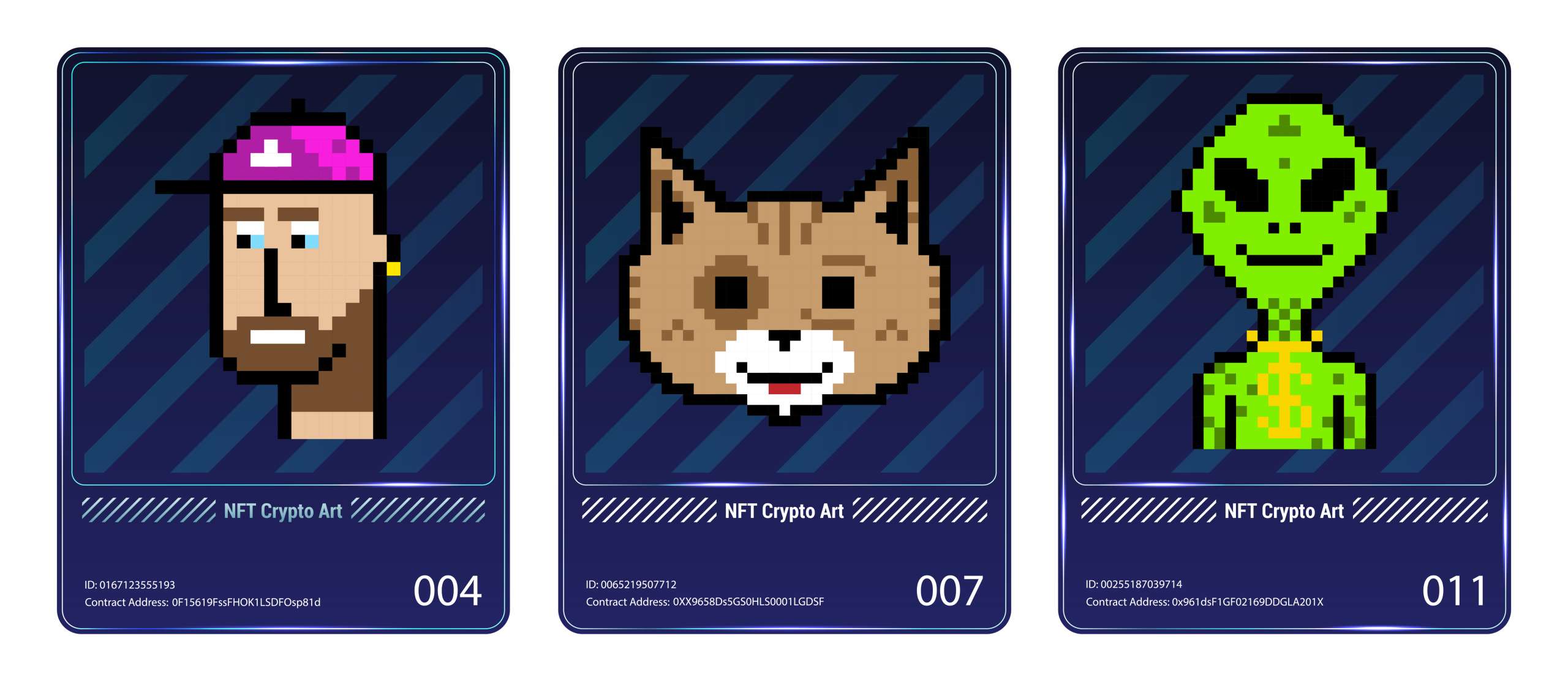
Digital cartoon images of bored apes or pixelated characters became popular collections, fetching several hundreds of thousands of dollars per item.
From peak to trough
Last year, Three Arrows launched Starry Night Capital, a fund that aimed to raise $100 million and invest in rare NFTs.
The Three Arrows founders partnered with a pseudo-anonymous NFT collector using the moniker Vincent Van Dough, who said on Twitter, “Our thesis is simple, we believe the best way to gain exposure to the cultural paradigm shift being ushered in by NFTs is owning the top pieces from the most desired sets.”
At the time, cryptocurrency values and NFT sales were riding on a high. Since then, the crash of cryptocurrencies has taken down NFT sales from a peak of $12.6 billion in January 2022 to less than $1 billion in June, according to blockchain data platform Chainalysis.
“This decline is definitely linked to the broader slowdown in crypto markets,” Ethan McMahon, a Chainalysis economist, told The Guardian. “Times like this inevitably lead to consolidation within the affected markets. For NFTs, we will likely see a pullback in terms of the collections and types of NFTs that reach prominence.”
OpenSea, the biggest NFT marketplace, experienced a monthly sales volume drop of 70% in June and began laying off staff in July.
High inflation, rising interest rates, and high volatility in the equity markets have led to a more risk-off attitude among investors that also affected digital assets.
The JPG NFT Index, which tracks several blue-chip NFT projects dropped by more than 70% since its launch in April, although it has recovered somewhat in July.
High-value, premium virtual art has also been impacted. The floor price, or cheapest item, of one of the most popular and high-priced collections, the Bored Ape Yacht Club, has dropped 39%, whereas the CryptoPunks collection last week fully recovered the almost 50% floor price decline since its peak in January.
Items in either collection are advertised for hundreds of thousands of dollars. Three Arrows reportedly spent $21 million on such high-priced digital art NFTs. Various crypto analysis websites now estimate the collection is just worth around $7.5 million.
With the secondary NFT market seeing only a fraction of the activity it used to, even these valuations are questionable.
KR1, a British digital asset fund, which said it invested $5 million into the Starry Night Fund, has, out of caution, written off its entire investment.

Uncertain valuation methods
Digital art and collectibles do not vary much from their physical counterparts, and valuation methods can be just as opaque.
Scarcity and desirability are two important factors in either market but emotional connection, hype and the fear of missing out also play their part.
When NFTs are connected to real-world assets, the value of the asset, its utility, popularity and rarity will drive the value of the token. But when that utility is stripped away in a digital asset, like the image of a bored ape, not much remains for investors to go by.
Asking prices, for instance, do not mean much without an actual sale.
Some valuation methods use the floor price of a collection, others the last sale price of the item adjusted for current market conditions, or the US dollar price at the time of the sale.
Because NFTs are bought and sold using cryptocurrency like Ether, it is not entirely clear whether changes in the value of underlying cryptocurrency should affect the cash value of the token.
Some argue that a piece of virtual art purchased for the equivalent of a specific dollar value in Ether should not lose its value only because the underlying cryptocurrency has lost value.
But this would mean that the market still has the same interest in digital art NFTs as during the peak of last year’s bull-run.
Current market activity indicates that is not the case. In fact, many NFT investors hoped that the rising tide of cryptocurrency values would also lift the worth of their NFT collections.
Another issue is the potential for market manipulation using wash trades. This is when traders buy and sell the same item back and forth to create the illusion of demand or to influence the price.
Just like in the regular art world, transactions between related parties could be used to drive up perceived market values.
The owner of Everydays, for instance, also owned a collection of other Beeple NFTs, leading to the accusation that the sales price paid for the digital collage was just a publicity stunt to raise the value of the collection, which was subsequently marketed through the issue of 10 million fractionalised ownership tokens.

Some believe that because NFT transactions are recorded on the blockchain, the verified values bring more transparency to the market.
Ian Thornton-Trump, chief information security officer at Cyjax, explained to delegates at the Cayman Islands Digital Economy Conference, CYDEC, in June, that this was an illusion, as it just opens a new avenue for scams.
One way to manipulate prices would be to pay for an NFT with cryptocurrency on a blockchain, while cash is changing hands in the opposite direction to record inflated but ‘verified’ values for everyone to see.
“The value of NFTs is wildly fluctuating,” Thornton-Trump said, because ultimately they are only “going to be worth as much as someone is willing to pay for it”.
The amount of fake NFT transaction activity is unknown, but the first criminal charges are rolling in for anything from simple theft from investors in NFT projects and insider trading to selling stolen, plagiarised or counterfeit tokens.
Despite the ebbs and flows of the market, the number of active NFT buyers and sellers continued to grow until the second quarter of this year, Chainalysis said in its recent State of Web3 report.
The research firm believes the recent period of reduced institutional activity, those trading NFTs for more than $100,000, “coincides with what appears to be an overall decline in interest in NFTs generally”.
Meanwhile, cryptocurrency data aggregator CoinGecko identified a trend towards items that resemble fine art in its second quarter crypto market update.
“During a market downturn, traders usually seek solace in more timeless pieces that traditionally hold value better,” the report said.
Related Videos