


With the cruise port referendum only a few weeks away, the battle for the hearts and minds of residents on either side of the debate is heating up.
The pro-pier Association for Cruise Tourism (ACT) group held two press conferences within three days last week to press home its arguments, while the anti-pier Cruise Port Referendum (CPR) Cayman is holding a fundraiser and public meeting on Wednesday, 9 April, at Sunset House and continuing to gear up its campaign in the run-up to the 30 April referendum.
At its most recent press briefing, at the Marriott on 3 April, ACT painted a pessimistic picture of the future of Cayman’s cruise tourism if a pier is not built, stating that by 2030-2032, “an estimated 75% of regional cruise passengers will be on ships that require berthing and they will not stop in Cayman”.
The audience at the tourism discussion, which included cruise industry pioneer Giora Israel, were told that, without piers, the cruise tourism product will effectively die out in Cayman, and lead to the loss of thousands of jobs.
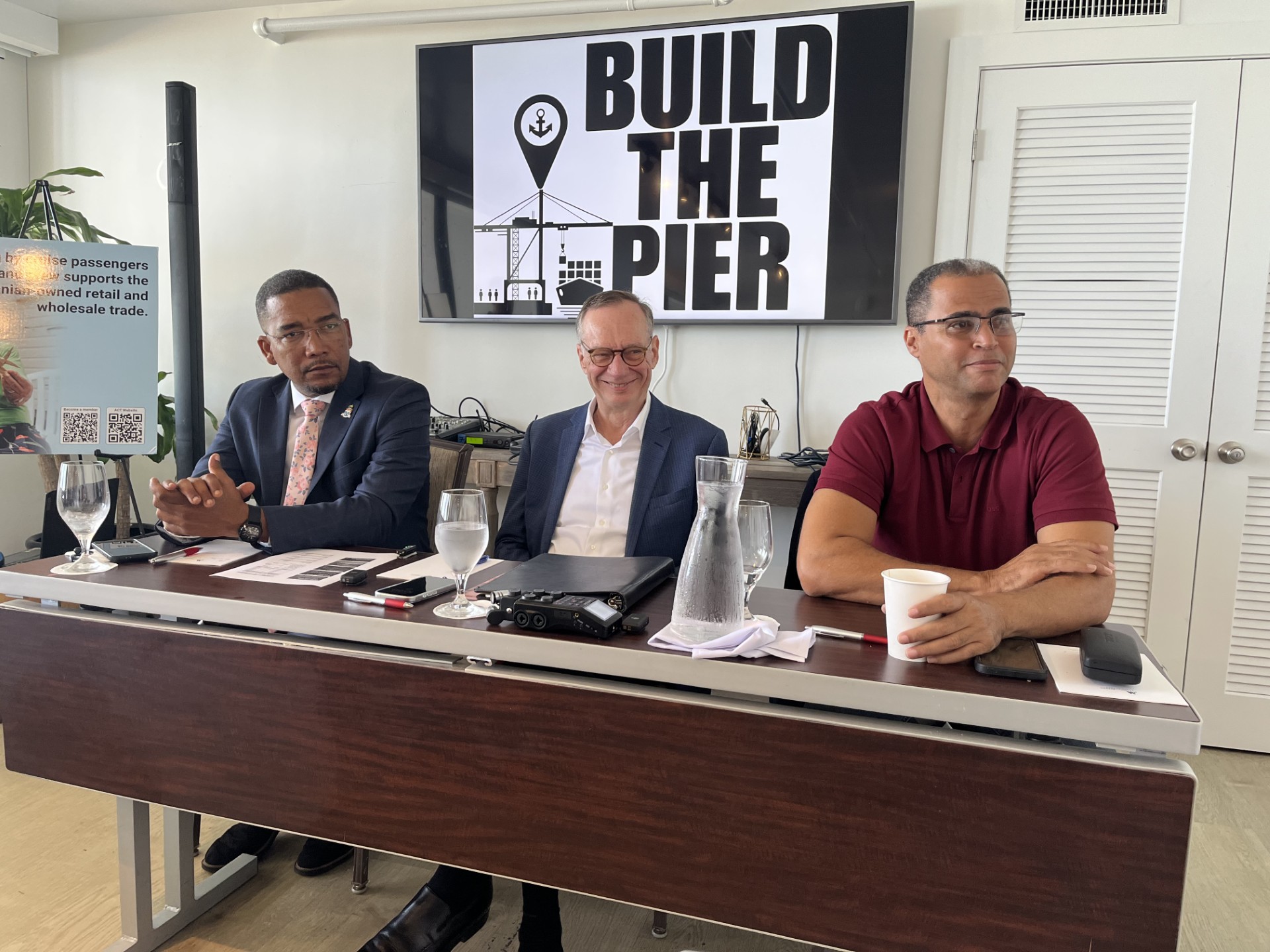
“The idea that we can go down to one ship every five days is illogical. So many businesses will shut down,” said Deputy Premier Kenneth Bryan, who was also on the panel. “Without piers, we will go back to what is described as ‘seasonality’, where a lot of shops will close until the winter time.”
Israel emphasised that mega ships with more than 5,000 passengers do not and will not tender – not in Cayman, Belize or even parts of Europe.
“This a global cruise industry policy, not specific to Cayman, and it is due to operational complexity, time constraints and accessibility concerns,” he said.
Bryan said he was “worried that over $350 million worth of economic investment in our country is at risk of being lost, and that doesn’t even include the potential lost revenues to government”.
“It is not just watersports operators and the tour businesses that won’t be able to survive. It’s the people that clean the carpets of the taxis, the suppliers of food, the delivery persons, the gas stations, the mechanics who fix and repair boats. It is all interconnected,” he said.
Environmental impact on marine eco-system
The environmental impact of a pier where giant cruise ships can dock has often been cited as an argument against building one in Cayman.
Israel said he had been involved in the development of numerous cruise piers around the region, where “the docks are built on pylons so the water flows through and it is minimally invasive”.
Citing examples in multiple Caribbean destinations, including Cozumel, Roatan, Grand Turk and Nassau, he said the marine ecosystems rebounded post construction.
“They have clear, blue water under the piers, and the reef and marine life is thriving,” he said.
Controlling numbers
One audience member rose and asked about concerns that, “Once these piers are built, are you are going have this mass amount of people, and everything is going to be overloaded?”
Bryan responded, “We don’t have a numbers issue. It is more of a management problem because we have been growing in an ad hoc way, without a proper plan.”
“It’s my job, along with the government and the next minister of tourism … to manage our attractions and our transport systems to make it efficient enough, so it doesn’t affect the quality of life of the people,” he said.
Israel stressed that Cayman is fully sovereign with regard to its cruise product and can also control how many ships or passengers it accepts. He provided examples from Bermuda and Nassau that he said show that destinations can successfully manage visitor numbers through policy.
“Tendering is time consuming and weather dependent and physically challenging for some passengers,” said Ellio Solomon, executive programme manager of the Association for Cruise Tourism.
He re-emphasised that the industry is changing.
“Ships that once carried 1,000 to 2,000 passengers have evolved to carry 6,000 to 7,000, making tendering no longer viable,” Solomon said.
CPR Cayman: Information is missing
Meanwhile, CPR Cayman, which opposes the cruise pier concept, issued a press release the same day as the ACT press conference, pointing out, “While the Government-initiated referendum is non-binding, it will be up to the new Government that comes to power after the 30 April 2025 election to determine the country’s position on cruise berthing. …
“The current Government who have brought this unnecessary referendum, have not provided any pertinent data or verifiable information to support this attempt to move forward on a cruise berthing facility which would saddle the country with more significant long-term debt.”
CPR Cayman argued that even without a pier and with passengers using tenders, passenger numbers are actually growing, stating, “February 2025 cruise arrivals are up 21% and Cayman remains 6th for the highest number of arrivals in the region in 2024.”
In its release, the group said the cruise berthing facility proposed in 2019 “would have cost the country over CI$400 million over 25 years, and would have required the dredging of over 20 acres of seabed and destruction of 12 acres of coral reefs”.
Referring to a recent report by economist Marla Dukharan, which concluded that the development of cruise berthing infrastructure in Cayman is “unnecessary” and would not necessarily reverse the decline in cruise passenger numbers, CPR Cayman countered
ACT’s arguments, stating the Dukharan’s analysis does not suggest Cayman’s cruise sector is in jeopardy.
“In fact, on the contrary, Cayman’s dominant cruise sector already has a higher than average per passenger spend, higher than average disembarkation rate, higher than average onshore tour purchase rates, higher than average earnings per passenger for onshore excursions, and a trend towards smaller and more high-end cruise lines and ships vs mass-market, which supports and is consistent with Cayman’s luxury brand, and the emphasis on quality over quantity,” the group said.
Related Videos











21 days before the referendum and no clear information on how the piers are going to impact, the environment, the way of life, the cost and where the funding will come from considering the government will be in a deficit. I will be voting no!
When I first moved to my Cayman Islands home over 40 years ago there were no cruise ships calling and a thriving George Town that local people came to.
The development of the cruise industry has turned our capital into a place that local people avoid, unless they want to buy an expensive watch, jewelry or a tacky T shirt.
The dreadful mess made of the so-called beatification project has been a hopeless waste of money that has increased traffic delays and caused several local businesses to close.
We DO need a better, deeper commercial port. But not a cruise port.
The reality is that without a dock Cayman will attract only the smaller ships which are older and have a lower per passenger rate charged by the cruise lines. They therefore attract a lower income passenger who spends less.
Cayman needs the newer, larger ships that carry the affluent , higher spending passenger and the only way to do that is to build a dock (and preferably select the ships and cruise lines that bring the quality of passenger that are synonymous with the high quality brand of the Cayman Islands).
To deny the building of the dock is to continue to attract the type of passenger that does not fit the image that the people of Cayman seem to want. The antis are lowering the image and damaging the economy
Dredging for the Cruise Berthing project:
1) Would destroy the reefs for miles off both side of Georgetown. The dredging “toxic” debris dust will suffocate the reefs and kill the breeding ground for all marine life.
2) The existing 7 Mile Beach erosion problem would become extremely worse. What is left of the yearly natural sand shifts from east to west would just fall into the 30 foot deep berthing trench. “NO” natural beach replenishment.
I remember in 2019 when Kenneth Bryan wanted to “force” the Cruise Berthing project without a referendum vote. Stating his political party were voted by the people to make decisions for the country. His political party had a CHINA owned company to build it with no upfront cost to Cayman Islands. Just a longer term 30 year lease with China keeping all the Port Fees. What a huge mistake that would of been! Thank God for the 7,000 signed petitioners!