

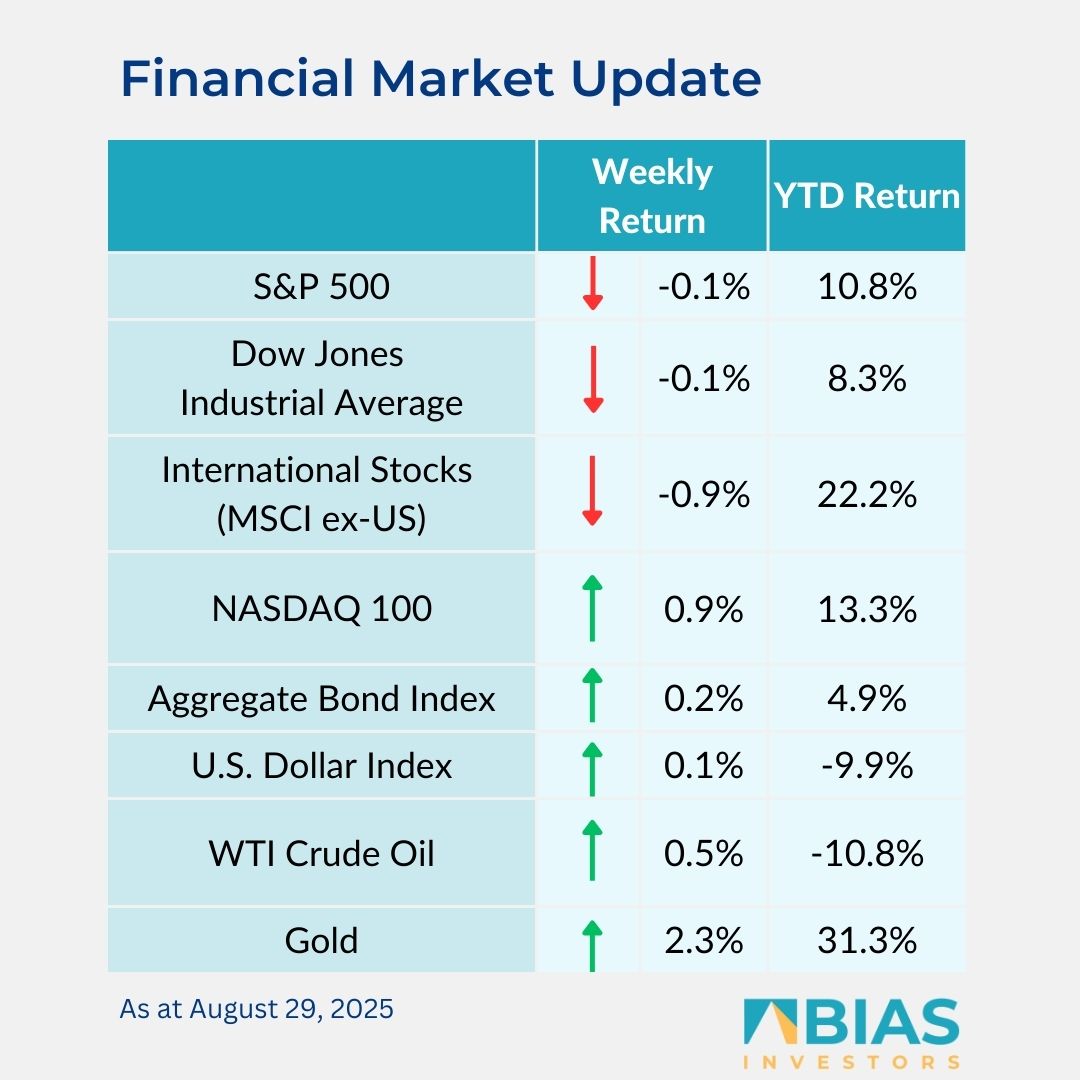
The equity markets posted a gain for August. It was the fourth straight monthly gain for the S&P 500 Index and the fifth straight for the NASDAQ.
For last week, the S&P 500 Index was -0.1%, the Dow Jones Industrials -0.1%, and the NASDAQ +0.9%.
The energy, financials, and communication services sectors led the S&P 500 Index for the week, while the utilities, consumer staples, and industrial sectors lagged.
The 10-year US Treasury note yield decreased to 4.224% at Friday’s close versus 4.257% the previous week.
September could see a pivot from the Federal Reserve on monetary policy. We’ll get a firmer view at the end of this week when the August Employment Situation Report is released.
A weakening labour market could push the Fed’s hand to an initial interest rate reduction.
In addition to the Employment Report this week, we have inflation data with the August Consumer Price Index (CPI) and Producer Price Index (PPI) scheduled for next week.
This all leads up to the Federal Open Market Committee (FOMC) Meeting on 17 Sept. Current CME Fed funds futures are projecting two 0.25% rate cuts for 2025, starting at the September meeting. One 0.25% cut is also projected for the first quarter of 2026.
The last few companies in the S&P 500 Index need to report earnings. This week, seven companies in the S&P 500 Index are scheduled to report earnings.
With these few reports remaining, S&P 500 Index earnings growth expectations for the quarter are 11.9%, up from 4.8% at the start of the reporting period, and revenue growth is expected at 6.4%, up from 4.2%.
Full-year 2025 earnings are expected to grow by 10.6% with revenue growth of 6.0%.
In our ‘Dissecting headlines’ section, we look at why less Americans are moving.
Dissecting headlines: Staying put
Have you not met any new neighbours lately? That is probably because Americans are moving less frequently than they used to.
In the early 2000s, approximately 14% to 15% of the population moved each year. Based on data from the Census Bureau, that number is now down to 8%.
Reasons cited for the slowdown in moves include higher home prices and mortgage rates discourage selling and buying, fewer people needing to relocate for jobs due to remote work, an aging population, and more Americans prioritising staying close to relatives and support networks. This last reason likely is for economic reasons as well.
Most of the moves were, and still are, local, within the same city or state. However, a distinct migration pattern has emerged with more Americans moving out of higher-cost states to lower-cost states.
From 2020 to 2024, the top five states seeing the largest loss of population are California, New York, Illinois, New Jersey and Massachusetts. The top five state gaining population are Florida, Texas, North Carolina, South Carolina and Tennessee.
Reasons cited for the southeast migration include lower cost of living, especially housing costs, lower tax burden (three of net in migration states have no state income tax), quality of life (mainly weather and congestion), and remote work flexibility.

BIAS Investors (Cayman) Ltd.
Grand Pavilion (Hibiscus Way)
802 West Bay Road
Grand Cayman, Cayman Islands
W: biasinvestors.com
E: [email protected]
T: 345-943-0003
Subscribe to the BIAS Investors newsletter here.
Related Videos