

Cayman’s mid-range residential property market has seen both prices and transaction volumes cool in recent years, yet the luxury segment continues to outperform.
That was the view from a panel of experts assembled to discuss the market at the Property Update Forum 2025, organised by the Royal Institution of Chartered Surveyors.
One point that all panellists agreed upon is that Cayman’s property market is clearly divided between the luxury and middle segment, with almost no lower-income, affordable housing. “There are two segments here – luxury and normal,” said Amanda Bodden, senior vice president and head of retail banking at Butterfield Bank and president of the Cayman Islands Bankers Association.
So, any analysis of the market must be tailored to a particular segment. All the panellists agreed that the middle segment has cooled in recent years. With higher interest rates and the increased cost of living cited as factors that might be dampening local demand for mid-priced properties.
“We saw the total number of transactions decrease by 1% between 2023 and 2024,” said Ruth Watson, chief valuation officer for the Cayman Islands Government. Yet the average value of those transactions – across all three islands – increased to US$650,000 from US$590,000 over the same period.”
Interest rate impact

“We saw the US prime rate go up by 5% over an 18-month period, so that had a lot of impact on [property] activity,” said Bodden. Local variable rate mortgages in the Cayman Islands are pegged to the US prime rate, which increased to 8.50% in July 2023, from 3.50% in March 2022. “But we also need to think about what we use as baseline for any comparisons when talking about activity. 2021 saw a surge in our population, which coincided with a well-timed release of inventory by construction forms but that probably isn’t repeatable.”
“The market is definitely softer,” said James Bovell, a broker and owner at RE/MAX Cayman Islands. “The last two years have been softer, down about 10% year-on-year, but currently stable.
I think a fair amount of that was driven by interest rates going up over the last few years. But now the market had dealt with that and is now moving forward with decent activity.”
Indeed, on 17 Sept. the US Federal Reserve cut the prime rate to 7.25%, a move that directly led to cheaper mortgage rates in the Cayman Islands. Further cuts, perhaps down to 6.75%, are expected before the end of the year.
“I think we’ve seen a little bit of a cooling off, but I wouldn’t call it a downturn,” said IRG president, Jeremy Hurst. “Challenges are more in the mid-market. But with the recent interest rate cut, once it cascades down, I think that will help stabilise that part of the market as well.”
Luxury outperformance
Data shared at the forum demonstrated the resilience of the luxury sector. “Between 1 Jan. and 30 April 2024, we received approximately 39 transactions of high value properties ($3 million and above) with an average sale price of $4.5 million, but during the same period in 2025, we received approximately 23 high value transactions but with an average sale price of $6.1 million.” said Watson.
Some panelists suggested the luxury sector’s strength is because buyers are relatively less impacted by cost of living, interest rates and stamp duty. “Luxury property prices are not typically impacted by the rate cycle, as there are plenty of cash buyers to maintain demand and we still have inventory available,” said Bodden
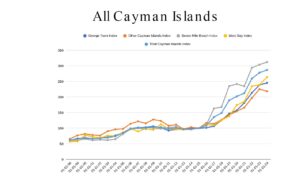
Indeed, data from the Cayman Islands Residential Property Price Index, which was launched by the Department of Lands & Survey at the Forum, shows that Seven Mile Beach, which has a high concentration of luxury properties, was the best-performing area between 1998 and 2024.
But while cash buyers are impervious to mortgage rate changes, panellists highlighted other factors that could impact the market in the future. The rising cost of storm and flood insurance is one threat, with a panellist mentioning multi-million dollar deals that collapsed once the international buyers discovered the insurance costs.
Immigration reform was also a hot topic on the panel. “I can understand why the government wants to reform the immigration system,” said Bovell. “Ultimately, they feel that Caymanians aren’t getting the opportunities. But we should also acknowledge that this will impact the real estate sector because it means less demand for housing. And presumably that would also impact government finances as stamp duty is the fourth-largest source of government revenue.”
Related Videos













Expats have been leaving, property prices have been dropping. Fellow Caymanians, now is your time to buy. Although the government won’t get any stamp duty money from us locals. Ha.
Let’s see how that works for the government.
I’m confused Ben.
My understanding is that Caymanians pay Stamp Duty when they buy.
Unless it’s a low value property.