The Financial Reporting Authority’s 2025 report revealed how the jurisdiction worked to prevent digital assets being used for money laundering, narcotics trafficking and child abuse.
The 62-page report from Cayman’s financial intelligence unit was full of statistics and detail, but one of the most telling trends to emerge from the report is that virtual asset service providers (VASPs) are now the largest source of suspicious activity reports (SARs) from Cayman-based entities.
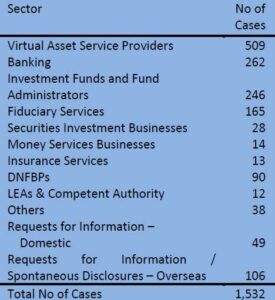
VASPs accounted for 509 of the 1,377 SARs submitted to the authority in 2025 – a 36% increase from 2024. That’s particularly notable given that there were only 18 registered VASPs in Cayman in 2025, compared to thousands of funds.
The report also gives detail on the types of suspicious activity flagged by the digital asset companies. For example, the report highlighted an “ongoing money laundering investigation into Subject A for receiving the proceeds of narcotics trafficking”.
In this instance the VASP was advised to keep servicing the client so that overseas law enforcement agencies could continue to monitor the subject. Eventually, the Cayman Islands Bureau of Financial Investigation obtained a seizing order against the assets.
Another example of serious criminal activity to emerge from the report concerned a “crypto wallet associated with child abuse related material”.
The Financial Reporting Authority received a SAR from a VASP after identifying that Subject A had directly transacted with a crypto wallet associated with child abuse related material. Subject A resides in Country 1. The account holder did not live in the Cayman Islands, so the authority passed on the information to its international equivalent in the relevant country and local law enforcement.
The regime is working

“The FRA Annual Report details numerous interesting statistics, including in relation to the Defence Against Money Laundering Regime, introduced at the beginning of 2025,” said Elisabeth Lees, co-founder of the boutique law firm Claritas. “This means that the person filing the suspicious activity report, normally a financial service provider, requires a defence from being prosecuted for money laundering in order to deal with the proceeds of crime being reported as suspicious.”
Lees noted that in the case of the VASP that was advised by the authority to keep servicing the client after it had filed the suspicious activity report, a property freezing order was subsequently obtained, preventing the assets being dissipated. “This shows that the regime is working, in that it is identifying the proceeds of crime and preventing them from being moved in order that they can be recovered.”
Not all of these cases end in judicial action. Sometimes the information is used “to develop strategic analysis on cyber enabled fraud,” the authority’s report stated.
There were also suspicions of more mundane activities. “During the year the FRA noted an increase in SARs from VASPs involving ‘cash back’ or reward farming behaviours that appear to have been exploited by their customers,” noted the report. “These ‘wallet specific behaviours’ like chain peeling, repeating self trades or circular transfers, using mixers or privacy tools raise suspicious patterns and are considered potential money laundering indicators.”
The report also noted that many SARs were linked to illicit markets on a hidden part of the internet known as darknet. “The Darknet Markets included: fraud shops; sale of illicit drugs; sale of credit card information or other personal identification; and entities sanctioned in another jurisdiction.”
Related Videos