

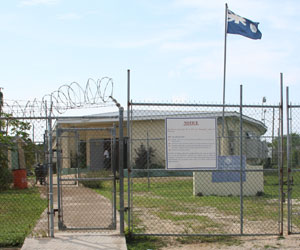

In a rare move, the Cayman Islands government asked the Office of the Complaints Commissioner to “reconsider” a decision it reached regarding the December 2010 strip search of three teenage female inmates at Fairbanks Prison.
That investigation, completed in October, led Complaints Commissioner Nicola Williams to determine the prison guards’ strip search of the three young women was done in retaliation for a complaint letter one of them had written about the guards. The finding contradicted an earlier decision reached by the government Portfolio of Internal and External Affairs, which has responsibility for prisons in Cayman.
“I disagree with both the Deputy Governor Designate [Franz Manderson] and his Acting Chief Officer [Eric Bush] in this regard,” Ms Williams wrote in investigative findings. “In my opinion, the strip search was retaliatory and there is evidence to support this.”
In a letter sent to Ms Williams on 23 December, then-Deputy Governor Donovan Ebanks wrote: “I would invite you to please revisit this matter and reconsider the decision which you arrived at back in October 2011, that the search was retaliatory.”
The complaints commissioner agreed to review the case, an exceptional step. Typically, decisions of the OCC are given the same weight as those issued by a court and can only be challenged if the office has investigated an area of the government service it is not allowed to probe or if it is determined that the office has not acted in good faith.
In this case, Ms Williams agreed to review the matter, noting the circumstances of the case warranted such a move “since no OCC opening letter (also known as a Notice of Investigation} was sent to Mr. Manderson”.
Mr. Manderson emailed Ms Williams on 28 October, following an article in the Caymanian Compass which noted the complaints commissioner’s findings which alleged retaliation in the Fairbanks Prison search, asking her to clarify several matters.
“The deputy governor [referring to Mr. Ebanks at the time] … is very concerned about some aspects of your investigation and its findings,” Mr. Manderson wrote.
Then-Deputy Governor Ebanks wrote on 23 December that he felt portfolio officers had been “inappropriately treated and maligned” by the OCC.
Ms Williams, in an email of 16 November, apologised for not sending a Notice of Investigation letter informing Mr. Manderson formally that a complaint had been made against him and/or his government entity, in this case, the Portfolio of Internal and External Affairs.
However, she also noted: “My decision and recommendations remain the same.”
In a separate response, made to Mr. Ebanks on 25 January, Ms Williams also took exception to what she believed amounted to the then deputy governor telling her how to do her job.
“With respect, it is up to me as commissioner to decide how I conduct an investigation, as long as there is a legal basis for it, as is the case here,” she wrote. “I do not accept that just because I have reached a different decision to those public officers that I have maligned them.”
Upon the OCC’s second review of the case, Ms Williams’ office found there was a “legitimate reason to conduct the search” at Fairbanks for the cell phone devices. Cell phones are officially not permitted in either the male or female prison facilities in the Cayman Islands.
“However, there was no legitimate reason in all the circumstances to resort to strip search rather than any other form of search,” Ms Williams noted, adding prison officers only had reason to search one inmate, not all three.
“Although there is insufficient proof that the original motive for the search was retaliatory, there is, in my opinion, sufficient proof that there was an element of retaliation in the execution of the search,” the OCC reported.
4 December, 2010
Two prison officers at Fairbanks were disciplined last year following the December 2010 strip search of the three inmates in a prison dorm.
The search was made one day after a few of the inmates wrote complaint letters concerning certain prison policies and which also alleged laziness or inactivity on the part of some of the prison officers.
Messrs. Manderson and Bush had earlier found that, while methods used by prison officers in effecting the 4 December, 2010 search may have been unreasonable, they were not done in retaliation.
Two of the prisoners reported hearing one of the prison guards involved in the search stating “that’s what you get for writing a letter about officers” after the search was over.
This account is corroborated by statements from two prison officers taken in the course of the government’s review of the incident.
One prison officer stated during her interview: “Yes, [the prison officer] said ‘that’s what you get for writing letters about officers.’ I was in the shower area and heard that.”
A second officer, who was also on the scene, said: “I’m not sure how to put it word-for-word, but my understanding was that the search was brought on by some letters wrote and something was said about that’s what happens when you write letters.”
These statements, taken in the context of what occurred on 4 December, 2010, do not equate to proof that the search was done in retaliation, Mr. Manderson said in an earlier interview.
“It should be noted that the complaint letter was in relation to a policy decision made by prison management and was not directed at any prison officer,” Mr. Manderson wrote in a letter to the father of one of the prisoners in March.
“In relation to the strip search … the investigating officer has determined that [the inmate] was not singled out or treated any differently from the other inmates in the same ‘pod’. The investigating officer has concluded that, on balance and in hindsight, other search techniques could have been deployed on 4 December, 2010, other than a strip search. However … there is no evidence to suggest that the strip search was capricious or retaliatory.”
According to a sworn affidavit filed by one of the inmates who was strip searched: “A large group of officers came to our dormitory and announced that they were going to strip search us for a cell phone. I refused to be strip searched. I was then forcibly held down, cuffed, strip searched, bruised and had my clothing ripped. Only after I was forcibly strip searched did one female officers go to my bed to retrieve the phone.
One of the two cell phones found in the prison dorm was in plain sight on the inmate’s bed, according to the prisoner’s account of what happened.

Related Videos












This revelation follows on from the disclosure last month that Mr Ebanks had objected not only to the content of Dan Duguay’s audit report on Operation Tempura but also to the fact that he had dared to challenge some of the decisions made.
Closing his memo to Mr Duguay, dated 15 July 2009, Mr Ebanks commented – I fail to see how it will make any positive contribution to overall better understanding by the public of why the funds have been spent and whether they are better off as a result.
He then went on to make a perverse comparison beween Tempura and a patient in rehab. In simple terms the whole tone of the memo expressed annoyance that Mr Duguay, who was just doing the job CIG paid him to do, had dared to interfere and blow the whistle on where all the money went.
People like the Complaints Commissioner and the Auditor General are in post for a purpose – they provide the essential checks and balances in the public sector – and when senior civil servants take it on themselves to seek to obstruct those duties the whole community starts a journey down a long, slippery slope into chaos.
In the event, when the full facts on Operation Tempura emerged the reason for the annoyance became apparent and hopefully that audit will be revisited this year in the light of new evidence. Already investigations are underway in the UK into two aspects of it.
But does it not make you wonder how many other legitmate investigations into public service activities have been subject to this kind of unwarranted interference?
The first story is at – http://compasscayman.com/caycompass/2012/01/04/Ex-Gov-sought-delay-in-Tempura-report-release/
John
I know that we disagree on certain aspects of this entire Operation Tempura thing but in truth, we agree on much more than we disagree.
For example, I’m totally in your corner in your quest to have ALL the available information released into the public realm because I believe that the cost to the public purse warrants it.
But you have to admit, all the evidence points to what has been Caymanian culture in past years and generations when the ratification of all human rights statutes and legislation was continually and consistently REFUSED by successive Cayman Islands Governments…with the supervisory power, the United Kingdom turning a completely blind eye to this refusal and its consequences over the years, until this culture set in…an attitude of Cayman’s authorities refusing to accept any challenges regarding the right or wrong of some of their actions.
That many of these challenges have ended up before the Privy Council in London and the cost of the loss of these cases to the CI Govt. is a matter of record, not opinion; any search will show millions of CI dollars having been paid to complainants long before Operation Tempura ever took place.
If the PPM Govt, in 2006, had not finally ratified the ECHR treaties regarding the right of individual appeal before the ECHR, these independent commissions of investigation and inquiry would never have come into existence.
With these continuing attitudes from the CI Govt., one can only imagine what type of cases will be brought before the Human Rights Commission when it becomes fully functional under the impending Bill of Rights later this year.
What this will lead to is not critical letters from Cayman’s officials but a straight human rights abuse case brought by the complainant before the courts in the Cayman Islands; whether this impending threat changes the attitudes of Cayman’s authorities in any way still remains to be seen.
As you can see, fromm all this evidence, old habits take a long time to die.
Firery, to paraphrase a current story in the UK, this is all a ticking timebomb waiting to go off. You make a lot of good points throughout your comment.
As for seeking the truth? It’s like my garden – the more you dig, the more dirt you turn up.
Right now (and this is posted elsewhere) I am fighting the FCO who are trying to argue that release of more material, which I am not allowed to specically identify for legal reasons, on Operation Tempura is a threat to international interests, a matter of national security and presents a threat to the safety of the UK.
Makes you wonder what the documents contain and what really went on?
The UK’s Information Commissioner has also, without apparently consulting anyone, taken it upon themselves to rule that release is not in the interests of the people of the Cayman Islands. In simple terms I think he just means that he feels that Caymanians are not ready for what I want made public.
With friends like that who needs enemies?
If two investigative bodies arrive at two different conclusion, there is every right to consider a re-examination of the facts.. I believe Mr Manderson was correct in asking for a review, and Mrs Williams an astute diplomat in doing so.
As for Operation Tempura; Cayman has spent enough money on that mess, and’ if the UK says we have nothing to gain by releasing more information, I will go with their call, especially if they mention national security be it ours or theirs.
I am behind Ms. Nicola Williams 100%, I do feel like it’s was retaliatory due to the written letter.
These prison warders and police officers feel’s like they can do what they want, when they want and how they want. Well here is a lesson to be learnt!