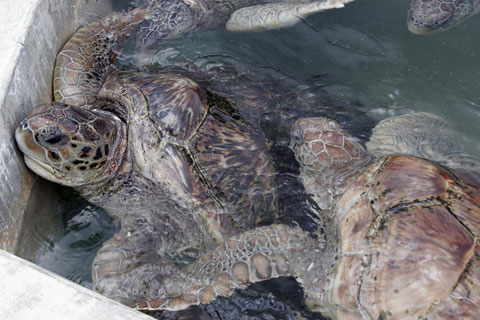
The Cayman Turtle Farm had a net loss of nearly $7.5 million in its 2012/13 financial year, according to an audit released last week.
In addition, the tourist attraction is still carrying more than $21 million in debt due between the date of the report and 2019, according to the financial statements reviewed by Auditor General Alastair Swarbrick’s office.
Those figures are an improvement over what the government-owned park reported during mid-2012, when the facility lost $8.1 million and owed nearly $24 million in long-term debts.
As they have for the past several financial years, auditors noted a “going concern” regarding the farm’s finances.
“Cost overruns of the development of the park, lower than projected visitor numbers and operating costs in excess of initial budgets have given rise to significant business risks that cast uncertainty over the company’s ability to continue as a going concern,” the 2012-2013 report said.
“Operational results subsequent to June 30, 2013 indicate that the company continues to generate significant losses from operations and experience cash flow difficulties.”
Earlier audits revealed that the turtle farm used or budgeted some $30 million in government “equity injections” between mid-2010 and mid-2012, but turtle farm officials have said such reports do not give “the full picture” of significant successes in recent years.
Revenues for the farm increased in several key areas, officials said. According to the farm, tours sold to cruise ship passengers were up by 13 percent in the 2011/12 budget year compared to the previous year. Overall tour revenues increased by 7.4 percent during the same time. Food and beverage sales and gift shop revenues each increased by more than 10 percent during the year, and revenue from the sale of turtle meat was up 16 percent.
The installation of a water slide in one of the park’s lagoon’s in December 2011 has been a boon, officials said.
The tourism facility is also reducing its debt from a significant expansion that began a decade ago. The borrowing, once totaling around US$54 million, were reduced to CI$24 million by the end of the 2011/12 fiscal year and have now been reduced even further. Most of the equity payments during the various budget years went to retire debt from previous loan payments, not to pay for operating costs, farm officials said.
What’s it worth?
As in the past, auditors pointed out that the turtle farm does not maintain an accurate register of its assets and has done no assessment of the fair market value for its property, plant or equipment.
A management report sent to the turtle farm by auditors and made public last year indicated: “The lack of a detailed fixed asset register increases exposure of the company’s assets to theft and fraud. Additionally, it increases the risk of error in the financial statements as it may result in fully depreciated assets being further depreciated.”
Auditors also noted that, because of this, assets may be considered “impaired,” essentially worth less than stated.
Auditors recommended that assets at the farm be identified and that officials determine if anything is recoverable from impaired assets. A government valuation of turtle farm land and buildings was planned, but has not yet occurred.
Debt
The turtle farm, which is overseen by a government-appointed board, also owes about $5 million for various bills, some dating as far back as 2006.
“The company appears not to be in a position or possibly does not intend to pay these invoices as they have been outstanding for a significant amount of time,” the management letter stated. “[The transactions] appear to be an equity injection from the government.”
Auditors said the amounts due should be taken off the books if they are to be classified as an equity investment, rather than a debt. What that means, according to auditors, is that taxpayers most likely will never see repayment. Similarly, the farm received interest-free loan advances from government in 2007 and 2008. Those advances were due to be repaid five years after the date the facility became fully operational. Again, the loan advance amounts were determined to be “unlikely” for repayment.
The turtle farm said to date it has had no response from government about the issue.

Related Videos