China has called for an emergency meeting of key nations
amid tension in Korea over the North’s deadly shelling of a Southern island.
It proposed that members of the six nations that have
been taking part in talks on North Korean nuclear disarmament should meet in
December.
The two Koreas, the US, China, Japan and Russia are
involved in the talks.
Correspondents say South Korea’s response has been
non-committal and that it will consult other countries.
Tension remains high on the peninsula, with the US and
South Korea undertaking joint military exercises the North has denounced as a
provocation.
The six-party North Korea talks have been stalled since
April 2009, and South Korea and the US say they should not resume until the
North has made a genuine offer on halting its nuclear programme.
Some analysts think North Korea is trying to raise
tensions in order to strengthen its negotiating position and force a resumption
of the talks.
Wu Dawei, China’s representative to the talks, said on
Sunday: “The Chinese side, after careful study, proposes to have emergency
consultations among the heads of delegation to the six-party talks in early
December in Beijing to exchange views on major issues of concern to the parties
at present.”
He said this was not a proposal to resume formally the
six-nation negotiations.
Mr Wu said “complicated factors” had arisen on
the peninsula, adding: “The international community, particularly the
members of the six-party talks, is deeply concerned.”
The BBC’s Chris Hogg in Seoul says the response of South
Korea and its allies to China’s move has been less than enthusiastic.
A South Korean foreign ministry statement said the
proposal would be “reviewed very carefully”.
South Korea’s Yonhap news agency said President Lee
Myung-bak had told visiting senior Chinese foreign policy adviser Dai Bingguo
that Seoul was not interested in the early resumption of the six-party nuclear
talks themselves, as it was more urgent to deal with Pyongyang’s belligerence.
Japan’s Deputy Chief Cabinet Secretary Tetsuro Fukuyama
said that Tokyo would “deal with the issue cautiously while cooperating
with South Korea and the United States”.
The Korea crisis began when the North launched a sudden
barrage of shells at Yeonpyeong island, close to the maritime border between
the two countries, on Tuesday.
Two South Korean civilians and two marines were killed,
sparking the resignation of the South’s defence minister and angry protests in
the South.
Pyongyang insists it was provoked into the shelling by
military exercises, which were being carried out by the South close to
Yeonpyeong.
The US and South Korea on Sunday began new, pre-arranged
military exercises in the Yellow Sea, about 125km (77 miles) south of the
disputed maritime border between the two Koreas.
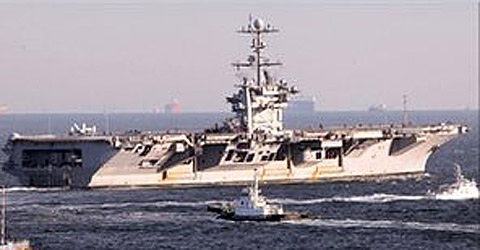
The aircraft carrier the USS George Washington and four
other US navy vessels are being joined by South Korean destroyers, patrol
vessels, frigates, support ships and anti-submarine aircraft.
Shortly after the exercises began, North Korea again
vowed to hit back if its waters were violated.
“We will deliver a brutal military blow on any
provocation which violates our territorial waters,” the North’s
state-controlled KCNA news agency said.
Yonhap reported that Pyongyang had placed
surface-to-surface missiles on launch pads in the Yellow Sea and had also moved
surface-to-air missiles to frontline areas, but the South’s defence ministry
could not confirm the deployment.
Residents of Yeonpyeong were ordered to shelter in
bunkers when artillery fire was heard on Sunday, but the order was lifted 40
minutes later. Only about 20 of the 1,700 residents remain on the island.
The South Korean defence ministry has also now instructed
journalists to leave by the end of Sunday as it cannot guarantee their safety.
“At this stage, it is unpredictable what kind of a
provocative action North Korea will take using the South Korean-US joint drills
as a justification,” the ministry said.
Yonhap also reported that South Korean troops on Sunday
accidentally fired an artillery round into the Demilitarised Zone (DMZ) that
divides the nations. Seoul quickly sent the North a message saying it was an
accident, the news agency said.
Earlier, Mr Dai had told President Lee that Beijing would
try to prevent the situation deteriorating any further.
Mr Lee had urged China to take what he called a more fair
and responsible position on the relationship between the two Koreas.
The chairman of North Korea’s parliament, an official
known to be a close confidant of North Korean leader Kim Jong-il, has been
invited to visit Beijing next week.
Related Videos