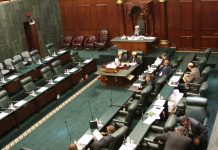
A move toward making the decision-making process more open and transparent with regard to planning and development has been recommended in a report tabled in the Legislative Assembly last week.
The 171-page report, prepared by San Diego-based Zucker Systems, suggests making planning meetings open to the public as one way of attaining the broad goal of the People’s Progressive Movement government to have open, transparent, honest and efficient public administration.
The Zucker report states that how that goal is met varies from government to government.
‘…But we believe it should start with a more public hearing process,’ the report states. ‘The current system of closed deliberations among the [Central Planning Authority] and the [Development Control Board] and the use of two sets of minutes – one set for the Authority members and one set for the applicant – does not convey a sense of openness.
‘If the general public does not have access to planning case files, it is very difficult for staff to portray a sense of openness and transparency.’
The report states that many of the CPA and DCB members interviewed ‘had significant issues with opening deliberations, stating the islands were too small and too personal for open deliberations’.
‘But a parallel can be drawn between the Cayman Islands and small rural towns in many parts of the United States that have similar population and geographic constraints.’
While stating that it did not want to impose an American-style planning process on Cayman, the Zucker team believes the planning process could be made more open and transparent to the benefit of all parties.
In presenting the report to the Legislative Assembly, Minister of Planning Kurt Tibbetts recognised the difficulty in implementing the recommendation.
‘While there is something of a paradigm shift required to open the authority’s meetings to the public, my ministry is committed to working with the Planning Department the CPA and the DCB to determine how to make the planning process more open and transparent, with the ultimate goal of having open deliberations and decision making, which I am confident will result in a better process overall.’
The report also makes 169 other recommendations, to be implemented in two phases.
The first phase, which identifies 135 recommendations, will take between six and nine months to implement, while the remaining 35 recommendations, which make up phase two, will take 18 months to implement.
Mr. Tibbetts said the recommendations dealt with all aspects of the Planning Department’s services.
‘The recommendations of this report provide us with a blueprint, identifying areas for improvement and making specific recommendations for change,’ he said.
‘This is no small report and its implementation will be no small task. However I am confident that the professional staff of the Planning Department is up to the challenge of implementation of the recommendations in this report…’
The report and recommendations were compiled after the Zucker team conducted a series of meetings with the Planning Department staff, stakeholder focus groups and other government agencies. Customer surveys were also done by mail, as well as surveys of Planning Department staff.
The report identified six priority areas, including timelines for approvals and inspections; staffing; resources; delegation; development plan, planning laws and regulations; and technology.
‘One important recommendation is the implementation of the proposed Builders Bill,’ Mr. Tibbetts said, adding that he intended to bring the bill to the House when it reconvenes later this month.
‘This proposed legislation will provide for the tiered registration of contractors and will give members of the public some assurances with regards to the qualifications of the contractor they hire.’
Mr. Tibbetts said the lack of registration for contractors creates more work for the Building Control Unit because of multiple review cycles and additional inspections than required.
‘It is my hope that once the Builders Bill is implemented, we will see an improved quality of construction and a subsequent decrease in the need for repeated re-inspections by the Building Control staff,’ he said.
Another recommendation in the report includes moving toward next-day inspections by Building Control.
‘Currently, there is – on average – a three-day lag time between an inspection request and the inspection,’ Mr. Tibbetts said. ‘This is resulting in contractors requesting inspections before they may be ready, sometimes resulting in partial inspections or incomplete inspections, which increases the workload for the Building Control Unit staff and causes frustration for the builders and their clients.’
Mr. Tibbetts said he could not blame the contractors for trying to anticipate when their project would be ready for an inspection because they were not guaranteed a next-day inspection.
‘By moving to next day inspections, it is hoped that such occurrences will be minimised, resulting in increased efficiencies on both sides of the table.’
The Zucker report also recommends a full review of the Grand Cayman Development Plan, which has not been done in 10 years.
‘The Development Plan needs to be reviewed to bring it in line with today’s environment and make it more responsive to the current state of the Islands,’ Mr. Tibbetts said, adding that such a review is under way.
The Planning Department is planning to launch a public outreach programme in September, with the ultimate goal of tabling a proposed Development Policy Statement in June 2008, Mr. Tibbetts said.
Related Videos