Despite a number of challenges presented by events during his term in office, outgoing Governor Bruce Dinwiddy said his experiences here were very rewarding.
Mr. Dinwiddy leaves the island today after three and a half years of being Governor.
His term saw major controversies develop concerning the Euro Bank trial, the implementation of the European Union Savings Tax Directive, rising crime and the Cabinet Caymanian Status Grants.
‘The position offered me a lot of hard work and interest, but I wouldn’t have wanted it otherwise. I wasn’t looking for a retirement featherbed.’
But perhaps the event that most marked his term as Governor was Hurricane Ivan last September.
‘It was undoubtedly one of the biggest events in my life, really,’ he said. ‘I’ve had my fair share of crises, but nothing in my life like that.’
Though he was never too worried about his personal safety during the storm, Mr. Dinwiddy said he was deeply concerned for the people of Cayman after seeing the destruction caused by Ivan.
‘With the awful condition of the island, people were looking to me for help, to restore law and order, and to communicate with London for assistance.’
Although some people have been disappointed with the assistance provided by the UK after Hurricane Ivan, Mr. Dinwiddy said he thinks London has also learned from the experience.
‘There’s been a rethinking in London about disaster preparedness and guidelines of response for the Overseas Territories as a result of Ivan,’ he said. ‘There’s a closer understanding of the needs of the territories, and in the future, for example, there will be prompt reinforcement for other territories to address security issues.’
Hurricane Ivan also offered Mr. Dinwiddy some lessons on a personal level.
‘The experience helped make me more conscious about what the real fundamentals of life are,’ he said.
‘A number of people said to me afterwards, ‘we lost everything, but we’re thankful we’re alive.’ They said it was the gift of life that was most dear.
‘It was a very moving experience.’
Mr. Dinwiddy thinks the Quincentennial Celebrations might have actually helped prepare Caymanians for Hurricane Ivan.
‘The Quincentennial helped remind Caymanians and new Caymanians of the hard work and resilience required of old Caymanians. Cayman in years past was not any easy place to live.
‘I think all of that remembering and rhetoric helped after Hurricane Ivan in September,’ he said. ‘When the chips were down, people really helped one another.’
Mr. Dinwiddy said he was fortunate not to have lost all of his belonging in the storm, and his efforts to help the people of Cayman recover from Hurricane Ivan have not stopped since last September.
‘I’ve been totally active in the recovery and the recovery fund for the past 13 months,’ he said.
The National Recovery Fund is a project in which Mr. Dinwiddy has taken a special interest, so much so he will remain a trustee of that organisation after he leaves the island in effort to raise private sector funding in the United Kingdom.
The Recovery Fund’s progress is finally reaching his expectations.
‘I was disappointed at first, but I’m satisfied now. I think the telethon was a bit of a watershed.’
Mr. Dinwiddy said he thought many people just needed some time to get their own situations stabilised after the storm before donating to the Recovery Fund.
‘Now that a lot of individual contributors have sorted out their own cash flow situations and can focus on the way forward, we’re seeing more support,’ he said.
Mr. Dinwiddy said he had found the speed of some of the aspects of Cayman’s recovery ‘astonishing’, especially as it relates to the financial industry.
Other aspects of Cayman’s recovery, such as the rebuilding of physical structures, the rebound of the tourism industry and the return to pre-Ivan social behaviour, could take as much as two more non-hurricane years, Mr. Dinwiddy thinks.
‘Discipline has dropped, there’s no doubt about that,’ he said. ‘You can see it in the way people drive, the way there is litter everywhere, in the way people walk their dogs on Seven Mile Beach without leads.’
Mr. Dinwiddy said the police, the media, the political leaders, the religious leaders and organisations like the Chamber of Commerce all have an important role it getting things back to normal in Cayman.
‘I think it will happen, though,’ he said.
Cayman government
Mr. Dinwiddy said he has seen some positive advances in Cayman’s government since he arrived.
He said he was very pleased with the conduct of the last election, especially since it was the first contested under a political party system.
He also noted the smooth transition of power.
‘I think it’s a real tribute to the public service, and I’m not just saying that because I’m technically the head of public service,’ he said. ‘I think there is a high-quality public service here.’
Mr. Dinwiddy said he has seen a great improvement in budgetary management since he arrived. ‘This is a real advancement,’ he said.
One aspect of the government which has not progressed the way he would have like to seen was with the constitution modernisation process.
‘I thought we would have had more progress in the time I was here,’ he said. ‘I’m pretty confident, though, that there will be more soon, so Cayman can catch up with the other territories. It really is much further behind.’
Mr. Dinwiddy said he was confident the constitutional talks would resume sometime next year.
Ceremonial Dress
Although Mr. Dinwiddy said he quite enjoyed wearing the Governor’s ceremonial dress, he said the UK government was of the mind that the practice was getting a bit inappropriate and somewhat old fashioned.
‘The Cayman Islands was the only remaining true Caribbean Overseas Territory where the Governor’s uniform was still worn,’ he said.
In the end, however, the decision to end the practice fell to Caymanians.
‘It was a matter for the Cayman Islands people,’ he said.
Mr. Dinwiddy’s uniform will be donated to the National Museum, with the exception of one part.
‘My family is very keen for me to keep the sword as a memento of my position,’ he said.
The future
Although Mr. Dinwiddy will retire from diplomatic service, the 59-year-old does not intend to retire completely when he returns to London.
‘I’ll take things fairly quietly for a while,’ he said.
More than likely, Mr. Dinwiddy will do two or three different things, he said, to leave more time for family and recreation.
‘I’m not looking for a full time job, but I’d consider any offers,’ he said.
What he will miss
Mr. Dinwiddy said he will miss many aspects of his life in Cayman, but it is the people and the relationships he’s formed that he will miss the most.
‘The people have been so welcoming and warm,’ he said. ‘I have forged closer and more intimate relationships than I had anticipated.’
As governor, Mr. Dinwiddy said he must keep his distance from people in certain ways, but he found that no hindrance in developing many friendships here.
‘The biggest surprise of being here was the extent we were accepted by the people,’ he said.
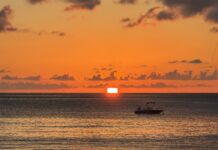
Mr. Dinwiddy said he would also miss the physical beauty of the Island, and living on Seven Mile Beach.
‘I particularly enjoyed it early in the morning and at sunset,’ he said.
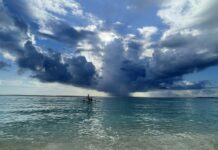
While here, Mr. Dinwiddy took a liking to swimming, and swam nearly every morning.
‘I’d never really done a lot of it before,’ he said. ‘Swimming developed here because it was at my doorstep.’
During his stay in Cayman, Mr. Dinwiddy participated in two of the Flower’s Sea Swims and a few 800-metre Sea Swims.
He will not have the opportunity to swim much back in London, so Mr. Dinwiddy will have to change his exercise regimen to ball-related sports such as golf, tennis and squash, he said.
Mr. Dinwiddy said he and his wife Emma enjoyed getting involved in the community and attending many local events, both here in and in the Sister Islands.
The couple also attended more than two dozen different churches while they were here, before settling in to going to Elmslie Memorial United Church for the most part.
Mr. and Mrs. Dinwiddy were also made honorary members of the Rotary Club.
‘I attended some of the luncheon meetings of the Rotary Club of Grand Cayman, while Emma attended some breakfast meetings of Rotary Sunrise,’ he said.
‘I must say, Emma and I have valued our honorary memberships of Rotary,’ he said, adding he would consider joining a Rotary Club in the UK after he returns.
‘Rotary has done a lot of good work here, which is important in a society with low taxation,’ he said. ‘They help fill in some of the gaps that Government cannot address. And of course Rotary offers a lot of good will and fellowship.’
Mr. Dinwiddy said he’d like to return for a visit to Cayman at some point in the future.
‘We’d like to come back and see the Islands again, and not just Grand Cayman, but the Sister Islands as well,’ he said. ‘We’d like to renew some of the friendships and enjoy the beauty of the islands as a tourist, with no work pressures.’
Although there’s no written protocol, Mr. Dinwiddy said it is generally understood that outgoing governors do not visit during the term of their successors unless they are specifically asked to for some reason.
‘I’m sure it will be three of four years before we return,’ he said.
Mr. Dinwiddy has already met his successor, Stuart Jack, in London when he was there during the summer.
‘He’s a very high-calibre individual,’ he said. ‘In a policy sense, in some ways he is better known in London than I was.’
The Dinwiddys will meet with the Jacks in London again on 12 November for a briefing session.
‘He and his wife will meet with Emma and me face to face so we can tell them about the island,’ he said.
‘I wish him and his wife every success,’ he said. ‘In some ways, I’m envious.’
Mr. Dinwiddy said he’d offer Mr. Jack this piece of advice: ‘I’ll tell him, just be yourself.’
Related Videos