Apparently, I don’t know how to breathe.
I discovered this as I took my fifth mouthful of saltwater
in as many seconds while trying to fill my lungs with air in a pre-Flowers Sea
Swim assessment.
On the beach, swimming coach Dominic Ross watched my efforts to swim straight
out to sea toward the first buoy off Governor’s Beach and back, ready to
critique my performance and offer some advice once I’d struggled back to shore.
Encouragingly, he said my stroke was generally OK, but I was pulling my head
too far out of the water each time to breathe. I’d had to, I thought, as there
were waves and water and things like that between me and my oxygen.
I was using up a lot of energy and making it harder to make my way through the
water breathing that way, the coach said.
Ross advised me to turn my head a little to the side on every second or third
stroke to take a breath, without taking my head too far out of the water.
It’s easier said than done, he admitted. “It takes a while to get used to it,”
he said.
He advised that if I was taking my head out of the water to see where I was
going, there was no need, because the lines of sand I could see below me while
swimming run parallel to the shore, so the chances of swimming onto the beach
by mistake when I take part in the mile-long sea swim on 18 June are unlikely
if I just follow the lines of sand.
Putting it to the test
Then, I headed back into the water to put some of his advice to the test. As it
turned out, my breathing efforts were as bad as ever, but I figured with a few
more days of training, I’d manage to swallow only two or three gallons of sea
water during the Flowers swim.
This time, I swam parallel to shore for a little while, following the lines of
sand I could see clearly through the water. However, in the five minutes I was
out of the water, my stroke had clearly suffered because when I got back out,
Ross had some advice for me on what I was doing wrong there.
“You seem to be putting your elbow in the water first,” he said. Instead, the
tips of my fingers should be entering the water before any part of my arm,
slicing into it and cupping water as I bring my arm below me and to my side
before coming back out of the water.
Ross advises people to do some training before tackling a one-mile sea swim.
“Do 400 metres one evening, 600 metres the next, maybe 800 the next. Build up
to it,” he said, pointing out landmarks along the beach so I could gauge how
far to swim.
Second go
This would not be my first Flowers Sea Swim.
I did it in 2009 when in a moment of madness, I signed up
for the swim the day before the event when I spotted people signing their names
to a list outside the Brasserie. It seemed like a good idea at the time.
Fast forward a day. About one minute into the swim, with my unlucky number 44
penned in black on my arm, it dawned on me that a mile is actually quite a long
way, especially if you’ve done no training and there are more than 700 other
swimmers thrashing around you.
I came 733rd that day, in one hour and seven minutes.
Anyone who takes more than 75 minutes to finish the swim doesn’t qualify to be
entered into the draw for prizes after the race and isn’t listed in the final
results. The thought of swimming through bursting lungs and cramped feet and
not even getting on the final scoreboard spurred me to pick up my pace and
“sprint” the last five minutes toward the finish line.
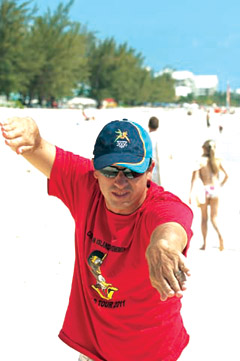
When I finally got to the end, I was so red in the face and panting so hard
that I was asked if I needed medical assistance. I politely demurred before
grabbing the nearest four bottles of cold water and downing them.
This year, I’m hoping that I can pass some of the 732 people who swam faster
than me last year.
After watching my efforts, Ross encouraged me that I’d do fine and he was
optimistic I’d finish well within the 75-minute deadline. I hope he’s right.
His advice for novice swimmers – take it easy, find a rhythm you can handle,
don’t start off too fast and, most of all, try to enjoy yourself.
When I finally got to the end, I was so red in the face and panting so hard
that I was asked if I needed medical assistance.
Related Videos