I signed off my last article by asking the question: Maybe I
should be practicing instead of writing? True to my word, I haven’t written
until now, (nor practiced that much
either, but that’s another story) Instead I’ve been focusing my energy on something
else.
Making a CD is a little like having a baby. They both take
about nine months and people tend to judge you based on how they do in the
world. Undeterred, people keep making babies and recordings. True, it is unlikely a recording will ever get
drunk, crash your car into the side of the house, or tell you it hates your
guts but it will suck the life out of you nonetheless. I’ve had six ‘children’
so far and am in the process of having a seventh. Not bad for someone who lives
in a small one-bedroom in Manhattan.
The first idea behind my latest CD No Smoking came from
trying to get a friend of mine in Italy to stop smoking cigarettes. She agreed
to stop if I wrote a piece that would make her. I took up the challenge and
produced a short, high-energy piece about the length it takes a very committed
smoker to finish a cigarette. She hasn’t smoked one since. Does my piece have
the same effect on everyone? I’m not sure, but if so, the people at Philip
Morris might want to have a word with me.
The other idea behind the title is my personal style of
performing which greatly favours the leather over the smoking jacket. My entire
concert philosophy is about communicating on multiple levels. I try to create a
relaxed atmosphere in which one can feel comfortable enough to participate in a
more interactive experience. Relaxed leather look, yes. Stiff waiter look, not
so much.
So what does producing a CD entail?
When I talk about making a CD I’m talking about a
self-produced CD. That means you record the music, edit it, and make all the
artwork for the final product. I’m not
talking about the kind where the executives at Sony come knocking at your door
and whisk you off in a stretch limo)
Recording
First there’s the part where you actually sit down and
record in a studio. Preparing for a
recording is slightly different from preparing for a concert. There is no live audience you can feed off.
Nor that edge-of-your-seat feeling of “you have only one shot at getting this
right” which pervades any live performance. You simply hear the recording
engineer say “take one” and after waiting a couple of lonely seconds you break
the silence with a valiant first note. You might picture a packed concert hall,
thousands of anxious fans in rapt silence eagerly awaiting your first sound but
in reality you are surrounded by microphones, stereo equipment and more
microphones. How anything good can come out of this is a mystery. Yet sometimes
it does. The great Canadian pianist Glenn Gould (1932-1982) favoured recording
over live performance and in fact, stopped performing altogether after 1964. As
a performer, used to playing live concerts, the concept of a ‘second shot’ is
rather mind-blowing. In fact, more often
than not, it can take the edge off a performance. That’s why recording is
tricky in the same way making a movie is tricky. In fact, it is precisely the
difference between making a movie and performing a play.
Editing
So you no longer have just one chance to play something. You
have, well, depending on your deadline (and budget), infinite chances. In
reality, you get tired rather quickly, and also usually find out that the first
attempt at recording something is often the best. But since you don’t believe this possible,
you usually make several attempts which rather quickly leave you spent. But
that’s not the worst thing you’re left with, as now you have a body of
different recordings of the same material. Usually a large body. The idea is
you can piece together your performance from different ‘takes’ of the same
piece. This doesn’t sound too appealing but seems to be the generally accepted
standard. I recently heard that the famous Italian pianist Maurizio Pollini’s seminal
recording of the Chopin Etudes is chock full of cuts. Didn’t seem to hurt his status too much. I
remember being an extra during the filming of the final scene of “Anger
Management” with Jack Nicholson and Adam Sandler. Adam didn’t really know his
lines and kept messing up. This seemed to be perfectly alright as they were
going to fix everything in the editing room.
But a world where I get to be on an even playing field with Pollini,
Nicholson and Sandler can’t be all bad.
That said, however, actually going through the many different versions
of a performance to pick out the best from each and then string them together
is not something you want to embark upon without a high-end espresso machine on
hand.
Photoshoot and art
The most important thing that can happen in the life of any
CD is getting purchased. (Yes, that’s you I’m talking to.) To make certain this
happens, probably more important than the music itself is the photo on the
album cover. This may sound silly but can
mean the difference between selling and not. Since the product people are
buying is actually “you” a nice photo of yourself is generally a good idea. The
key is striking a pose ideally somewhere between an “I-really-don’t-need-you”
look to a “you-really-need-me” one. (The
same kind we use so effectively at the beginning of romantic
relationships.) With CD artwork I’m of
the idea that less is more. Stay away from busy graphics.
Selling
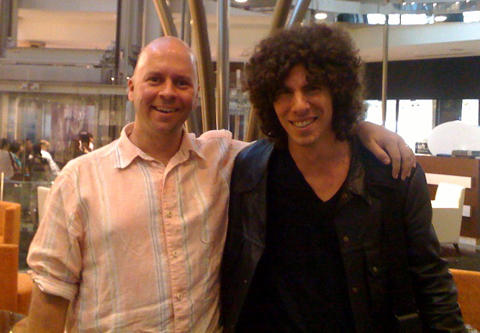
I recently had the good fortune of talking with Derek
Sivers, the ex-founder and owner of CDBaby, the biggest online music store for
independent musicians. Derek is a
personal hero of mine and of many other musicians. One of the smartest and
coolest (not a typical combination) people you will ever meet. When I sat down for coffee with him I had the
feeling I was sitting down with Bill Gates. He started his company in 1998
because he wanted a place to sell his own CDs online and by the time he sold it
ten years later it had grown into 150,000 musicians with over $100 million in
sales. Derek’s piercing blue eyes and straight talking attitude come through in
everything he does. He actually cared for his company like you would care for a
baby (true, there were no diapers involved) I told him that at live shows,
where you actually do most of your CD sales, the actual person selling the CDs
makes a huge difference in the amount sold. So much so that it would almost be
worthwhile to travel with someone who is able to move the merchandise
best. This is the story he told me in response.
A band Terry McBride was managing (Griffin House) was doing
the usual thing of selling CDs for $15. He would mention it once or twice from
the stage, and sell about $300 per night on average. He asked them to try a
completely different approach: Say to
the audience, “It’s really important to us that you have our CD. We worked so
hard on it and are so proud of it, that we want you to have it, no matter what.
Pay what you want, but even if you have no money, please take one tonight.”
Mention this again before the end of the show, adding, “Please, nobody leave
here tonight without getting a copy of our CD. We’ve shared this great show
together so it would mean a lot to us if you’d take one.” It changes the
request from a commercial pitch to an emotional connection. Soon the band was
averaging CD sales of $1,200 but even more importantly because everyone left
with a copy of the music they became much bigger fans, told their friends about
it, and listened to the music more. When the band returned to those cities,
attendance doubled.
Derek is in the process of creating a new company called
muckwork (muckwork.com) whose byline is “we do your dirty work”. Though it
sounds like it could be a line from one of the Godfather movies this company is
actually about having someone else do the uncreative “dirty” work so you can
concentrate on playing, writing, and improving. Another brilliant idea from a
brilliant mind.
Creating something out of nothing is a wonderfully
invigorating feeling. I feel much better just by having written this article
and chances are, people will continue making CDs and babies for quite some time
for similar reasons. My CD “No Smoking” will be coming out in about a month and
while fans don’t seem to be queing up for it like the new Ipad I personally am
very excited. Oh, and about that friend of mine in Italy who quit cigarettes,
well, she’s since taken up the pipe, but that can be our little secret.
Mostly Julian
Julian Gargiulo is a pianist and composer who divides his time between wishing
sabre-toothed tigers weren’t extinct and making paper pirate hats out of his
old bios. In between his involvement as fundraiser for and friend of
www.diabetes.ky, he also finds time for touring with his albums, working on his
nonprofit 16000children.org, curating the Water Island Music Festival in the US
Virgin Islands and Crossing Borders of Hunter College in NY, and endlessly
walking the streets of New York in search of people to add as Facebook friends.
You can contact him on [email protected].
Related Videos