

Under section 55 of the Cayman Islands Constitution, the
responsibility for internal security, including police, falls to the governor,
without prejudice to the responsibilities of the National Security Council.
The National Security Council, which is mandated and first
came into existence as a result of section 58 of the 2009 Constitution, advises
the Governor on matters of internal security, with the exception of operational
and staffing matters. What this means is that ultimately the responsibility for
nuts and bolts aspects of policing falls under the governor as the United
Kingdom’s representative in the Cayman Islands.
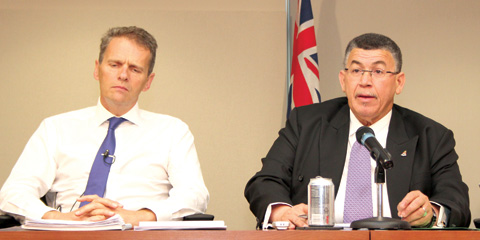
Governor Duncan Taylor’s role in fighting crime, however, is
one of an administrator, and it’s the police commissioner who dictates
operational matters.
“I supervise and line manage the police commissioner and
therefore I take an interest in his operational decisions and how he is going
to try and deliver law and order,” Mr. Taylor said during an interview.
The police commissioner, currently David Baines, formally
briefs Mr. Taylor every two weeks about what is happening on the policing
front.
“I have a formal briefing, called the Governor’s police
briefing,” he said, noting that the briefing is also attended by the deputy
governor, the chief officer and deputy chief officer of the Portfolio of
Internal and External Affairs, the head of the governor’s office and usually
deputy police commissioners.
“It’s really a briefing to update me and the others on key
issues facing the police and what’s happened in the previous two weeks,” he
said. “I don’t need to know every little detail of everything the police are
doing, but it is good to look at the numbers and have a chance to be briefed
and talk about any of the more serious things that are going on. It’s also an
opportunity to ask questions and to talk about longer term issues and funding
issues and things like that as well.”
Mr. Duncan said that besides the formal briefing every two
weeks, he speaks to Commissioner Baines regularly.
“I would say that hardly a day goes by that I’m not speaking
to the commissioner about something to do with policing; pretty much every
day,” he said. “Anytime that there is an incident of note, like a robbery or
something like that, I’ll probably get a call from the commissioner, just to
let me know, make sure I’m aware, give me a quick briefing and give me the
opportunity to ask any questions. So I would say that I’m kept pretty well
informed, and pretty rapidly and regularly informed of what’s going on.”
However, they way the governor and commissioner interact can
differ to a certain degree with different governors and commissioners.
“How the relationship works depends a lot on the confidence
the governor has in the commissioner,” Mr. Taylor said, adding that he has a
lot of confidence in Mr. Baines.
“I think we’re lucky to have a very strong commissioner
here, and I’m very happy generally to leave him to decide operation of what he
should be doing,” he said. “To my mind, if you have a good commissioner, I like
to try and leave him the space; I don’t want him to feel I’m trying to second
guess everything that he’s doing or that somehow I might know better about what
he does as an experienced, senior police officer, or how he should deal with
things. But I do like to know.”
FCO oversight
Mr. Taylor reports to Foreign and Commonwealth Office, which
he said is interested “in everything which is to do with how well the Overseas
Territories are being governed, and that includes law and order”.
“But their interest is sort of an arms-length interest,” he
said, noting that the Overseas Territory directorate in London wouldn’t attempt
to interfere in how policing is run in the Cayman Islands.
The FCO does, however, put some resources into helping the
Overseas Territories maintain law and order. Mr. Taylor said there is a police
advisor who provides advice and support to the Overseas Territories based in
Miami.
“He is in regular touch with the commissioner, but also he
comes here from time to time and visits the other Overseas Territories,” he
said. “If the commissioner wanted to bring in some expertise on something from
the UK, he might well want to talk to the advisor on that, as an example.”
National Security
Council
Cayman’s National Security Council was created when the new
Constitution came into effect in November 2009.
Governor Taylor acknowledges that the structure of the
Council is a little odd, given that he chairs the body which in turn gives him
advice.
“I guess the idea that the Council should be chaired by the
governor is because the governor is responsible for internal security,” he
said. “It’s a slightly odd concept in a sense that I want to challenge members
there to discuss things, kick them around, in a forum that is going to be
advice to me.”
In addition to the governor, the Constitution mandates other
members of the National Security Council include the premier, two other Cabinet
ministers, the leader of the opposition, two people from civil society, the
deputy governor, the attorney general and the commissioner of police.
Even though the Council is relatively new and still finding
its way, Mr. Taylor believes it will be a worthwhile entity.
“Obviously all of us on the council, and certainly I as the
chair of the council, want to make sure this is a body that actually makes
Cayman a safer place and it’s going to add value and not just going to add
another layer of bureaucracy… and it’s not just going to be a talking shop that
achieves nothing.”
However, being new, it will take a little time for the
National Security Council to find its feet.
“All these [constitutional] commissions need to find their
role and find their place the National Security Council is no exception to
that,” he said.
Governor Taylor does see limitations in the Council’s
mandate.
“It is mandated to provide advice to the governor, but on
strategic security matters,” he said. “Strategic really means long term in this
context.”
The Crime Reduction Strategy, which was the Council’s
primary focus during its first year in existence, is one example of the kind of
long-term strategy matters he sees the Council dealing with.
“[W]hat we’ve done is looked at existing programmes that
might come under the umbrella of reducing crime in one way or another,” he
said. “It’s looking at programmes that address at-risk youth and rehabilitation
and issues like that and it’s just trying to look at whether we can essentially
coordinate those better.
“But what we don’t have in there are suggestions and
recommendations that are suddenly going to reduce crime levels we’ve seen in
the first quarter of this year in the second quarter of the year because those
are operational matters for the police, so we’re looking more at a strategic
level,” he said. “The members of the National Security Council are of course
concerned about day-to-day crime as well, and would like to make suggestions
about how we can tackle those issues, but those would be dealt with
differently… that’s really for the police commissioner…”
Mr. Taylor said having responsibility for internal security
meant he had the final say on policing matters.
“As an example, if elected representatives felt that police
should be conducting operations in a particular way, and the commissioner
and/or I didn’t think that was the right way to go, in theory I would be able
to say, ‘no we’re not going to do that, we’re going to go with what the commissioner
wants to do’,” he said. “In other words, the representatives are voting the
money and they have a very real and clear interest in what’s going on, but they
can’t dictate how policing is carried out.”
Differing views
Premier McKeeva Bush generally agrees with the Mr. Taylor’s
interpretation of the Constitution when it comes to the National Security
Council.
“The National Security Council really doesn’t empower the
elected government to deal with crime,” he said. “What it does is it gives the
elected government a voice in how crime is dealt with.”
Mr. Bush pointed out that only three elected members of the
government in power – himself and two other Cabinet ministers – sit on National
Security Council.
“We are only three of nine NSC members,” he said. “So unless
we have the backing of other members, what we say may not necessarily be taken
on board.”
Since its inception, the National Security Council has
mostly busied itself with the preparation of a National Crime Strategy, which
is the kind of thing Mr. Bush thinks the organisation should be doing.
“The National Security Council is notdoing any more than I
thought it would and that the Constitution gives it power to do,” he said.
Legislator Alden McLaughlin, who became a member of the National
Security Council when he became leader of the opposition in February 2011,
disagrees that the Council is doing everything it can.
“[T]he truth of the matter is the National Security Council
is a very powerful body,” he said. “I don’t think the governor actually wishes
to acknowledge just how powerful it is.”
In Mr. McLaughlin’s view, the governor no longer has any
role to play in policy making in Cayman, except where he holds a special
responsibility.
“That is the remit of Cabinet and he’s not even a member of
Cabinet,” he said.
Mr. McLaughlin said that in his view, the National Security
Council had to start getting “its teeth into policy”.
“It must start examining what it is we’re doing or not doing
at the policing level, not at the operational level, but in terms of policy,
the policy we’re adopting to deal with the growth of crime. That is the proper
role of the National Security Council.”
Definition of
‘operational’
At the crux of the question of how much power the National
Security Council does or does not have is Section 58 (4) of the Cayman
Islands Constitution. That section states “The National Security Council shall
advise the Governor on matters relating to internal security, with exception of
operational and staffing matters, and the Governor shall be obliged to act in
accordance with the advice of the Council, unless he or she considers that
giving effect to the advice would adversely affect Her Majesty’s interest,
(whether in respect of the United Kingdom or the Cayman Islands); and where the
Governor has acted otherwise than in accordance with advice of the Council, he
or she shall report to the Council at its next meeting.
Mr. McLaughlin sees that section as “pretty powerful stuff”,
partially because of the way he defines the word operational, which is what
limits the National Security Council’s authority in policing matters.
“Operational means operational,” he said. “Operational means
not policy; otherwise it would say so.”
He says the definition of operational was well understood by
all of the participants involved in the Constitution negotiation process.
“We had long debates about operational and staffing
matters,” he said. “What that means is the National Security Council can’t tell
the commissioner of police [for example] that he should have a task force of 10
men armed to the teeth and go and knock down the door of this house, in this neighbourhood;
that’s an operational issue. That’s what we’re not supposed to get into. You’re
not supposed to tell the commissioner how to do his job.”
Mr. McLaughlin said the idea that operational means pretty
much everything the police do is “an extension of the attitude that nothing
really changed” with the implementation of the new Constitution, a concept he
rejects.
“Of course, if you allow the governor to say that everything
is operational, then you’re in trouble,” he said. “But there’s a reason why it
says operational and not policy; operational is being distinguished from
policy.
We can’t tell them who to hire and we can’t tell them which
doors to knock down.”
UK resistance?
Mr. McLaughlin said that historically, when it came to
internal security with its overseas territories, the UK government excluded
involvement of the local government and the commissioner of police was
generally an Englishman.
“Generally the UK has resisted too much involvement of
elected government in internal security, because I believe they worry about a
police force that was armed and so forth coming influenced by or under the
control of the elected ministers,” he said.
“But in more recent times, and this is where the idea of the
National Security Council came from, the UK itself made… a recognition that
matters of internal security required deeper local government involvement.”
Mr. McLaughlin said that because governors and police
commissioners come here from the UK and don’t stay all that long, their
knowledge of the local crime situation and the nuances of Cayman is limited.
“Unfortunately, in the construct that was there, they
got to make all of the decisions [about crime],” he said. “So, we got the
National Security Council.” Regardless of what the Constitution says, Mr.
McLaughlin believes it is the elected government that shoulders the
responsibility for crime.
“As far as the electing people are concerned, [they say] ‘we
elected you’. I’ve had people say to me, if you can’t do anything about it, why
even bother to elect you…?”
Advocating more involvement
Mr. McLaughlin believes the National Security Council now
has to look at bigger issues and strategies when it comes to crime.
“Because absent that… what you wind up with is, quite
frankly, a bunch of expats, all newly arrived, who are making key decisions
about these sorts of things without the background knowledge and experience,”
he said. “And if you talk to any police officer who’s been in the force any
length of time, that’s what they tell you. They’ll still tell you that about
[Police Commissioner David] Baines, and it’s not just him; all the ones that
came before him. The whole objective of [the National Security Council]
exercise is to have broader group, a more representative group, informing
policy decisions of internal security.
“If the Council decides to treat all this stuff as
operational, then it’s a pretty pointless body.”
Mr. McLaughlin said he believes the National Security
Council needs to do more in addressing crime from a policy standpoint.
“I want the Council to be holding Baines accountable on a
regular basis, almost a weekly basis about ‘How are we doing here’; ‘How are we
doing here?; How is this policy working or not working?; Why is it that there
has been a spike in crime over the past week?; Do you know why?; How intelligence
driven is your approach to this?; Do we need more intelligence?’. That’s the
sort of stuff; I’d be riding herd on the commissioner the whole time if I were
left to my own devices about how the Council was supposed to operate.”
Now that he is a member of the National Security Council,
Mr. McLaughlin said he will push for it to get more involved in broader policy
issues.
“If I can’t get the support for this Council to take on the
issues I believe it ought to take on, I’m going to make noise about it; I
really am,” he said. “And I’m going to complain bitterly about it, because it
was not designed as a talk shop; it was not designed as some sort of concession
to the elected government. It has a real important role and it’s not just an
advisory body; it’s a body that gives advice that the governor must accept,
unless he’s convinced that it’s somehow going to adversely affect her majesty’s
interests.”
Policy decision
limits
Mr. McLaughlin believes the kind of policy decisions the
National Security Council could make would even include issues as large as the
arming of Cayman’s police officers, even though he stressed that he’s not
advocating that.
“I believe that if the Council decided that, given the
circumstances, the policy is that police officers should be armed, that is
advice the governor should accept,” he said. “That a major policy issue; that’s
not an operational issue.”
Although the governor doesn’t have to take the advice of the
National Security Council if he feels it would adversely affect the UK’s
interests, Mr. McLaughlin doesn’t see the arming of police officers as
something that would do that.
“If we were to do something that would cause major
embarrassment to the UK or make the UK be in breach of some of its
international obligations, or [cause] insurrection or something like that,
those are the kinds of things that would be contrary [to the UK’s interests],”
he said.
Premier Bush disagrees with Mr. McLaughlin’s assessment.
“The carrying of guns by police would be something the UK
itself would authorise or not authorise,” he said. “The UK has to have that
say. It’s not going to give any territory – outside of hoisting your own flag –
that authority.
“For the police to carry guns is a… fundamental change and
not something the National Security Council can tell the governor.”
Supporting the police
All of the elected representatives have other roles to play
in the fight against crime, Mr. Taylor noted.
“If people are concerned about crime, it’s quite natural
that the person they are going to go see about that is their representative,
their MLA,” he said. “In addition, government has to allot funds to the budget,
so the budget for the police has to be approved by the government. So, it’s not
that I can operate in isolation.
“My approach… is that actually the only way we can deliver
decent law and order here is by all working together on it,” he said. “It would
be silly to try and achieve it in any other way.”
Premier Bush said the role of the elected government in
addressing crime centred on giving their support to police in a variety of
ways.
“Elected officials play a key role in developing and
maintaining the public’s confidence in the police, by publicly voicing their
support for the police, encouraging persons with information to come forward,
and advising the public that the government will not tolerate or condone
criminal behaviour,” he said.
In addition, members of the Legislative Assembly serve as an
important “go-between” for people in the community and the police, Mr. Bush
said.
“Members of the public who do not feel comfortable talking
to the police can talk to their MLAs, who can pass the information to police.”
The premier said of the most important things all MLAs can
do is help develop public confidence in the police.
“The public’s confidence in the police is key in fighting
crime,” Mr. Bush said. “If people have confidence in the police, then they will
communicate with the police more. We have to break this culture of silence.”
Mr. McLaughlin agrees that getting more people to tell the
police what they know or saw in relation to crimes is a vital aspect in solving
crimes. He said he’d like to see a true national discussion on crime in which
people could talk about what they think is keeping people from reporting crime.
“Because people have to know,” he said. “Somebody has to
know what’s going on in most of these cases. Unless we get real community buy-in
and unless we get some trust developed between the community and the police, I
don’t think we’re ever going to be able to deal with these issues in a small
society.”
Governor Taylor acknowledges that respect and trust is a
two-way street and that everything that happened as a result of the ill-fated
Operation Tempura investigations had a negative effect on police relations with
the community.
He believes that one key to mending that relationship is
through community policing.
“Community policing is important in terms of restoring
respect for the police,” he said. “It’s quite important that you’ve got someone
you can deal with face-to-face.”
However, the trust won’t come overnight.
“Restoring confidence, that takes time, years actually, and
it can be undermined by one incident,” he said.
“You could do four or five years of really good work to
restore confidence and then you have one incident that can seriously undermine
what you’ve done.”
Open communications
Governor Taylor said the elected members of the National
Security Council will discuss points that have been made to them by their
constituents with Commissioner Baines.
Beyond that, Mr. Taylor said he thinks the MLAs know they
can pick up the telephone and speak to Mr. Baines about particular concerns.
Mr. Taylor said he encourages communication between the
politicians and the commissioner.
“I’m encouraging the commissioner to have meetings with the
UDP caucus, with the opposition, because I think those are useful for him…”
In addition, Mr. Taylor wants the National Security Council
to be more open about what it is doing, starting with the Crime Reduction
Strategy report.
“[W]e… recognise that when we put out the strategy, we’ll
need to provide some briefing on how we got there, why we’ve done it the way we
have and what we hope is going to come out of it,” he said, adding that he
might start giving a briefing about the topics discussed at National
Security Council meetings after every meeting.
“We don’t want to be secretive; there’s no need for that,”
he said. “But we do need to allow people to speak openly and confidentially in
the knowledge that what they’re saying in the meetings is not necessarily going
to go out, but that doesn’t mean that the broad thrust of our conclusions
should be made public.”
In its first year, the Council met every couple of months or
so, but Mr. Taylor said they might aim to meet once a month going forward.
Crime and education
The responsibility for the education system falls to the
elected government and many people believe that failures in that system have
helped cause the increase in crime in Cayman.
Mr. McLaughlin said the education system has played a large
role in crime.
“I think it has done so in a major way,” he said.
“Significant numbers of kids come out of the schools functionally illiterate,
with no skills, not even the ability to read, in a society surrounded by lots
of money and material things – people driving BMWs and Mercedes Benzs – and
they can’t even get a job.”
In addition, there’s a drug factor in the schools, Mr.
McLaughlin said.
Premier Bush also thinks failures of the education system
have led to more crime.
“The failure of past education administrators to train those
students who were not academically inclined and the policy of passing students
through school without them having achieved any level of learning, certainly
have to be taken into consideration when looking at the crime situation,” he
said.
Mr. Bush said that when people enter the workforce with no
skills, they will likely only find menial labour, which could make them look to
crime as a means of making money.
“But being poor is never an excuse for going out and robbing
somebody or breaking into a store,” he said.
Mr. Bush said the way delinquent youth were handled in the
past has also played a part in the crime equation.
“There were those who were never put back on the right track
and continued their delinquent behaviour as adults,” he said.
“This is what the Ministry of Community Affairs is aiming to
correct now by adopting a therapeutic approach… to rehabilitate our troubled
youth to that they can become productive citizens.
“This is perhaps where we failed most in the past.”
Related Videos









I am very grateful to Duncan Taylor for finally publicly admitting what we already knew, that Operation Tempura had (and is still having) a disastrous impact of the ability of the RCIPS to police the Cayman Islands.
What I do not understand is how, after making this admission, he is still prepared to support attempts to try and bury all requests for an investigation into the conduct of some of the officers involved.
In addition to some still unresolved financial questions there remains the fact that the conduct of senior members of the Operation Tempura team brought the RCIPS into disrepute and may well have broken Cayman Islands law.
Whilst this is being bounced back and forward between the Governor’s Office and the FCO without any sign of real progress Mr Taylor’s actual committment to law and order might seem to be, at best, a bit selective.
Mr Bush is right on one aspect: the way delinquent youth were handled in the past.
But it goes further and deeper than that: families and parents in particular have failed to properly bring up and educate their children for too many years, generations even.