Vaccinations help your body build resistance to specific infections. They train your immune system to create antibodies, just as it does when it’s exposed to a disease. Your immune system becomes stronger.
COVID-19 vaccines help protect you from getting seriously ill and dying from COVID-19.
What are the different types of vaccines?
• Live, attenuated vaccines e.g. MMR, chickenpox vaccines
• Inactivated virus vaccines e.g. Polio, rabies vaccines
• Viral vector vaccines: e.g. Ebola vaccine, AstraZeneca, Janssen/Johnson & Johnson, University of Oxford COVID-19 vaccines
• Protein-based/Subunit vaccines e.g. HPV, Hep B, influenza vaccines
• Genetic vaccines e.g. Messenger RNA (mRNA) vaccines (Pfizer-BioNTech and Moderna COVID-19 vaccines) and DNA vaccines (ZyCoV-D COVID-19 vaccine)
Which type is in use in the Cayman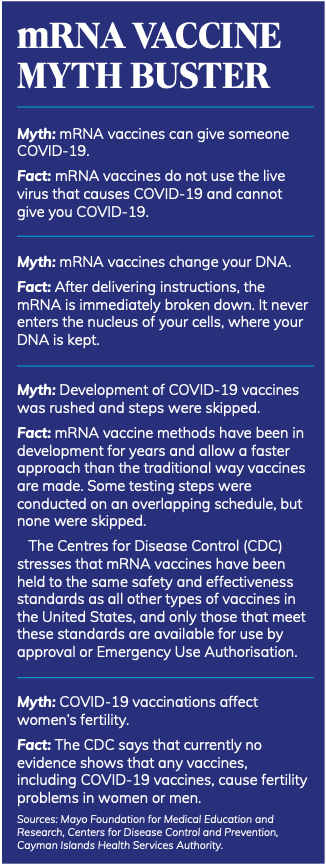 Islands as part of the COVID-19 National Vaccination Programme?
The Pfi zer-BioNTech vaccine, a mRNA vaccine, is in use in the Cayman Islands. The country received its fi rst batch from the United Kingdom on 5 Jan. 2021 due to its position as a UK Overseas Territory. Since 11 Dec. 2020, the Pfi zer-BioNTech COVID-19 vaccine has been available under Emergency Use Authorisation (EAU) in individuals 16 years of age and older, and the authorisation was expanded to include those 12 through 15 years of age on 10 May 2021. The vaccine was fully approved for over 16s on 23 Aug. 2021.
How does the mRNA vaccine work?
The messenger RNA (mRNA) vaccine is made using genetically engineered mRNA that gives your cells instructions on how to make the spike protein found on the surface of the COVID-19 virus. After vaccination, cells begin making the spike protein and displaying them on cell surfaces. This causes your immune system to create antibodies to fi ght the COVID-19 virus if you become infected.
Related Videos