

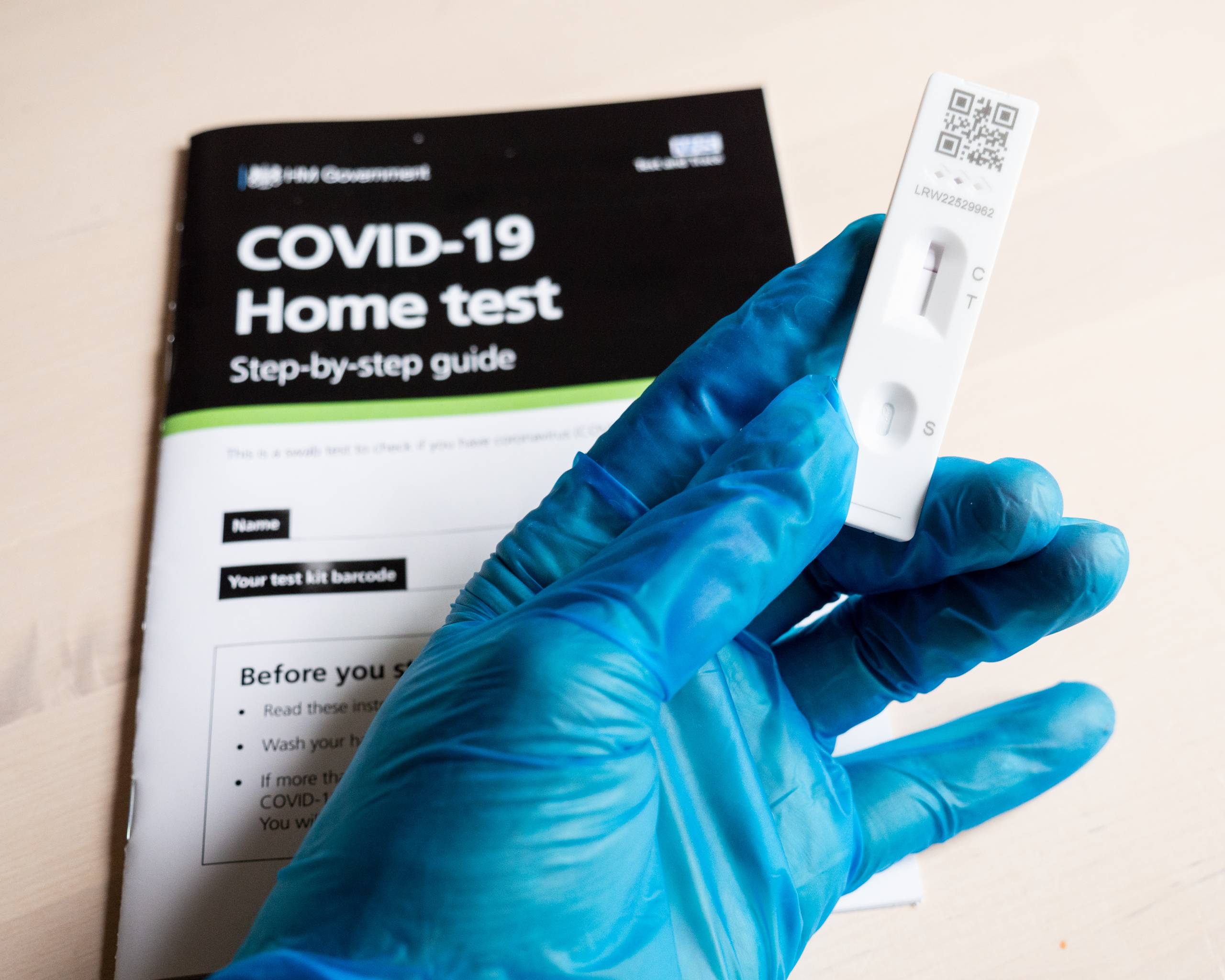
Government has released formal guidelines on the use of lateral flow tests (LTF), with the aim of reducing isolation times for close contacts of positive cases and managing the strain placed on labs doing COVID-19 testing.
The national policy comes as local labs at the Health Services Authority and Doctors Hospital face an influx of residents submitting for testing following the recent spike in community transmission cases. The last testing results released were valid as of 8am Thursday Oct., where there had been 1,845 PCR tests conducted.
Of those tests, 154 positive tests were recorded, comprising one traveller and 153 people from the community.
Premier Wayne Panton, through a media statement Friday announcing the release of the National Policy on Lateral Flow Tests and guidelines, said it is designed to offer “some supportive information and direction in what can be a very challenging and disruptive time for families”.
The guidelines advise the community on what steps to follow when a member of a household either tests positive for the virus that can cause COVID-19, or is a primary contact of a positive case.

“Government’s introduction of lateral flow tests will assist in quickly identifying positive cases via a more scalable and accessible option, which does not create additional pressure on the healthcare system, while also limiting the number of people having to go into required isolation, which is less disruptive for the community,” Panton said.
The 12-page document outlines scenarios for the tests to be used in schools and workplaces for screenings, and what the next steps in terms of isolation are based on the results.
“People still need to earn a living, and children still need to access education services, even as we do our best to stay safe and learn to live with the virus,” Panton added.
The tests do not replace PCR testing, as those will still be required by Public Health.
What do the guidelines say?
Under the guidelines published Friday, if a member of a household tests positive then that person must immediately isolate, and “where the other members of the household are vaccinated, each individual, including children, should conduct daily lateral flow tests for 10 days”.
Related stories
Explainer: How do lateral flow tests work?
Duty waiver approved for lateral flow tests
Businesses fear labour shortages as COVID cases mount
“Daily testing must continue until all positive cases in the household are
cleared by Public Health,” the guidelines state.
If an individual receives a negative result, that individual can attend school or work if daily test results continue to be negative.
“If an individual receives a positive LFT result, that individual must stay at home and contact Public Health immediately. If an individual refuses to test, they are required to isolate for 10 days,” it added.
But members of the household who are unvaccinated, and are 18 years of age or older, would be required to isolate for 14 days. Public Health should be notified, it stated.
“Public Health will advise the date of the PCR test and will confirm final
approval for release. Unvaccinated children under 18 years old residing in the household can continue to go to school if daily LFT result is negative. Daily testing must continue until all positive cases in the household are cleared by PH,” the guidelines state.
Follow-up testing using a PCR test may be conducted by the Public Health Department, “but a positive or equivocal/inconclusive lateral flow test should be treated as indicating someone has a SARS-CoV-2 infection”.
These guidelines are applicable across the board for all residents.
Government approved lateral flow tests
- ACON Biotech Flowflex SARS-CoV-2 Antigen Rapid Test
- Bioperfectus Technologies Novel Corona Virus Ag
Rapid Test kit- Hughes Veritas Rapid Antigen Test for SARS CoV-2
Any other LFT brand selected for use by government will undergo confirmatory testing by the accredited laboratory of the Cayman Islands Health Services Authority (HSA).
The recommended age for persons to be screened with the tests is 2 years and older, unless otherwise guided by Public Health.
The guidelines make it clear that if any individual is contacted by Public Health and they are instructed to isolate, “a negative lateral flow test cannot be used to override the Public Health instruction in accordance with the Public Health Act (2021 Revision) and any relevant regulations”.
Public Health may also instruct members of the individual’s household with other directions that must be followed, it added.
Additionally, the guidelines state that screening using lateral flow tests is not intended for persons who are symptomatic.
“In line with Public Health advice, persons with symptoms should stay home when sick. Any person with symptoms suggestive of COVID-19 disease should contact their local healthcare provider or the Flu Hotline to seek advice on the best next steps,” it stated.
LFT tests are also not intended for persons who have recovered from a laboratory confirmed (PCR) COVID-19 test within the past 90 days and are asymptomatic.
“To avoid false positives, they should follow the advice of the Public Health Department on how to conduct future testing (including screening tests)” it added.
Residents are required to report their results to Public Health via an online form every time a rapid lateral flow test kit and a positive result is received.
It must be reported as soon as possible. Results after more than 24 hours cannot be reported.
Only one result can be reported at a time with the online form.
If an individual does not have access to the webform, they should contact their local healthcare provider or the Flu Hotline on 1-800-534-8600 or 947-3077 (Digicel), or email [email protected] to report a positive and seek advice on the best next steps.
When it comes to employers who may introduce the reporting of results as part of their company policy, the guidelines recommend that a comprehensive assessment of any legal issues be conducted.
They should also ensure the policy is carried out in compliance with the Data Protection Act (2021), and its requirements, for the storing and processing of sensitive personal data relating to the health of the employees.
The policy is expected to remain in effect for the duration of the public health emergency related to COVID-19, which was declared a pandemic in March 2020.
It includes renewals made by Cabinet approval, in accordance with regulations made under the Public Health Act (2021 Revision) and associated legislation, the document states.
“This policy is subject to periodic review to assess whether it remains an appropriate and proportionate public health and safety measure, in relation to developments of the pandemic internationally and any changes in the transmission levels in the Cayman Islands,” it added.
Testing process for schools
Lateral flow test kits have been made available for parents and guardians to test students at home twice per week, Premier Panton said.
“I am urging all parents and staff to utilise the opportunity for at-home screening testing to protect the health and wellbeing of our children, teachers, and fellow students; their families; and, the entire Cayman Islands community,” he said.
Panton encouraged parents of students enrolled in both private and government schools to embrace the simple testing process which, “although not mandatory, is strongly recommended by Public Health and is an important community health measure”.
He stressed that these government-issued test kits are intended for student use only.
“The tests may be administered on Monday or Thursday mornings, or the preceding nights. Positive results should be reported to the Public Health web portal once they are known. Students with negative results may attend school. However, students with positive results must not attend school. Their parents/guardians must, instead, contact Public Health to arrange for a PCR test and the child’s school to report the absence,” he explained.
In describing the testing process as “quite simple,” Premier Panton pointed out that “most of the older children will be able to administer their own tests themselves”.
Testing costs
According to the guidelines, government will initially cover the costs associated with procuring the tests to be used for screening employees within the Civil Service and the wider public service.
Statutory authorities and government companies should liaise with their respective ministries should they wish to obtain test kits procured by government, the guidelines said.
“All test kits for screening and surveillance testing using LFTs for staff, teachers and children/students in educational institutions, both Government and private, will be provided by the Government and are free of charge to staff, teachers, and children/students,” they state.
This includes early childhood care and education (ECCE) centres, schools, and post compulsory educational organisations, such as colleges or universities.
“Supplies of test kits will initially be provided to staff, teachers, and children/students for routine screening and, in the event of an outbreak or a positive case, additional supplies will be provided for those individuals only,” the guidelines added.
Outside of government and schools, the full cost of implementing a screening regime using the tests, which includes the purchase of kits, must be borne by the employer, organisation, or individual.
Government, the document states, will provide sector specific guidance for deployment of tests in Early Childhood Care and Education (ECCE) Centres and Schools, tourism, care homes, guidance for Prisons and Detention Centres, large events and gyms and indoor exercise facilities.
Workplace testing
The guidelines state that employers may choose to implement testing as a voluntary regime or mandatory.
However, if the option is to mandate screenings, the guidelines recommend employers assess any legal issues.
“Where routine screening of employees using LFTs is conducted, it is recommended that it be administered regardless of whether or not persons are fully vaccinated, and as a minimum recommended standard, tests should be conducted twice weekly, with each test taken within a minimum of three days of each other,” the guidelines state.
Employers may choose to set up their own workplace testing, or they may choose to hire a third-party provider to administer the tests, the guidelines state.
They can also provide employees with test kits and ask employees to carry out tests at home before attending the office, but they “may choose to implement appropriate protocols for confirming that the tests have been administered as requested and to confirm the results”.
Related Videos










“LFT tests are also not intended for persons who have recovered from a laboratory confirmed (PCR) COVID-19 test within the past 90 days and are asymptomatic. To avoid false positives, they should follow the advice of the Public Health Department on how to conduct future testing (including screening tests)”
So what exactly is that guidance? There is no information available about this. I was on hold for quite some time today before giving up on the call.
At present I believe, a fully vaccinated parent returning to the island after Nov 20th with children will have to quarantine for 14 days with the children. If they all test negative on arrival could we not follow the Channel Islands’ and provide them each with a free kit containing 5 LFT’s to be taken every 3 days and avoid quarantine?.
If a visitor has access to the Abbott rapid test kits is that an acceptable testing method. These are available in the U.S. and are accepted as a screening procedure.