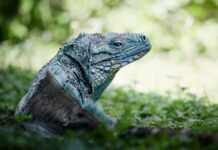
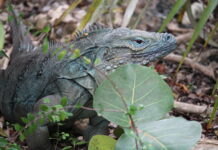
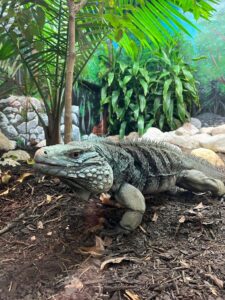
One of Grand Cayman’s blue iguanas has been introduced as the newest resident at the San Antonio Zoo.
The iguana, aptly named Blue, which took up residence at the zoo’s reptile house this week, created a stir on the San Antonio Zoo’s Facebook page with people posting their excitement over the new arrival.
“This species was actually one of the most endangered animals in the world at one point, with only 12 remaining in the original population. But, thanks to conservation organizations like zoos, they were brought back from the brink of extinction!” the San Antonio Zoo posted.
Blue iguanas on loan
Craig Pelke, director – ectotherms (cold-blooded animals) at San Antonio, told the Compass in an email that Blue is now residing at his third zoo in the US.
Blue was hatched at the Indianapolis Zoo on 22 June 2008, and that fall moved to the Fort Worth Zoo, where he stayed until going to the San Antonio Zoo in May last year, Pelke said.
“Grand Cayman blue iguanas are managed in (American Zoo Association)-accredited zoos with a Species Survival Plan (SSP) to help maintain a sustainable and genetically viable population. The population at the Queen Elizabeth II [Botanic Park] is managed in a similar manner, although not part of the actual SSP,” he explained.
Luke Harding, project manager at Blue Iguana Conservation which is run by the National Trust for the Cayman Islands, confirmed the iguana at the zoo was one of the animals on loan from Grand Cayman.
“We are aware that a blue iguana was approved to be moved to San Antonio Zoo as part of the American Zoo Association (AZA) Species Survival Programme (SSP) for the Grand Cayman Blue Iguana. All the animals in this breeding programme are on loan from the Cayman Islands and are strictly monitored and reported upon,” he said in an emailed response to Compass queries.
Blue, Pelke said, is the only blue iguana at the San Antonio Zoo at this time, which makes it special.
“For the zoo, the ability to contribute to another SSP or a species of concern fortifies what we already do well, and that’s to secure a future for wildlife. San Antonio Zoo is involved in conservation both on property and globally, which now includes Grand Cayman Blue Iguanas in these efforts.
“We also help fund the International Iguana Foundation (IIF) which supports iguana conservation globally, and I serve on the Cyclura SSP steering committee (which manages Grand Cayman blue iguanas and Jamaican iguanas in AZA institutions),” he said, adding, “blue iguanas are one of my favorites and hold a special place in my heart”.
“My experience with them goes back to 2002 when I first learned of the species (10-12 left in the wild at that time),” Pelke said. “I connected with Fred Burton of the Blue Iguana Recovery Programme [now Blue Iguana Conservation], and began traveling to Grand Cayman yearly through 2007 to assist with field work and reintroductions of the species.
“I am very proud to have been part of the reintroduction process to help expand the island’s blue iguana population, and am very happy to continue the connection at San Antonio Zoo with blue iguanas,” he said.
While Blue is the only blue iguana in the San Antonio facility, Pelke said he is hopeful there may be more in the future.
“Blue iguanas are highly territorial, both genders, and our current facilities can only properly manage one at this time. However, the future expansions at San Antonio Zoo have me optimistic,” he said.
Conservation a main goal
Harding pointed out that American Zoo Association Species Survival Programme (SSP) members are partners in the Blue Iguana Conservation Programme and information on husbandry and care are shared among members.
“The San Antonio Zoo is a well-respected and accredited institution and maintains standards of accreditation. They have a rich history of excellence in species management and conservation activities. Indeed, some of their staff have volunteered their time with the programme on island over the years,” he added.
Harding explained that AZA iguanas have the appropriate legal permits from the Cayman Islands government and the US.
“[Blue iguana] breeding is controlled as part of a focused effort to ensure that required genetic representation exists off the island in the event of an island-wide disaster here on Grand Cayman,” Harding said. “If there were such a catastrophe on Grand Cayman, we are assured that a genetic mirror image of our endemic blue iguanas in the AZA population, that has been preserved over years of careful management, could help to rebuild our population here.”
The captive AZA population of blue iguanas is managed and overseen by world experts at the San Diego Zoo, he added, saying it is through their expert guidance and expertise that “we have been able to ensure the long-term future of the breeding programme on Grand Cayman and the AZA population”.
He added, “Our position is that we will continue to work with our international partners within AZA to ensure that their blue iguana population is managed appropriately and provides an effective safety net for blue iguana survivability. In addition, our partner zoos continue to promote the species through these ambassador animals which allows for global attention to the species, our work and the Cayman Islands.”
Related Videos