Nick Joseph

As at 16 Jan. 2023, 34,067 foreign nationals were recorded by Workforce Opportunities and Residency Cayman as having a work permit or government contract in the Cayman Islands.
This number is not only the highest we have seen, up from 32,913 on 17 Oct. 2022, but has some striking implications – beyond the fact that we have been adding, on average, an additional dozen foreign workers a day, every day, for the last three months.
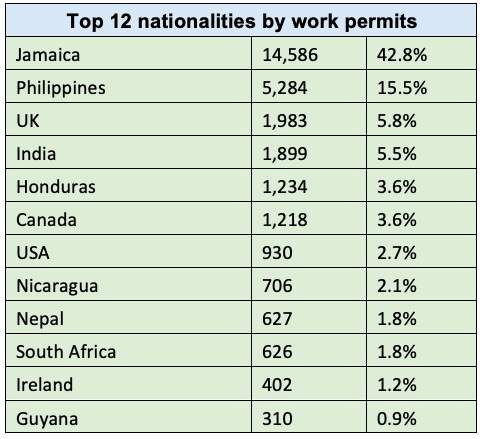
There are now 135 different nationalities recorded amongst us. That is a number we can and should be proud of. Jamaicans continue to be the most numerous, followed by Filipinos, Brits and Indians.
If these figures are relied on by the authorities in their consideration of permanent residency applications, the increase in the Indian population means that persons of that demographic may now face a loss of five points on the basis that their number appears to today constitute more than 5% of the population on work permits.
The detail of the top 12 nationalities on work permits is:
PR points for nationality uncertain and potentially arbitrary
The maths is not as easy as it may seem. Policies relating to treatment and interpretation long requested of the authorities on this and a great multitude of other issues have never been provided. There are many consequences of this and the resulting uncertainties and potential arbitrariness.
The Permanent Residence Points System is supposed to reward “rare” nationalities by awarding more points – and inherently penalise those that appear “overrepresented” in our community.
The noble, and lawful, intention is that no foreign culture be permitted to overwhelm, or otherwise dominate, the Caymanian people and these Islands, and that an “appropriate demographic balance” be maintained, both in society and in each private sector workplace.
The civil service appears exempt from such considerations, up to the point of an individual civil servant applying for permanent residence, given the fact that the WORC department plays no role in civil service hiring decisions.
The points system makes it clear that 10 points are awarded to those applicants for permanent residence who are representative of a demographic of origin which is less than 5% of work permits in the Cayman Islands, whereas five points are available to those who are represented by more than 5% but less than 10% of the population on work permits. No points are available in the category of demographics to those who are of a demographic of origin which is represented by more than 10% of the population on work permits.
Which work permit figures are used and when?
Of the many details we have sought for most of a decade is the question of whether it is the population on the date of application, the date of the eighth anniversary of applicant’s arrival as a resident, or the date of consideration of their application, that is the basis of the treatment of applicants under the demographics section of the points system.
We have never received clear guidance. Nor is there any indication of what happens when an application is delayed in its consideration by so long, through no fault of an applicant, that the statistics materially change in a manner adverse to an applicant.
Denying an Indian national PR because of a delay in the processing of their application (now averaging 17 months) is not a good look. It also would appear unlawful, and unlikely to survive legal challenge.
There is another issue to contemplate. What do the authorities contend is a work permit for the purposes of their calculations? Those on government contracts (1,130) or with Permission to Continue Working (668), or Working by Operation of Law (33), are very arguably not work-permit holders – yet they are reported in the statistics as if they are.
Persons with Residency and Employment Rights Certificates, and there are thousands, are not work-permit holders and are not recorded in the referenced statistics at all. Adjusting the percentages to account for them is difficult, and ever changing.
An analysis that counts only those persons with work permits, as that term is defined by reference to the Immigration (Transition) Act), changes the percentages further.
In fact, despite the above figures, the number of Indians on work permits exceeds, for example, the number of Brits on work permits, given that 170 Brits are reported to be here on government contracts compared to only 48 Indian nationals.
The system ought to be capable of working well, but delays, a historic failure and even refusal to provide needed clarity, deprive it of so much potential. Statistics are no longer reported quarterly. We do not know which ones the authorities use. It does, however, appear that Brits are on a trajectory to gain an extra five points on their PR applications.
There is no uncertainty in relation to the demographic points available to Jamaicans and Filipinos. Their number so greatly exceeds the 10% threshold that we have no expectation of persons from those countries achieving anything more than their current zero points for demographics.
Any imminent uncertainty is not the fault of the government of today. The hand they now hold was dealt to them some time ago.
The committee appointed by Deputy Premier Chris Saunders to look into the points system will no doubt have this issue in its sights.
About 90,000 people likely to be living in Cayman
Whatever happens next, the figures appear to help reveal many other things.
One, is Caymanians are in a minority. As at census day, 2021, there were reported to be 6,378 holders of permanent residence in the Islands. The overwhelming majority of them are still here, and with status applications now languishing for up to 12 months, many of those who have qualified to apply to become Caymanian will still be permanent residence holders.
Adding them to the work-permit numbers raises the number of expatriates living in Cayman to 40,445. Allowing for expatriate spouses, children, and other dependents, there are today somewhere around 50,000 foreign nationals living here.
With a tourism room capacity of 20,527 – at 75% occupancy there would be another 15,000 sleeping here. Add 10,000 cruise ship passengers and crew (there were more than 13,000 on one day in January 2023); snowbirds in their condos, and family and friends visiting from overseas; and a few hundred Cuban refugees, there are quite probably 75,000 non-Caymanians here on a high season, busy cruise ship day.
According to the census, there were 38,047 Caymanians. We are aware that a number of them are “ghosts” – persons perceived to be Caymanian but who in fact and in law are not. The number of Caymanians will now be around 40,000, but it is unlikely to be much more than that.
It seems there are now likely around 90,000 persons “living” here in the Cayman Islands.
We contend that we have a population of 80,000; 78,554 was the revised official estimate last summer. We appear erroneous in that conclusion.
Whatever the number, right now, our infrastructure needs to cope with more than 110,000 people who are actually here.
The rapid growth is at least creating a demographic dividend providing much government revenue and private sector economic activity. Let us hope we invest these potential windfalls wisely. We need to find a mechanism to generate income that is not as reliant on unbridled population growth. It is unsustainable. We cannot grow, at this rate, forever. Nor will we.
Nick Joseph is a partner at law firm HSM.
Related Videos