


Typically having cancerous tumours removed involves painful, sometimes lengthy, surgical procedures and days-long recovery time, but that was not the case for Robert Slatter.
The 82-year-old grandfather-of-two drove himself home less than three hours after having a tumour in his kidney destroyed using the new minimally invasive radiofrequency ablation (RFA) procedure now available at the Cayman Islands Hospital.
“When this procedure was mentioned as a possibility to avoid surgery, I thought it sounded like a thing to do,” Slatter told the Cayman Compass on Monday.
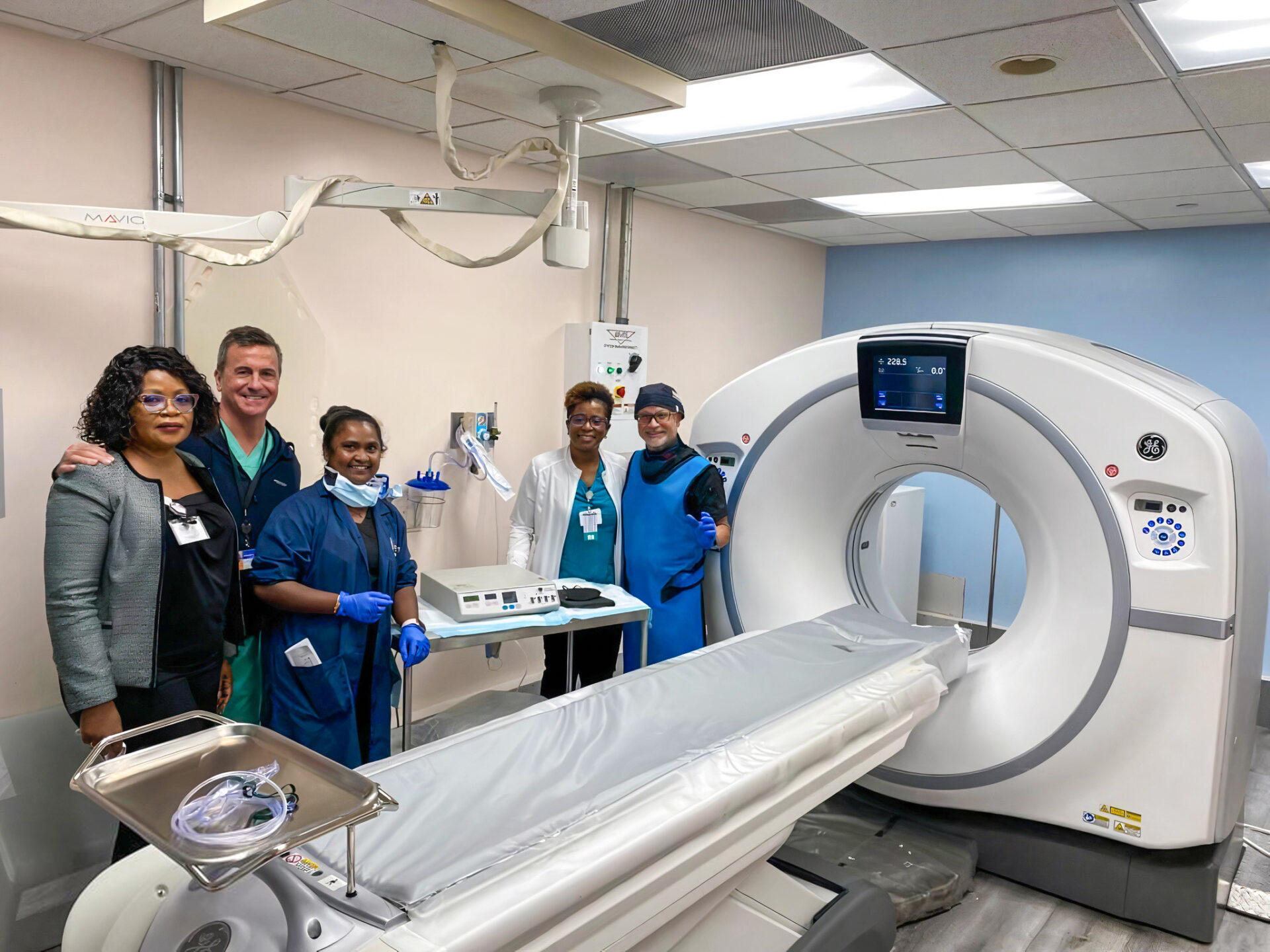
In fact, Slatter was one of the first two people to undergo RFA for their treatment at the Health Services Authority.
He said he was excited to experience modern medicine in action.
“I’m one of these kind of guys that when I have a colonoscopy I watch it on TV live,” he said, adding how “amazing” modern science is “and how complicated our bodies are”.
What is RFA?
RFA is a thermal ablation technique that uses electrodes to generate heat and destroy abnormal tissues. It is used to treat several cancers, including bone, liver, and renal tumours, as well as cardiac arrhythmias, an HSA statement explained.
“The procedure is done by an interventional radiologist who uses imaging techniques such as computerized tomography (CT) scan, ultrasound, magnetic resonance imaging (MRI) or fluoroscopy, to insert the RFA electrode through the skin into the tumour via a needle,” it added.
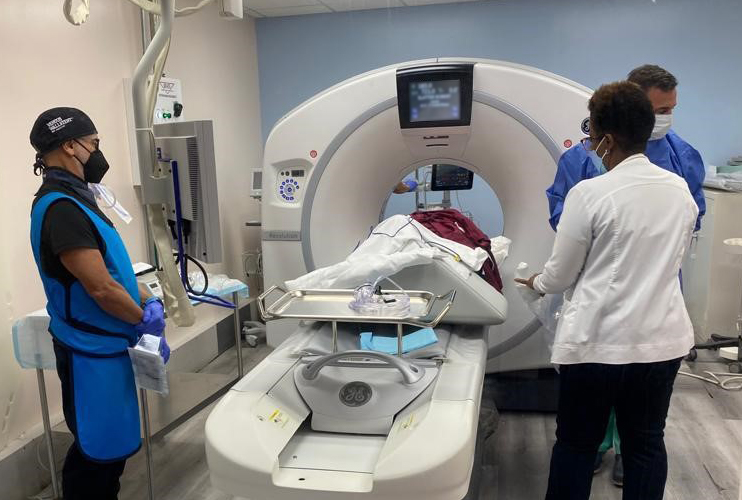
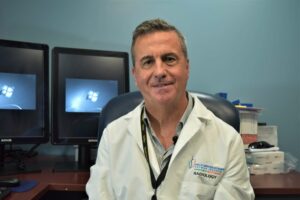
Interventional radiologist Dr. Alessandro Lemos, who did the procedure using the CT scan, said RFA is simply the “burning to death” of the tumour.
“It is a very precise procedure, very sophisticated procedure,” Lemos said, adding that he was trained in conducting RFA which is an “exciting” development for cancer treatment at the Cayman Islands Hospital.
“It is a very good additional option… minimally invasive with the possibility to avoid big surgeries such as complete [removal] of the [kidney.]” Lemos explained.
Routine check leads to unexpected discovery
Slatter initially went to the HSA for a routine check but wound up on the CT scan table undergoing a groundbreaking procedure.
“I went to my GP with [a problem] and she sent me to HSA emergency room and then in trying to find out what was causing that specific problem they did some scans and they discovered the tumour completely by accident,” Slatter said.
Slatter said he does not get upset over medical news, and admitted that he thought if “worst comes to worst” he would survive on one kidney.
“Having lived as long as I have and been mostly quite healthy, and thinking of my mother, for example, who died at 61, I say, ‘Well, I’ve had a good run at it.’ So I’m not overly concerned if I got really, really bad news. This wasn’t bad news, and they said it was a small tumour, which was possible for this new procedure to resolve as opposed to open surgery,” he said.
Lemos, he said, told him after that “they found and zapped the tumour”.
“They have to know exactly where [the electrodes are] going and position it just right or it doesn’t work,” he added.
Now that the procedure is over, Slatter said he’s happily pursuing his passion for golfing.
Related Videos











Well, aren’t we all extremely lucky to benefit from modern medicine? Please inform any anti-vaxers acquaintances of your joy and relief. Thank you