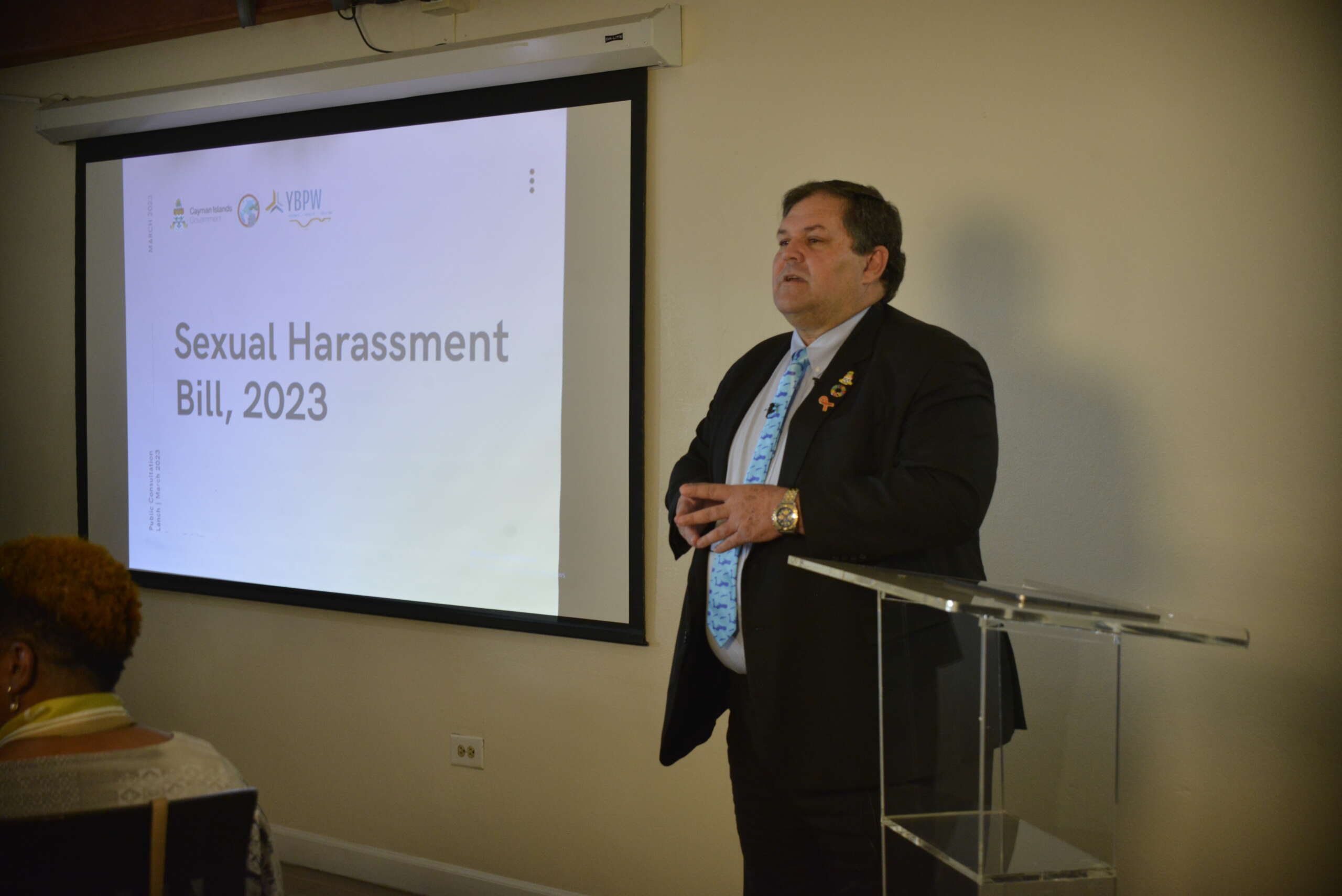
More than a decade-and-a-half after Cayman’s Business and Professional Women’s Club began campaigning for sexual harassment legislation, a bill has finally been written.
Premier Wayne Panton delivered the draft legislative document to members of the non-profit organisation at a luncheon on Wednesday, and announced the beginning of a six-week public consultation on the proposed legislation.
“This landmark piece of draft legislation has been a long time in the making,” he said.
“I don’t know why it’s taken this long but it’s not going to take much longer,” he told the BPW members, whom he congratulated for their persistence in pursuing the issue over the years.
“When sexual harassment becomes socially acceptable, when a precedent is set that it is OK to violate another human being, their dignity and their rights, or when the belief that being silent is better than speaking the truth becomes widespread, then that is the time that we know urgent legislative action is needed,” the premier said.
Long road to new law

The path to this legislation has been a long one, beginning back in 2006, when the BPW set up a Sexual Harassment and Stalking Task Force, led by the Young Business and Professional Women’s Club and its then president Joannah Bodden-Small. The task force carried out a survey, the findings of which, published in 2008, showed that two in five people had experienced sexual harassment.
The results of the survey and the task force’s work were submitted to government, with a recommendation that legislation be drafted. The taskforce disbanded in 2009.
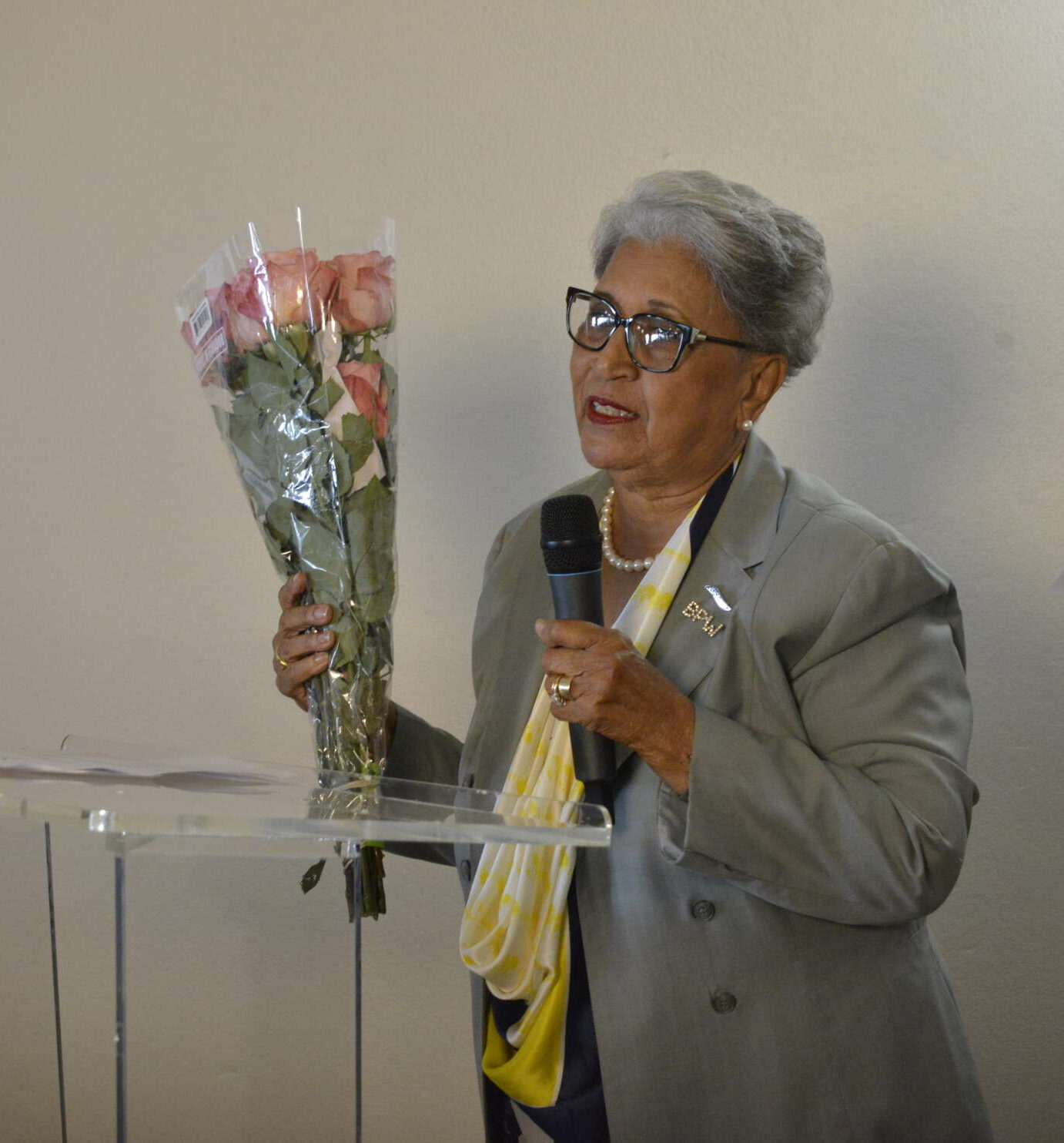
BPW founding member Annie Multon, speaking at Wednesday’s luncheon, said, “We are grateful to everyone who participated in the Task Force on Sexual Harassment and Stalking… The task force was a very special imitative for BPW, as it was spearheaded by Young BPW, under 35 years of age.”
She added, “Without them, we would not be here today.”
Following the work done by the task force, in 2012, the Law Reform Commission published a draft law on sexual harassment for public consultation. The following year, the commission forwarded its final report on supporting the Sexual Harassment Bill to the attorney general, who in turn forwarded it to the Ministry of Community Affairs.
Although no legislation was forthcoming at the time, in 2016, government released its own policy for the civil service, which set out how complaints of workplace harassment could be made and handled.
Many of the suggestions and recommendations put forward to government by the BPW and the Law Reform Commission are included in the current proposed bill.
Compass Media, through the Cayman Compass and the Rooster Crosstalk show, in 2021 rans a series of stories on the prevalence of sexual harassment in Cayman. Appearing on Crosstalk in July that year, Panton vowed to bring legislation dealing with sexual harassment to Parliament within the next year.
At the time, he said, “Let’s be honest. When you have policymakers dominated by males you may find that kind of thing is down the priority list. … I want to make it clear to the country and to the women of this country that, for our government, it is not lower down the list. It is something we are concerned about.”
Draft legislation to get public feedback
Speaking at Wednesday’s luncheon, Panton said the proposed legislation would create a mechanism whereby victims could report harassment to the relevant authorities, without fear of retaliation.
He noted that Jamaica had passed its own sexual harassment legislation in 2021.
“There is no justification for Cayman not implementing similar legislation with appropriate penalties surrounding sexual harassment offences, greater definitions of what constitutes these human rights violations, rules in place to protect victims and to thoroughly investigate perpetrators,” he said.
Under the draft legislation, penalties can be imposed for individuals found guilty of sexual harassment, including fines of up to $5,000 and/or imprisonment for one year.
The bill states that complaints of sexual harassment can be made by the victim, or on behalf of the victim – with his or her permission – to the Gender Equality Tribunal, which will have the power to impose penalties and remedies.
Panton pointed out that the proposed legislation also addresses false reports of sexual harassment and the making of vexatious or frivolous complaints.
Defining sexual harassment
The draft law defines sexual harassment as making unwelcome sexual advances, comments or gestures to a person; sending a person unwanted sexual images or graphics; making it appear a person will receive preferential treatment or other advantages at work if the person submits to sexual harassment; or directly or indirectly engaging in any other form of unwelcome conduct of a sexual nature.
The premier acknowledged that attitudes about what constitutes sexual harassment will need to change, noting that what one person may have intended as a joke could be considered sexual harassment by the individual to whom it is addressed.
“Unfortunately, many people in our community are accustomed to using, hearing or receiving language that is considered sexual harassment,” he said. “Therefore, [addressing] sexual harassment involves changes to cultural and social norms.
“We know that some may feel that the bill restricts social banter amongst one another or friendly compliments, which may have become normalised. … It will challenge us to acknowledge that even if a person intends for their conduct to be flattering, it may still be ultimately regarded as offensive if it is allowed to continue.”
He added, “We must hold each other accountable and let our peers and colleagues know when a joke or comment crosses the line.”
12 main elements of Sexual Harassment Bill
- The bill provides a definition, and examples of conduct and circumstances which would constitute sexual harassment.
- It requires every employer, regardless of the size of the company, to formulate a policy statement about sexual harassment in the workplace.
- It prohibits employers and employees from committing acts of sexual harassment.
- It outlines the employer and employee obligations and duty.
- It imposes sexual harassment liability on an employer under certain circumstances.
- It requires institutions to have a policy to protect, employees, students, children, residents or clients.
- It prohibits sexual harassment in the provision of accommodations, goods, services or facilities, including landlord-and-tenant transactions.
- It requires qualifying bodies, organisations, employment agencies, and professional and civic associations to have a sexual harassment policy.
- It provides a procedure to make complaints of sexual harassment to the Gender Equality Tribunal, and for the hearing and resolution of such complaints, including orders and costs that may be imposed.
- It prohibits victimisation of a person as a result of making a complaint.
- It provides for confidentiality and a limitation on publication of details pertaining to cases appearing before the Gender Equality Tribunal.
- It provides a sample sexual harassment policy which an entity may adopt or modify as appropriate for use.
The new bill will undergo a public consultation process, until 15 April, via online comments, emails and public town hall meetings. After that, it will be redrafted with any relevant public input and resubmitted to Cabinet, following which it will be introduced to Parliament for debate and to be passed into law.
Dates of town hall meetings will be released at a later date.
For more information and to submit feedback on the proposed legislation, visit www.gov.ky/pch/sexualharassmentbill.
Sexual harassment in Cayman
- Compass special report: Sexual harassment is rife in Cayman
- “I had to keep quiet because my life felt threatened”
- Pursued and assaulted by respected colleague
- Deflecting the unwanted attention of an older boss
- Harassment the norm, say female bartenders
- Sexism, harassment and indecent proposals in the legal profession
- Editorial: Time’s up for dealing with sexual harassment
Related Videos