


A quarry in Cayman Brac, where quarrying work is taking place without planning permission, is damaging a boardwalk along the historic Salt Water Pond public trail, that was used in the 1932 hurricane to get people to safety, the National Conservation Council heard this week.
The council, at its 23 Aug. meeting, considered whether an environment impact assessment was necessary in relation to an after-the-fact planning application, and another application for an extension of the quarry.
An after-the-fact application is one that is submitted to the planning authority after the work for which the applicant is seeking permission has already been done.
Frank Roulstone, executive director of the National Trust and a member of the council, said at the meeting, “The Salt Water Pond Trail… is an historic trail. It is how many people survived the 1932 storm, by crossing through this trail to get to the south side of the island, including to Rebecca’s Cave.
“From the National Trust perspective, it’s a disgrace to see our built heritage destroyed and I wanted to publicly state that.”
He added that the trail is a public access area, and the people of the Cayman Islands will suffer if it is destroyed. As a neighbouring landowner, he said, the National Trust had already submitted objections to the quarry’s after-the-fact and expansion planning permission applications.
Flyrock from blasting hitting trail
In her briefing on the project to the council, Department of Environment senior environmental assessment officer Lauren Dombowsky explained that flyrock from blasting at the site was striking and damaging the wooden boardwalk on the trail, which runs adjacent to the Scott’s West End quarry, owned by the Scott Development Corporation.
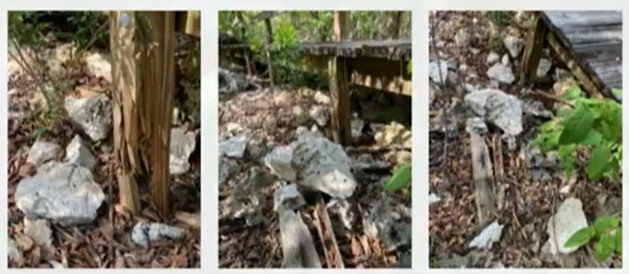
She said that during one of the DoE’s site visits, “we found that the flyrock was hitting the trail”, and she showed images of rock blasted from the quarry that had damaged the trail’s wooden boardwalk.
Dombowsky noted that when quarrying work is going on, the trail, which is on Crown land, is often closed to the public, but raised concerns about “safety and human life risks from the flyrock coming from the blasting of the quarry”.
She noted that the trail’s boardwalk is a tourism amenity put in place with District Administration funds.
No EIA recommended as damage already done
Dombowsky told the council members that it appeared “like they are proceeding with the extension they are applying for, even though they have not been granted planning permission”.
She added that this matter would be a “tricky” one for the council, as the DoE was recommending that an environmental impact assessment was not required, simply because the impact was already taking place and therefore there was “no need for technical studies”.
“We don’t think an environmental impact assessment, which would involve studying what is happening here would really provide that much more information than what can already clearly be seen,” she said. “There is no real practical benefits to doing an environmental impact assess for an after-the-fact quarry. Any impacts that would have been predicted have already occurred.”
She stressed that the DoE nonetheless felt that there were “serious concerns” about the site.
“There are impacts to Salt Water Pond Trail. The lack of regulatory involvement is causing adverse impacts and that can cause degradation of the trail for tourism, as a historic site, and as a public amenity,” she added.
Dust management
The DoE recommended that the Development Control Board, which is the planning authority for the Sister Islands, should require the quarry to have a dust-management plan and an assessment to evaluate the levels of noise from the quarrying work, as well as to take into account the “serious environmental impacts on the trail”.
Council member Lisa Hurlstone queried whether any legal proceedings might be forthcoming that may lead to compensation being claimed to help repair the damage done to the boardwalk.
Dombowsky responded that this would be up to the planning authority.
Director of the Department of Environment, Gina Ebanks-Petrie, who is a member of the council, said the National Conservation Act does not allow the council or the DoE, on behalf of the council, to take any enforcement action in such situations because those actions come under planning legislation.
She said the Aggregate Advisory Committee had met with the applicant to get a better understanding of what had transpired with the after-the-fact application and what pertains in terms of supply of aggregate on Cayman Brac.
Voting for action
The National Conservation Council members voted in favour of not recommending an EIA for the quarry, but called for a dust-management scheme and noise assessment for the expansion of the quarry, and to alert the Development Control Board to the environmental impacts of the quarry.
The council also voted in favour of the DoE asking the Aggregate Advisory Committee or the Planning Department to secure a future plan from Scott Development Corporation, noting the level of activity at the quarry which had taken place without planning permission.
The members also recommended asking the Aggregate Advisory Committee to carry out a strategic environmental impact assessment on all quarrying and aggregate use in Cayman, taking into account the movement of aggregate between islands.
Ebanks-Petrie said the Planning Department should be requesting details of future plans for the quarry site, rather than the National Conservation Council or the Department of Environment.
“The fact that there’s been this much quarrying outside of their planning permission, and no action has been taken thus far, is astounding to me,” she said. “I do believe the Aggregate Advisory Committee, as a committee of the Central Planning Authority, could make that recommendation; it would be within their remit to ask for a future plan.”
She pointed out that the trail is not part of a protected area or was subject to a conservation agreement, meaning the council’s only option in this instance is to make recommendations to the planning board.
Council member Patricia Bradley noted that until or unless the Brac had a development plan, the trail would always be at risk of being demolished.
Ebanks-Petrie agreed, saying, “So many of the issues we are dealing with stem from the lack of proper planning regulation on the Sister Islands. From the very onset of the National Conservation Law, when we were taking this out to the public many, many years ago, I remember trying to explain to people who were questioning provisions of our law, that our law could not possibly fill the gap that is needed to be filled by proper development plans and planning legislation… We don’t have a development plan for either of the Sister Islands and, obviously, they are desperately needed.”
The meeting can be viewed on the Department of Environment Youtube channel.
Related Videos











lol, nothing like getting approvals AFTER THE FACT.
Quote: Ebanks-Petrie agreed, saying, “So many of the issues we are dealing with stem from the lack of proper planning regulation on the Sister Islands.” I could not agree more. Lack of proper planning regulation is going to be the demise of the sister islands and result in them becoming just another small over developed island in the Caribbean. Don’t repeat the mistakes made on Grand Cayman.