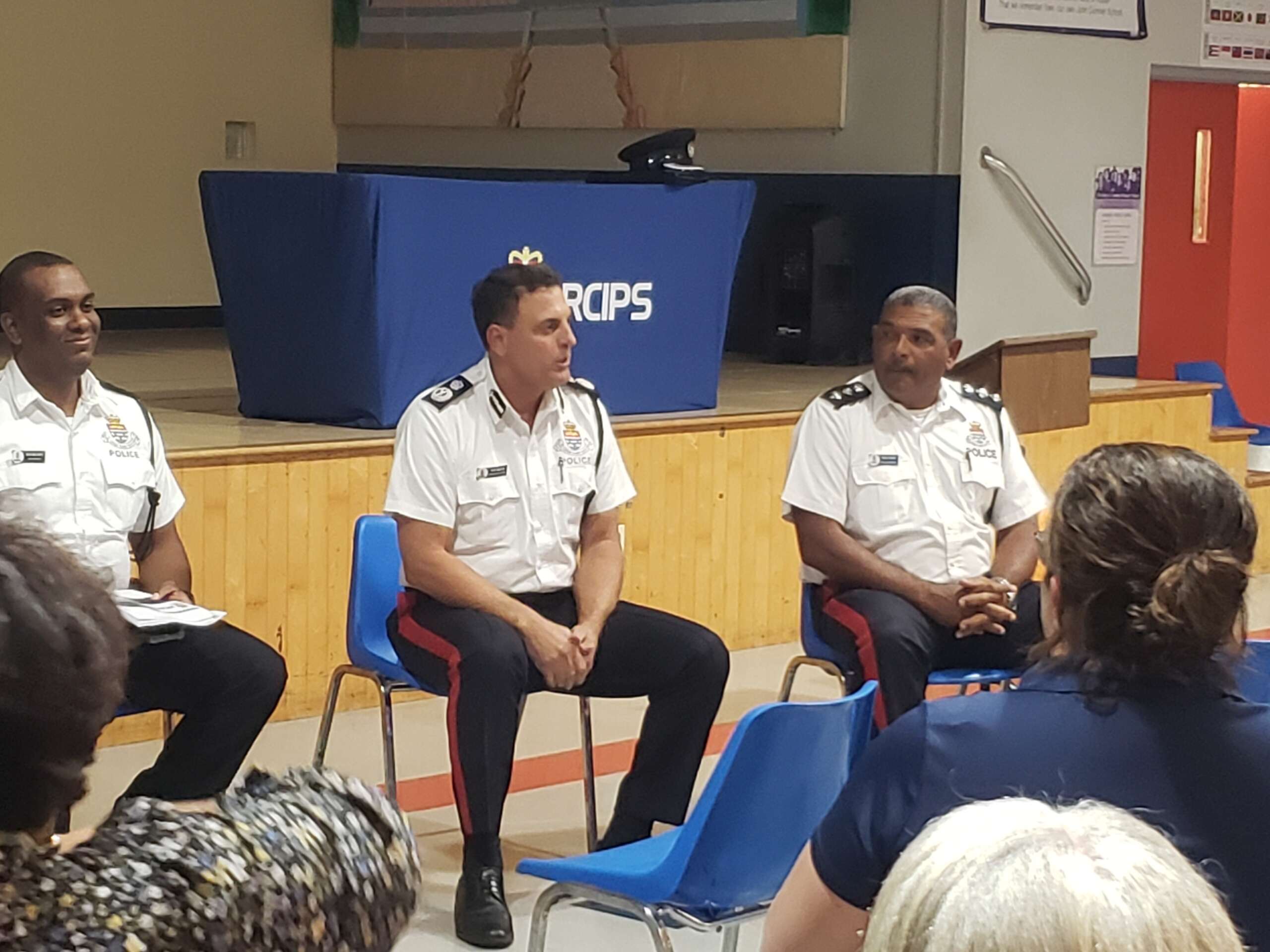
Child safeguarding, illegal gun possession and use, reducing road fatalities and tackling financial crimes are the four main priorities of new police Commissioner Kurt Walton.
Walton, who is the second Caymanian to have served in the post of police chief, has been touring the Cayman Islands with his lead team of officers in an attempt to engage public feedback about concerns and potential solutions.
“In broad terms, the plan is ‘Continuing to Keep Cayman Safe’,” said Walton, during the team’s fifth town hall meeting, which was held at the Sir John A. Cumber Primary School in West Bay on Tuesday night.
Walton’s four areas of concern reflect an increase in those types of activities, as outlined in the latest crime statistics reports and data.
According to the RCIPS, from 2018 to 2022, there were 435 reported serious sexual offences, including 71 rapes. The 104 reported sexual offences in 2019 represented the highest number over those five years, while in 2022 there were 19 reported rapes, the highest over that time period.
However, 2023 will likely shatter those numbers, as the Compass understands that between January and June this year, 157 sexual offences were reported.
The RCIPS statistics do not reveal how many of the reported sexual assaults were against minors, but the numbers show an overall increase in that type of offending.
In relation to gun crime, 126 guns were seized by police since 2017, with 16 of those seizures occurring this year.
A sustained year-on-year increase of traffic accidents has resulted in 15,605 collisions, including 53 fatalities between 2017 and 2022.
Through financial crime data is not fully available, data that does exist show an marked increase from low double-digits to low triple-digit figures.
“The fact is we must take a look a how to future-proof the police service, and this means we must look at these areas of growth, and prepare ourselves to be able to handle this issues,” Walton said at the West Bay meeting.
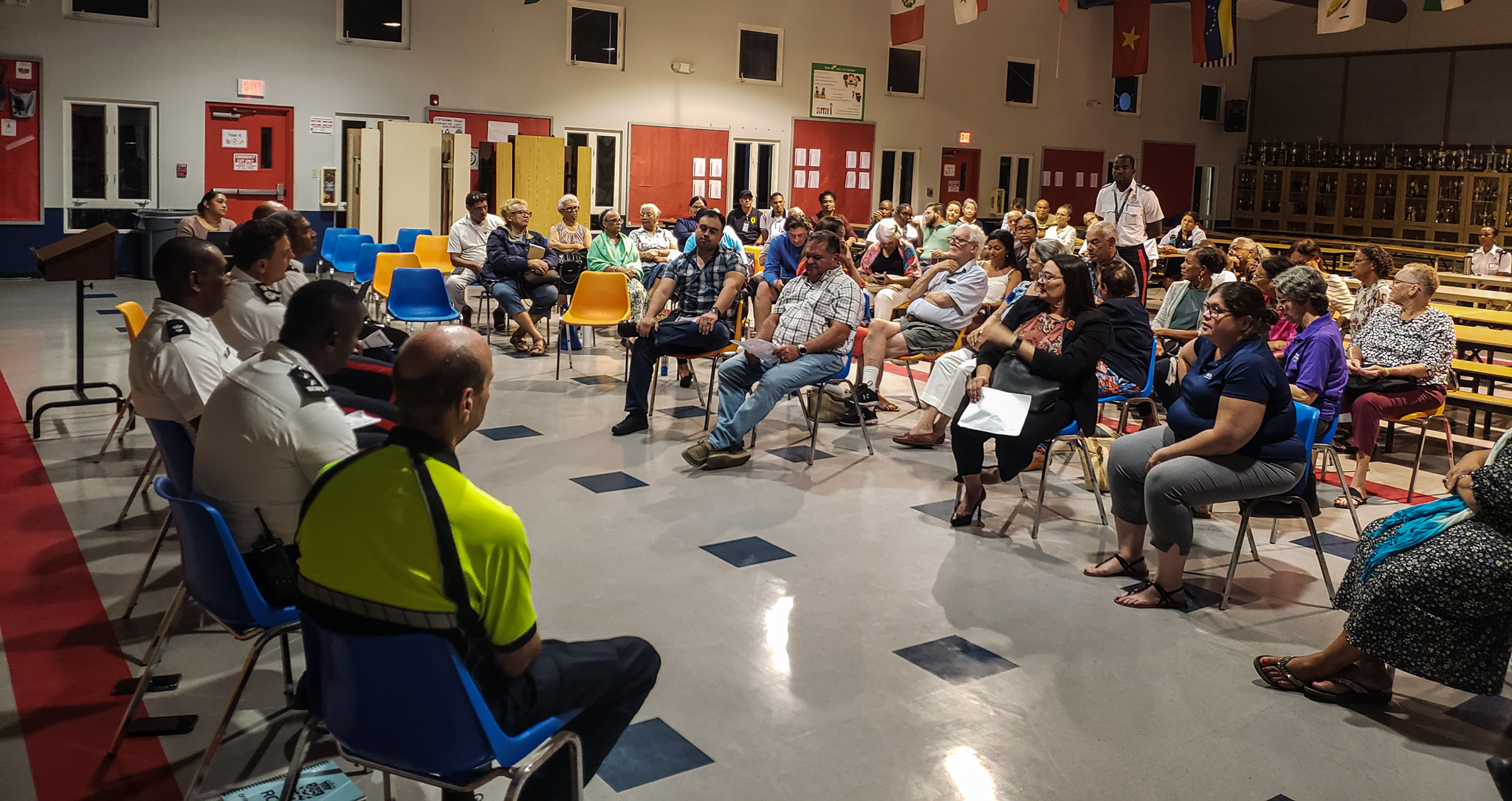
Community feedback
Tuesday night’s meeting was a marked difference from those of 2017, when then incoming Commissioner of Police Derek Byrne took on the role.
At those town hall meetings, members of the public expressed their outrage, as they accused police of corruption, unprofessionalism, and having a lack of interest in the community.
This time round, Walton and his senior command team, and the wider service, were met with applause and cheers.
An initial crowd of two dozen people quickly doubled in size, with various people quick to voice their concerns and their support.
“They are treating my road like a race track, 24/7, I don’t even walk my dog any more on the main road because I’m afraid to get hit,” said one resident.
Her concerns were quickly reiterated by another who joined in, calling for speedbumps to be installed.
“We need speedbumps, not just along portions of the main roads, but also in parts of residential areas as well,” said the second resident.
The other main topic of concern was that of anti-social behaviour, predominantly from people outside of the community.
“It is just a matter of time before something bad happens,” said one resident, referring to homeless people in the community.
Another resident raised a concern about the notion that “bad apples were still in the force”, sullying the reputation of all.
“I am aware that some people won’t talk to police because some of the very police themselves are involved in the crime,” said another resident.
This comment was swiftly addressed by the new commissioner.
“We have a zero tolerance for corruption, and it is an unfair label when people said in broad terms, ‘Oh, the police is corrupt’,” he said. “We have demonstrated that where there is a corrupt officer, we will find them and prosecute them to the full extent of the law.”
Once such example is that of former auxiliary constable Courtney Levy, who was convicted of breach of trust and other charges.
According to Walton, an unidentified independent body from the UK has been invited to review the RCIPS and its procedures to provide an impartial report.
“From that report, we will know if and how we need to grow the police service, in addition to any areas where we might be getting things wrong,” Walton said. “I can say this much, it’s not a matter of if we need to grow the police service, because we absolutely do.”
Related Videos