

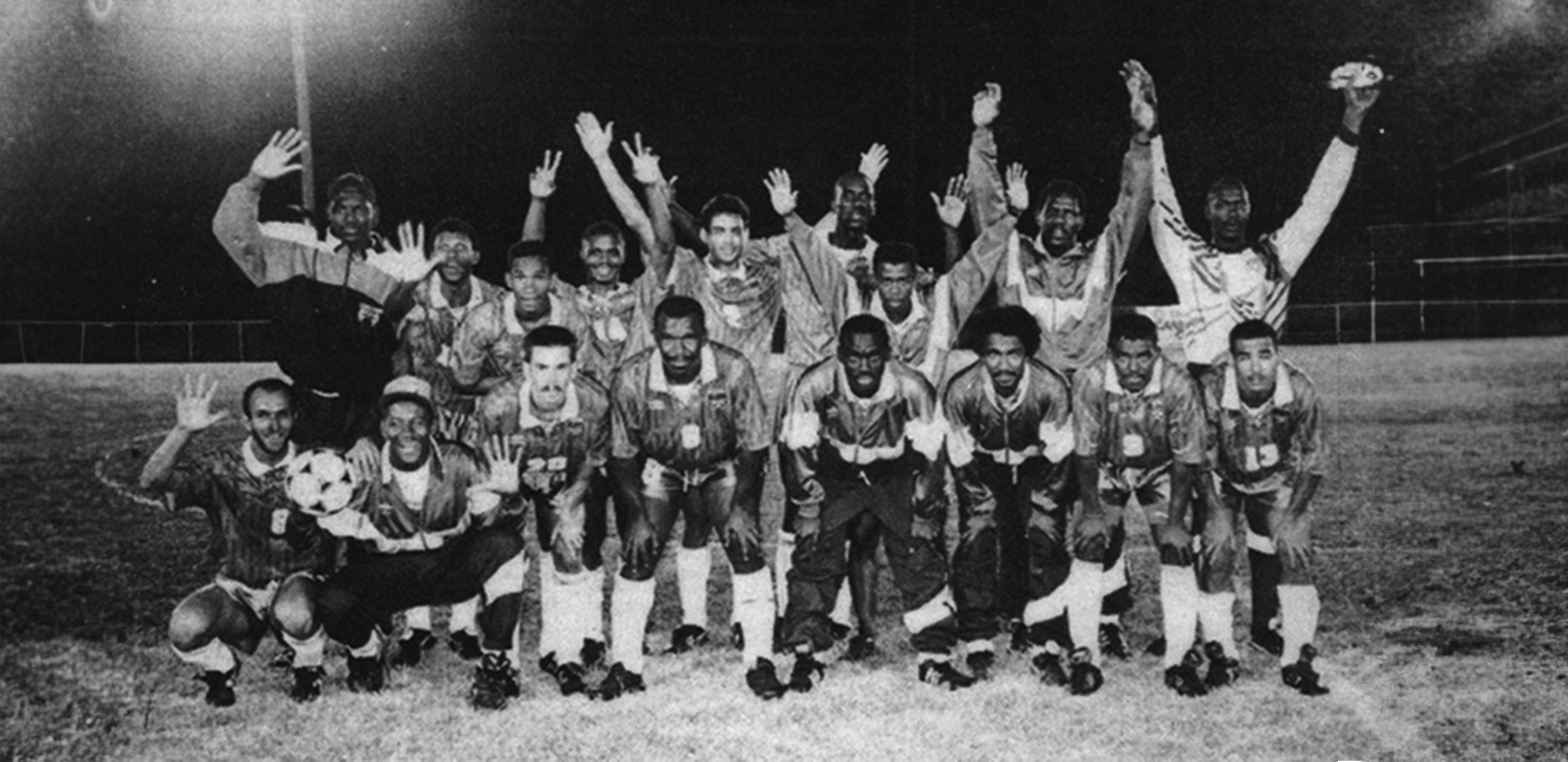
From its roots as a game played barefoot in backyards across the islands to the pinnacle of international success, football has had a storied history in Cayman.
The latest chapter for the beautiful game looks set to be a demotion from its status as our national sport in favour of swimming – a decision that has drawn mixed reactions in the community. While some stress that football caters to more local athletes, others say swimming is bringing more favourable results, with Caymanians like Jordan Crooks and others tasting glory in the pool.
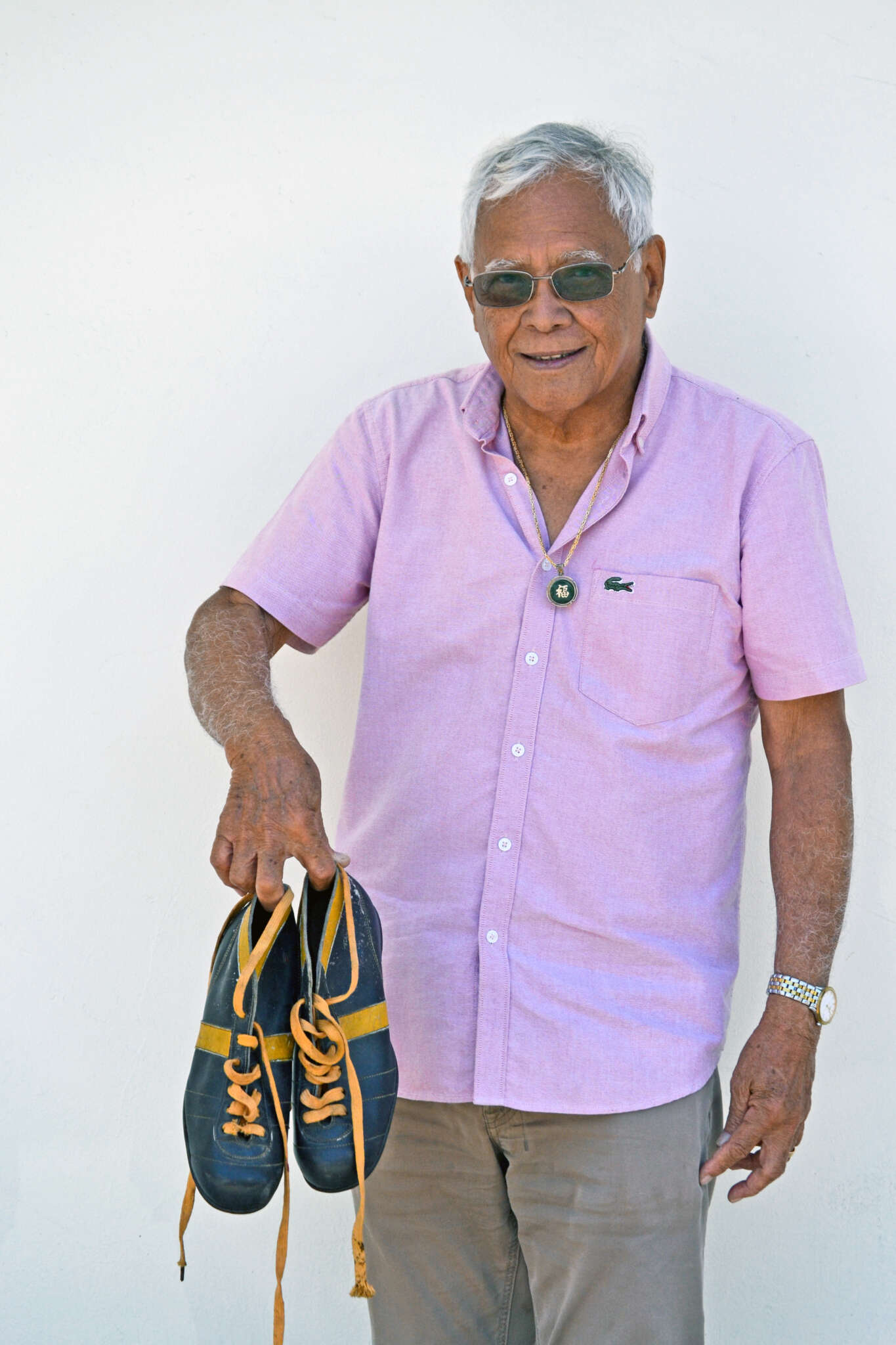
Against that backdrop, the Cayman Compass breaks down the rise and fall of football, a sport that has produced no shortage of thrills and agony over the last century – from domestic teams plummeting in numbers to the national team’s greatest accomplishments and the various controversies on and off the field.
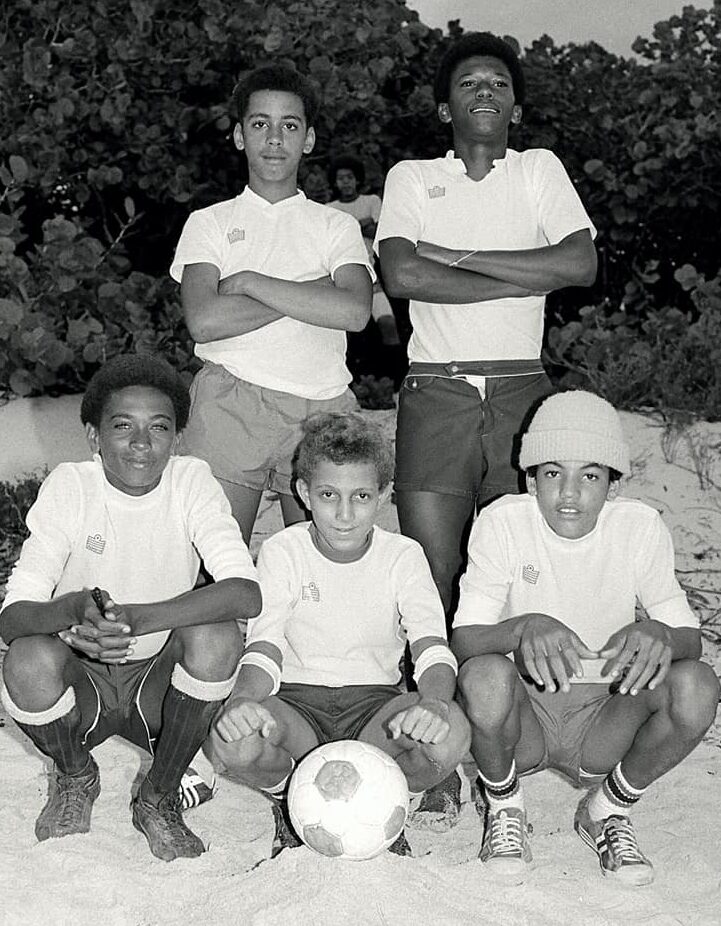
Sailing – particularly catboat racing – cricket and horseback riding were the first sports that Caymanians enjoyed competitively from as early as 1900. But in the background, football enthusiasts were playing the game for fun, barefoot, in open lots and backyards.
Some 60 years later, the onset of competitive football turned it into a true spectator sport and pulled many Caymanians into the game.
“You had hundreds of people there,” said 87-year-old Lenny Hew, who helped build the foundation of football in Cayman from the 1950s through the 1970s. “I wish I had videos of those days … the competition was always intense.”
In 1966, the Cayman Islands Football Association was formed with the help of Timothy Emanuel ‘Teacher’ McField and Hew, who noted that Clifton Hunter was the president at the time because it was vital for a credible Caymanian to lead.
Hew recalls McField’s vision of opening the Annex in George Town as a football venue coming to fruition after Mike Simmons assisted in excavating the “swamp land”. The result was not a ‘world-class facility’, but, instead was, in Hew’s words, a “rugged pitch with a cement slab in the middle for cricket”.
“The players would all walk on the pitch and pick up the rocks before the practice or a match,” Hew told Cayman Compass.
Cayman’s first primary school football match was played in 1969 with a group of George Town school boys beating the West Bay boys 11-1, according to Hew, who led the George Town team at the time.
“After that, everybody was forming clubs,” he said, noting that the competition really intensified after 1970.
“When Derek Ebanks joined the football association, we got affiliated with the FA Jamaica and Kingston and St. Andrew Football Association. We weren’t a part of FIFA, or CONCACAF at the time.”
Back then, Cayman still didn’t have an officially recognised national team, so Hew, along with Ebanks, enlisted the help of Peter Tomkins – the founder of Cayman National Bank – to form an all-star team with the best players in the league for a trip to Belize.
“Tomkins … granted Derek and myself money to charter a jet to take a Cayman select team to Belize. That was our first trip,” Hew said.
From 1980 to 1984, Cayman’s all-star team was well established on the international scene, playing clubs from Jamaica, the US and England.
However, in 1985, Cayman formed its first national team, consisting of 14 players, and played in the Caribbean Football Union, where they were matched up against Dominica, Guadeloupe, and Antigua and Barbuda.
‘Incredible’ years of football
The late Winston Chung entered the Cayman scene in the late 1980s as the football association’s technical director – with CIFA led by Allan Moore, before Ed Bush took over.
Chung’s agenda was simple: Get the best results from underprivileged players looking for purpose – a plan that led to Cayman’s best football years to date.
In 1989, Chung led Cayman to a 2-2 draw against Brazil’s under-21 team. That game was the beginning of what would turn into an incredible run, according to Hew. While Cayman enjoyed many wins over teams in the region, there were victories that were monumental – leading some daring to say that it would never happen again.
DID YOU KNOW?
From 1979 to 2002, Caymanian striker Lee Ramoon, scored 12 times – the record for most goals at a senior national level to date.
In 1990, Cayman defeated Trinidad and Tobago’s Olympic team 3-1. Two years later, Cayman eked out a 1-0 victory over Norwich City FC, who finished third in the English Premier League for the 1992-93 season. They also drew 1-all with Southampton, which was also in the Premier League.
In 1994, at the Shell Caribbean Cup qualifiers, Cayman advanced to the finals after laying waste to the British Virgin Islands and Sint Maarten – with both games ending 5-0.
But the victory heard around the region was when Cayman upset Jamaica at home at the Ed Bush Stadium, winning 3-2 – a bragging-rights moment that stood the test of time – as the Jamaican team went on to debut at the FIFA World Cup.
That wasn’t the only time that Cayman defeated Jamaica, but it is the victory that resonates the most with fans.
Three years before Cayman dominated at the Shell Caribbean Cup, Ernie ‘Gillie’ Seymour led Cayman’s under-19 team to a 1-0 win over Jamaica’s U19 in the Caribbean Football Union – marking the first time that the Jamaicans were ever defeated in that competition.
In 1995, Cayman was ranked 127th in the world by FIFA – the nation’s highest ever achieved. The senior squad continued to hold their own against competition in various tournaments, including Central American and Caribbean Games, while junior national teams won friendly events in Canada as well as at the Miami Classics.
But Cayman football would start to take a turn for the worse going into the 2000s.
‘Football became very stagnant’
Chung hosted a football camp in 1986 at the Cayman Islands Middle School, where he spoke on how sports can provide an alternate avenue for youngsters at risk of a life of crime.
“Let us join together in wiping out these evils that would destroy our young people,” Chung said at the camp.
That goal, however, hit numerous roadblocks, including multiple violent situations during and after games, in which several referees were assaulted, and culminating earlier this year in a football match becoming the venue for Cayman’s first mass shooting, a shocking blow to Chung’s hope for the game he had devoted his life to.
But what went wrong?
DID YOU KNOW?
Over eight years (1993-2000), the Cayman senior men played 11 sanctioned friendlies to gain experience. Since 2001, Cayman has played five.
“Credibility,” Hew said. “Programmes weren’t put in place to carry on properly. The money was spent otherwise. We have lost credibility and discipline went with it. Everything went with it and football became very stagnant.”
From 2000 to 2015, the Cayman men’s national team recorded 30 losses, 10 draws and only five wins at FIFA- and CONCACAF-sanctioned competitions.
The number of teams within the domestic leagues plummeted from 40 squads – all of which were sponsored – to the 14 senior clubs active today. Exacerbating the situation is the lack of financial support with only a few teams attracting sponsorship, and a corresponding drop in attendance at domestic matches from hundreds to an average of 50.

In addition, the national team plays fewer games overseas compared to the 1980s and 1990s. Worse, the public lost trust in CIFA following the 2015 arrest of since-disgraced former long-term CIFA president and FIFA vice president Jeffrey Webb, who pleaded guilty to racketeering and money-laundering conspiracy charges.
In the mist of this upheaval, coach Gillie led the country to its first-ever medal in 2015, claiming bronze at the CFU Boys’ Under-15 Championship. No medal has been won before or since for Cayman in the youth and senior level.
Is there hope?
After Webb’s arrest, the Cayman national men’s team went on hiatus and returned to the pitch in 2018 under the presidency of Alfredo Whittaker.
Since then, the team has recorded 13 losses – including their biggest defeat at 11-0 to Canada – five draws and five wins. Four of those wins came after Benjamin Pugh took over the national team four years after the Webb fiasco.
Pugh steered the squad to their most notable performance in the CONCACAF Nations League when the Cayman men narrowly missed a promotion on goal differential after winning four out of six matches.
Pugh resigned from CIFA in 2021 following the World Cup Qualifiers without offering a reason for that decision but players who attended those games said that Pugh was mistreated. One player noted that CIFA officials interfered with team selection and argued with the coaches during those matches.
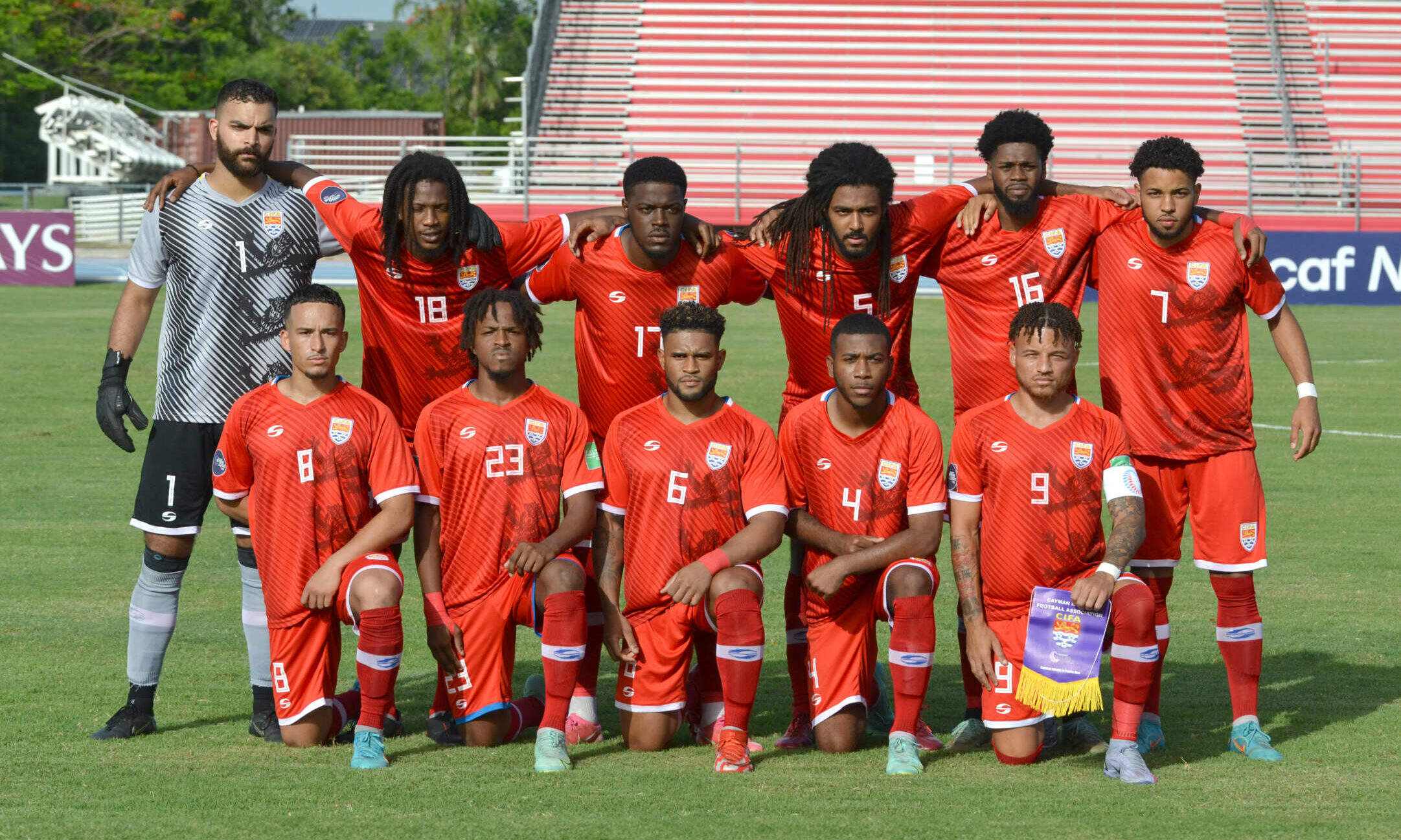
The same year Webb was arrested, many prominent football aficionados gave their thoughts to the Compass on the state of the sport.
“In my opinion, football at the senior level is the poorest that it has ever been since I have been watching and playing,” Neil Murray told the Compass in 2015.
Fast forward, nearly nine years later, players and coaches alike are making similar complaints.
Following Cayman’s loss to Aruba in the 2023-24 CONCACAF Nations League – a result that added to a four-year winless streak – players spoke out on not being comfortable with how things were being handled by CIFA executives.
“It is sad to see where football is today, to the point where I don’t even watch,” Hew said, when asked if he believes the sport that he once built could return to its glory days.
The current CIFA executives have taken a stance that they are rebuilding the team with youngsters. That plan dates to 2021, when multiple CIFA officials noted that the squad is young, and they are gaining experience.
In addition, since Pugh left in 2021, there have been three men’s head coaches – Alexander Gonzalez, Cláudio Garcia and now Joey Jap Tjong – for an average of one coach per year.
Since Cayman’s loss to Aruba, they have won one game and lost two. The Cayman men will kick off their 2026 FIFA World Cup campaign on 8 June in a home game against Antigua and Barbuda – with the team looking to begin a run of favourable results.
Related Videos







We can solve this problem very easily, we do not need a “national sport”, and as far as I’m aware not many countries have one. In the UK we have football, rugby, cricket and a host of other sports with big followings but is one of them the national sport?. How about the U.S. is it basketball or baseball?.