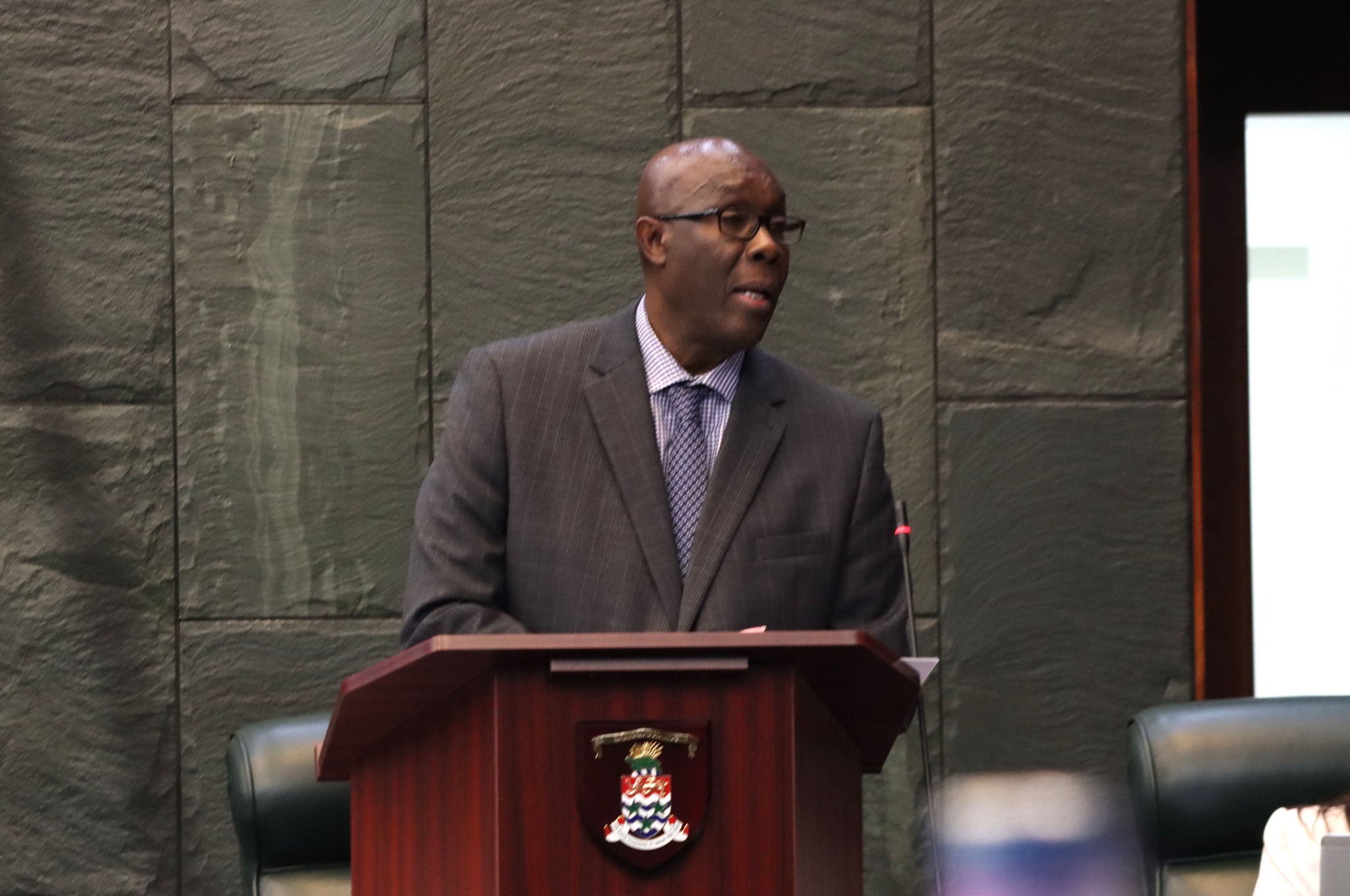
The Attorney General is to ask the Chief Justice to carry out a review of drug case sentences amid fears of two-tier justice that favours foreigners over Caymanians.
Samuel Bulgin KC told Parliament he would discuss the claims with the islands’ top judge, Margaret Ramsay-Hale, and suggest a review going back several years to establish the facts.
Bulgin said, “I think the best way for me to do that and to help have the matter properly ventilated is to speak to the Chief Justice to see if we can look back at five years of data or something and assist us with that empirical evidence so we can have an informed position on the issue.”
The Attorney General was speaking after he introduced legislation to amend the Misuse of Drugs Act (2017 Revision) to extend the authority of the Coast Guard to include aircraft using Caymanian airspace and facilities that are suspected of drug trafficking, in line with the service’s responsibilities at sea.
He told MPs last Thursday the change was in line with the international Treaty of San José, designed to combat drug trafficking in the region.
Bodden Town West MP Chris Saunders praised the performance of the authorities in 2023, which logged one of the lowest on record for drugs crime.
But Saunders added, “We need to be mindful in terms of the actual sentencing and so forth, we’ve seen in many ways, the media reports, that there seems to be different sentencing guidelines between people that show up at the airport with kind of drugs, or even gummies, for example, and those who are basically Caymanians.
“That is something that is causing concerns, at least among some of the people who have spoken to me on it.”
Saunders added it was already recognised that people should not be criminalised for possession of small amounts of cannabis, but that a recent case where children became ill and were taken to hospital after they got their hands on gummies infused with the drug highlighted that it remained a dangerous substance.
He backed calls by lawyer Richard Barton, the president of the Cayman Islands Legal Practitioners Association, for special bins to be set up at points of entry so visitors could dump drugs that may not be illegal in their homeland, but were restricted in Cayman, as was done in some countries.
But he said there appeared to be “disproportion” in the way Caymanians were treated by the courts in Cayman.
Bulgin explained that courts examined not only the nature and seriousness of the offence, but also whether a defendant had previous convictions, and the findings of a social inquiry report.
He said, “Based on the outcome of all of that exercise, they would look at the sentencing guidelines that have been crafted by the Chief Justice and see where that particular person falls, what range that particular person falls into.”
Bulgin admitted, “I am not in a position to say one way or the other that I’m aware of any sort of deliberate effort or otherwise in terms of how sentences are handed out, based on one’s nationality, status, or anything.”
Former premier, now independent opposition MP, Wayne Panton said he had been under the impression Customs and Border Control officers already had powers to deal with Cayman-registered aircraft the way the service dealt with ships.
Panton added, “We have lots of anecdotal evidence that aircraft, particularly smaller aircraft, have been used to smuggle drugs in the Caribbean.
“I am particularly happy that the Bill seeks to include aircraft and treat them as an extension to this treaty in the same way we treat Cayman Islands-registered vessels.
“Empowering the Coast Guard is a very useful addition in that respect.”
Related Videos