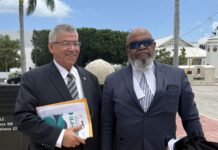
After losing an election for the first time in 40 years, McKeeva Bush said on Thursday that he was in “a state of reluctant relief”.
First-time candidate Julie Hunter won the two-person election in West Bay West by a mere 19 votes, putting an end to Bush’s 10-straight election victories.
Although he won’t have a seat in Parliament for the first time since 1984, Bush says he still has another political foe to fight.
“Single-member constituencies are the worst thing that ever happened to this country,” he said. “It is not healthy for a small-island democracy.”
Bush has never been a supporter of single-member constituencies, which became a popular idea after his United Democratic Party became the government in the 2009 election.
At the time, electors in various districts were able to cast different numbers of votes. Electors in West Bay and George Town got four votes each, while those in Bodden Town got three votes, those in Cayman Brac and Little Cayman got two votes and those in North Side and East End got only one vote.
This was seen as inequitable, and Caymanians thought a system of “one man, one vote” would rectify that.
Bush acknowledges that those who opposed him and the United Democratic Party government thought single-member constituencies would put an end to the four-member West Bay bloc that Bush and his running mates continually won.
Referendum on single-member districts
In 2012, a petition was circulated to force a people-initiated referendum on adopting single member constituencies in hopes to have it in force before the 2013 general election. As the petition crossed 3,000 signatures of the approximately 3,800 needed to force the people-initiated referendum, Bush and his administration called a government-initiated referendum on single-member constituencies in July of 2012.
Held outside of the general election, the referendum attracted only 57% of the electorate and while the majority of those who voted did so in favour of single-member constituencies, the number represented only 37% of the total electorate. As a result, the UDP government refused to institute the change for the 2013 election.
However, after the People’s Progressive Movement won that election, and having campaigned on a platform that included adopting single-member constituencies, it announced that it would implement the change for the 2017 elections.
What has happened since that time is a series of coalition governments that have not been able to get through four years without upheavals. The 2025 election will be no different.
Bush says it’s time to change from single-member constituencies.
“I was against it from the start and I’m still against it,” he said, adding that coalition governments “can’t get anything done”.
Bush said that he intends to lead a campaign to change single-members constituencies and that the groundwork to do that was already started before Wednesday’s election.
Such a campaign could have a groundswell of popular support because there have already been calls for a national vote, where everyone gets the same number of votes – whether it is one or more – from a slate of candidates on a national level, with the 19 candidates with the most votes earning seats.
However, this could lead to some districts not having direct representation, so voters in small districts like East End, North Side, Cayman Brac and Little Cayman would likely object to the proposal.
Related Videos